In the first order reaction A → products, [A] = 0.398 mol/L initially and 0.185 mol/L...
In the first order reaction A → products, [A] = 0.398 mol/L initially and 0.185 mol/L after 17.0 min. What is [A] after 250 min, in mol/L?
If you added too much acetic acid to the milk solution , what would happen to...
If you added too much acetic acid to the milk solution , what would happen to the lactose? Please, draw the products of the reaction that would occur. Thank you!
Would the genomic DNA isolated from blood differ from those isolate from cheek cells? Motivate your...
Would the genomic DNA isolated from blood differ from those isolate from cheek cells? Motivate your answer.
For questions 8 and 9, use the following reaction scheme which is part of the B-oxidation...
 For questions 8 and 9, use the following reaction scheme which is part of the B-oxidation of a fatty acid. FAD FADH Compound 2 CoA Reaction A Compound 1 HO Reaction B OH NADH H NAD CoA Compound 4 Reaction C Compound 3 (9 pts) For each reaction A, B and C, shown above, correctly name the type of transformation...
please explain why these two structures are the right answers and not any of the rest....
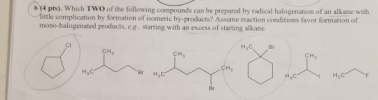 please explain why these two structures are the right
answers and not any of the rest.
6 (4 pts). Which TWO of the following compounds can be prepared by radical halogenation of an alkane with little complication by formation of isomeric by-products? Assume reaction conditions favor formation of mono-halogenated products, eg starting with an excess of starting alkane. H₂C Br
please explain why these two structures are the right
answers and not any of the rest.
6 (4 pts). Which TWO of the following compounds can be prepared by radical halogenation of an alkane with little complication by formation of isomeric by-products? Assume reaction conditions favor formation of mono-halogenated products, eg starting with an excess of starting alkane. H₂C Br
The reaction of 2,3-dibromobutane with two equivalents of strong base gives three different products, each of...
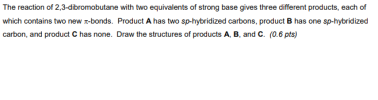 The reaction of 2,3-dibromobutane with two equivalents of strong base gives three different products, each of which contains two new T-bonds. Product A has two sp-hybridized carbons, product B has one sp-hybridized carbon, and product C has none. Draw the structures of products A, B, and C. (0.6 pts)
draw the products of the reaction. include hydrogen atoms. Draw the products of the reactions. Include hydrogen atoms. S...
 draw the products of the reaction. include hydrogen
atoms.
Draw the products of the reactions. Include hydrogen atoms. Select Draw Rings More Erase HC=CH H+ La || H H.C—&— —0-6 CH + HO H* CH + H20 = ll CH3 HC—CH el 3 Q121@ We were unable to transcribe this image
draw the products of the reaction. include hydrogen
atoms.
Draw the products of the reactions. Include hydrogen atoms. Select Draw Rings More Erase HC=CH H+ La || H H.C—&— —0-6 CH + HO H* CH + H20 = ll CH3 HC—CH el 3 Q121@ We were unable to transcribe this image
Draw the organic product(s) of the following reaction. CH3 CH3 NBS monosubstitution products CCI You do...
 Draw the organic product(s) of the following reaction. CH3 CH3 NBS monosubstitution products CCI You do not have to consider stereochemistry. Draw one structure per sketcher. Add additional sketchers using the drop-down menu in the bottom right corner. Separate multiple products using the + sign from the drop-down menu. opy aste
3. Two possible products of the below reaction are illustrated. Meo H,so, (cat.) Meo︿ .. a....
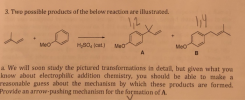 3. Two possible products of the below reaction are illustrated. Meo H,so, (cat.) Meo︿ .. a. We will soon study the pictured transformations in detail, but given what you know about electrophilic addition chemistry, you should be able to make a reasonable guess about the mechanism by which these products are formed. Provide an arrow-pushing mechanism for the formation of...
2. Complete the following? . Name the type of reaction? Draw the reactants and products? Name...
 2. Complete the following? . Name the type of reaction? Draw the reactants and products? Name all the products? . a. 1-Butanol [O] /HCrO4 b. 1-methylcyclohexanol [O] /H*/Croz C. Propanal + 2CH3OH → H d. Acetone Cut2 e. Methanol Ag* CULL f. Benzaldehyde + CH3OH H g. 2-Propanone * H2 Pd
 For questions 8 and 9, use the following reaction scheme which is part of the B-oxidation of a fatty acid. FAD FADH Compound 2 CoA Reaction A Compound 1 HO Reaction B OH NADH H NAD CoA Compound 4 Reaction C Compound 3 (9 pts) For each reaction A, B and C, shown above, correctly name the type of transformation...
 please explain why these two structures are the right
answers and not any of the rest.
6 (4 pts). Which TWO of the following compounds can be prepared by radical halogenation of an alkane with little complication by formation of isomeric by-products? Assume reaction conditions favor formation of mono-halogenated products, eg starting with an excess of starting alkane. H₂C Br
please explain why these two structures are the right
answers and not any of the rest.
6 (4 pts). Which TWO of the following compounds can be prepared by radical halogenation of an alkane with little complication by formation of isomeric by-products? Assume reaction conditions favor formation of mono-halogenated products, eg starting with an excess of starting alkane. H₂C Br
 The reaction of 2,3-dibromobutane with two equivalents of strong base gives three different products, each of which contains two new T-bonds. Product A has two sp-hybridized carbons, product B has one sp-hybridized carbon, and product C has none. Draw the structures of products A, B, and C. (0.6 pts)
 draw the products of the reaction. include hydrogen
atoms.
Draw the products of the reactions. Include hydrogen atoms. Select Draw Rings More Erase HC=CH H+ La || H H.C—&— —0-6 CH + HO H* CH + H20 = ll CH3 HC—CH el 3 Q121@ We were unable to transcribe this image
draw the products of the reaction. include hydrogen
atoms.
Draw the products of the reactions. Include hydrogen atoms. Select Draw Rings More Erase HC=CH H+ La || H H.C—&— —0-6 CH + HO H* CH + H20 = ll CH3 HC—CH el 3 Q121@ We were unable to transcribe this image
 Draw the organic product(s) of the following reaction. CH3 CH3 NBS monosubstitution products CCI You do not have to consider stereochemistry. Draw one structure per sketcher. Add additional sketchers using the drop-down menu in the bottom right corner. Separate multiple products using the + sign from the drop-down menu. opy aste
 3. Two possible products of the below reaction are illustrated. Meo H,so, (cat.) Meo︿ .. a. We will soon study the pictured transformations in detail, but given what you know about electrophilic addition chemistry, you should be able to make a reasonable guess about the mechanism by which these products are formed. Provide an arrow-pushing mechanism for the formation of...
 2. Complete the following? . Name the type of reaction? Draw the reactants and products? Name all the products? . a. 1-Butanol [O] /HCrO4 b. 1-methylcyclohexanol [O] /H*/Croz C. Propanal + 2CH3OH → H d. Acetone Cut2 e. Methanol Ag* CULL f. Benzaldehyde + CH3OH H g. 2-Propanone * H2 Pd
Most questions answered within 3 hours.