Part A of experiment: Working in the fume hood, combine 4.0 mL of 10% NaOH solution and 4 mL EtOH in a 50 mL round bot...
 Part A of experiment:
Working in the fume hood, combine 4.0 mL of 10% NaOH solution
and 4 mL EtOH in a 50 mL round bottom flask.
Dissolve 1.0 mL (8.6 mmol) of acetophenone into your
solution.
Add 1.0 mL (9.8 mmol) of benzaldehyde and a magnetic stir bar to
your flask. Clamp the flask
above a stir plate.
Monitor...
Part A of experiment:
Working in the fume hood, combine 4.0 mL of 10% NaOH solution
and 4 mL EtOH in a 50 mL round bottom flask.
Dissolve 1.0 mL (8.6 mmol) of acetophenone into your
solution.
Add 1.0 mL (9.8 mmol) of benzaldehyde and a magnetic stir bar to
your flask. Clamp the flask
above a stir plate.
Monitor...
Flash memory works by storing charge on a floating gate that is electrically isolated from the ga...
 Flash memory works by storing charge on a floating gate that is
electrically isolated from the gate to which power can be applied.
The memory is “set” by applying a bias to effect tunneling into the
floating gate. When unbiased the charge stays within the floating
gate. However tunneling can still happen but at a much lower rate.
If data...
Flash memory works by storing charge on a floating gate that is
electrically isolated from the gate to which power can be applied.
The memory is “set” by applying a bias to effect tunneling into the
floating gate. When unbiased the charge stays within the floating
gate. However tunneling can still happen but at a much lower rate.
If data...
Chapter 39, Problem 62. An unstable particle with mass m = 2.81 * 10 ^ -27...
Chapter 39, Problem 62. An unstable particle with mass m = 2.81 * 10 ^ -27 kg is initially at rest. The particle decays into two fragments that fly off along the x axis with velocity components u1 = 0.987c and u2 = -0.898c. From this information, we wish to determine the masses of fragments 1 and 2. (a) Is...
Streak Place Isolation for Obtaining Pure Cultures Data Interpretation Please type the answers to the following...
 Streak Place Isolation for Obtaining Pure Cultures Data Interpretation Please type the answers to the following questions below (double spaced) and attach the data collection sheets when you hand in this lab report. 2. When an agar plate is inoculated, why is the loop sterilized after the initial Inoculation is put on? 2. Define pure culture, a mixed culture? 3....
What is the rate of the reaction if the concentrations of A and C are doubled...
 What is the rate of the reaction if the
concentrations of A and C are doubled and the concentration of B is
tripled?
Exercise 14.85 13 of 32 > I Review | Constants 1 Periodic Table Consider the following reaction: A + B + C + D The rate law for this reaction is as follows: Part A Rate =...
What is the rate of the reaction if the
concentrations of A and C are doubled and the concentration of B is
tripled?
Exercise 14.85 13 of 32 > I Review | Constants 1 Periodic Table Consider the following reaction: A + B + C + D The rate law for this reaction is as follows: Part A Rate =...
please Help its due in 1 hour 3. Consider the following reaction at 25°C N204(g) = 2NO2(g) AG° = 5.40 kJ ontains initia...
 please Help its due in 1 hour
3. Consider the following reaction at 25°C N204(g) = 2NO2(g) AG° = 5.40 kJ ontains initial concentrations of 0.453 M N2O4 and 0.150 M NO2. What A reaction vessel contains initial concentrang is the AG for the reaction at this temperature? a. -7437 kJ b. -68.00 kJ c. 9.08 kJ d. -2.04 kJ...
please Help its due in 1 hour
3. Consider the following reaction at 25°C N204(g) = 2NO2(g) AG° = 5.40 kJ ontains initial concentrations of 0.453 M N2O4 and 0.150 M NO2. What A reaction vessel contains initial concentrang is the AG for the reaction at this temperature? a. -7437 kJ b. -68.00 kJ c. 9.08 kJ d. -2.04 kJ...
4. Here is a counter-intuitive reaction. Use curved-arrows and add the structure of the anionic intermediate...
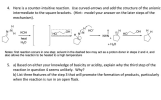 4. Here is a counter-intuitive reaction. Use curved-arrows and add the structure of the anionic intermediate to the square brackets. (Hint: model your answer on the later steps of the mechanism). N-N HO HKOH ең олон нн NEN heat H20 + H2O Notes: first reaction occurs in one step, solvent in the dashed box may act as a proton donor...
Can you explain these 2 especially how you will know the leaving groups... please only answer...
 Can you explain these 2 especially how you will know the leaving
groups... please only answer if you know the correct answer. I will
rate
3. Predict the major product for the following elimination reaction. Make sure that you draw any relevant Newman projections (looking down the C3-C4 bond) to support your answer. КО-Bu Hас" ён, t-BuOH 1 Draw a...
Can you explain these 2 especially how you will know the leaving
groups... please only answer if you know the correct answer. I will
rate
3. Predict the major product for the following elimination reaction. Make sure that you draw any relevant Newman projections (looking down the C3-C4 bond) to support your answer. КО-Bu Hас" ён, t-BuOH 1 Draw a...
Close Problem Tutored Practice Problem 15.4.2 COUNTS TOWARDS GRADE Predict and calculate the effect of volume...
 Close Problem Tutored Practice Problem 15.4.2 COUNTS TOWARDS GRADE Predict and calculate the effect of volume change on an equilibrium system. Consider the equilibrium between COBr2, CO and Br2. COBr2(g) PCO(g) + Brz(9) K = 0.254 at 350 K The reaction is allowed to reach equilibrium in a 8.60-L flask. At equilibrium, [COBr2] = 0.288 M, [CO] = 0.270 M...
Tutored Practice Problem 15.4.2 COUNTS TOWARDS GRADE Close Problem Predict and calculate the effect of volume change on...
 Tutored Practice Problem 15.4.2 COUNTS TOWARDS GRADE Close Problem Predict and calculate the effect of volume change on an equilibrium system. Consider the equilibrium between COBr2, CO and Br2 COBr2(g) CO(g)+ Br2(g) K 0.338 at 354 K The reaction is allowed to reach equilibrium in a 5.30-L flask. At equilibrium, [COBr2] 0.295 M and [Br2] = 0.257 M, [CO] 0.295...
 Part A of experiment:
Working in the fume hood, combine 4.0 mL of 10% NaOH solution
and 4 mL EtOH in a 50 mL round bottom flask.
Dissolve 1.0 mL (8.6 mmol) of acetophenone into your
solution.
Add 1.0 mL (9.8 mmol) of benzaldehyde and a magnetic stir bar to
your flask. Clamp the flask
above a stir plate.
Monitor...
Part A of experiment:
Working in the fume hood, combine 4.0 mL of 10% NaOH solution
and 4 mL EtOH in a 50 mL round bottom flask.
Dissolve 1.0 mL (8.6 mmol) of acetophenone into your
solution.
Add 1.0 mL (9.8 mmol) of benzaldehyde and a magnetic stir bar to
your flask. Clamp the flask
above a stir plate.
Monitor...
 Flash memory works by storing charge on a floating gate that is
electrically isolated from the gate to which power can be applied.
The memory is “set” by applying a bias to effect tunneling into the
floating gate. When unbiased the charge stays within the floating
gate. However tunneling can still happen but at a much lower rate.
If data...
Flash memory works by storing charge on a floating gate that is
electrically isolated from the gate to which power can be applied.
The memory is “set” by applying a bias to effect tunneling into the
floating gate. When unbiased the charge stays within the floating
gate. However tunneling can still happen but at a much lower rate.
If data...
 Streak Place Isolation for Obtaining Pure Cultures Data Interpretation Please type the answers to the following questions below (double spaced) and attach the data collection sheets when you hand in this lab report. 2. When an agar plate is inoculated, why is the loop sterilized after the initial Inoculation is put on? 2. Define pure culture, a mixed culture? 3....
 What is the rate of the reaction if the
concentrations of A and C are doubled and the concentration of B is
tripled?
Exercise 14.85 13 of 32 > I Review | Constants 1 Periodic Table Consider the following reaction: A + B + C + D The rate law for this reaction is as follows: Part A Rate =...
What is the rate of the reaction if the
concentrations of A and C are doubled and the concentration of B is
tripled?
Exercise 14.85 13 of 32 > I Review | Constants 1 Periodic Table Consider the following reaction: A + B + C + D The rate law for this reaction is as follows: Part A Rate =...
 please Help its due in 1 hour
3. Consider the following reaction at 25°C N204(g) = 2NO2(g) AG° = 5.40 kJ ontains initial concentrations of 0.453 M N2O4 and 0.150 M NO2. What A reaction vessel contains initial concentrang is the AG for the reaction at this temperature? a. -7437 kJ b. -68.00 kJ c. 9.08 kJ d. -2.04 kJ...
please Help its due in 1 hour
3. Consider the following reaction at 25°C N204(g) = 2NO2(g) AG° = 5.40 kJ ontains initial concentrations of 0.453 M N2O4 and 0.150 M NO2. What A reaction vessel contains initial concentrang is the AG for the reaction at this temperature? a. -7437 kJ b. -68.00 kJ c. 9.08 kJ d. -2.04 kJ...
 4. Here is a counter-intuitive reaction. Use curved-arrows and add the structure of the anionic intermediate to the square brackets. (Hint: model your answer on the later steps of the mechanism). N-N HO HKOH ең олон нн NEN heat H20 + H2O Notes: first reaction occurs in one step, solvent in the dashed box may act as a proton donor...
 Can you explain these 2 especially how you will know the leaving
groups... please only answer if you know the correct answer. I will
rate
3. Predict the major product for the following elimination reaction. Make sure that you draw any relevant Newman projections (looking down the C3-C4 bond) to support your answer. КО-Bu Hас" ён, t-BuOH 1 Draw a...
Can you explain these 2 especially how you will know the leaving
groups... please only answer if you know the correct answer. I will
rate
3. Predict the major product for the following elimination reaction. Make sure that you draw any relevant Newman projections (looking down the C3-C4 bond) to support your answer. КО-Bu Hас" ён, t-BuOH 1 Draw a...
 Close Problem Tutored Practice Problem 15.4.2 COUNTS TOWARDS GRADE Predict and calculate the effect of volume change on an equilibrium system. Consider the equilibrium between COBr2, CO and Br2. COBr2(g) PCO(g) + Brz(9) K = 0.254 at 350 K The reaction is allowed to reach equilibrium in a 8.60-L flask. At equilibrium, [COBr2] = 0.288 M, [CO] = 0.270 M...
 Tutored Practice Problem 15.4.2 COUNTS TOWARDS GRADE Close Problem Predict and calculate the effect of volume change on an equilibrium system. Consider the equilibrium between COBr2, CO and Br2 COBr2(g) CO(g)+ Br2(g) K 0.338 at 354 K The reaction is allowed to reach equilibrium in a 5.30-L flask. At equilibrium, [COBr2] 0.295 M and [Br2] = 0.257 M, [CO] 0.295...
Most questions answered within 3 hours.