The reaction between nitric oxide (NO) and chlorine (Cl2) to form nitrosyl chloride (NOCl) was found...
The reaction between nitric oxide (NO) and chlorine (Cl2) to form nitrosyl chloride (NOCl) was found to occur as an elementary reaction as follows: 2 NO (g) + Cl2 (g) à 2 NOCl (g) A table of the concentrations and initial rates data is shown below: [ NO ]0 (M) [ Cl2 ]0 (M) rate = - D[Cl2]/ Dt (M / min) Run 1 0.10 0.10 0.18...
5. Carbonyl fluoride, COF2, can be prepared by the following reaction? CO2(8) + CF4(g) < +...
 5. Carbonyl fluoride, COF2, can be prepared by the following reaction? CO2(8) + CF4(g) < + 2COF2(g) At 1000°C, K for this reaction is 0.50. What are the partial pressures of all the gases at equilibrium when the initial partial pressures of CO2 and CF4 are 0.513 atm.
Question 3 (Mandatory) (5 points) The rate constant of a first-order decomposition reaction is 0.0147 s....
 Question 3 (Mandatory) (5 points) The rate constant of a first-order decomposition reaction is 0.0147 s. If the initial concentration of reactant is 0.178 M, what is the concentration of reactant after 30.0 seconds? a) 8.72 x 10 M Ob) 0.0785 M Oc) 0,115 M O d) 0.643 M e) 0.0645 M Question 4 (Mandatory) (5 points) The reaction quotient,...
The reaction NO(g) + 7/2 Cl_2(g) rightarrow NOCl(g) is first-order in [Cl2] and second order with...
 The reaction NO(g) + 7/2 Cl_2(g) rightarrow NOCl(g) is first-order in [Cl2] and second order with respect to [NO]. Under a given set of conditions, the initial rate of this reaction is 6.20 times 10^-6 mol/L s. What is the rate of this reaction if the concentration of NO is doubled and the concentration of Cl_2 is reduced to half...
The reactant concentration in a zero-order reaction was 0.100 M after 165 s and 2.50×10⁻²M after...
 The reactant concentration in a zero-order reaction was 0.100
M after 165 s and 2.50×10⁻²M after 345
s, and the rate constant of the reaction is 4.17*10
What was the initial reactant concentration for the reaction
described in Part A?
Express your answer with the appropriate units. Indicate the
multiplication of units, as necessary, explicitly either with a
multiplication dot...
The reactant concentration in a zero-order reaction was 0.100
M after 165 s and 2.50×10⁻²M after 345
s, and the rate constant of the reaction is 4.17*10
What was the initial reactant concentration for the reaction
described in Part A?
Express your answer with the appropriate units. Indicate the
multiplication of units, as necessary, explicitly either with a
multiplication dot...
The reaction rate of CO and NO2 in the reaction CO(g) + NO2(g) → CO2(g) +...
The reaction rate of CO and NO2 in the reaction CO(g) + NO2(g) → CO2(g) + NO(g) is measured using the initial rates method. The results are tabulated below. [CO] (mol/L) NO2 (mol/L) -([CO]/Δt (mol/L·s) 8.00 10-4 5.50 10-4 8.40 10-8 8.00 10-4 7.78 10-4 1.68 10-7 1.60 10-3 5.50 10-4 1.68 10-7 Determine the rate expression and calculate the...
The reaction of NO and O2 produces NO2. 2 NO(g) + O2(g) → 2 NO2(g) The...
The reaction of NO and O2 produces NO2. 2 NO(g) + O2(g) → 2 NO2(g) The reaction is second-order with respect to NO(g) and first-order with respect to O2(g). At a given temperature, the rate constant, k, equals 4.7E+2 M–2s–1. What is the rate of reaction when the initial concentrations of NO and O2 are 1.95E-2 M and 1.40E-2 M,...
The nucleophilic addition reaction depicted below involves a prochiral ketone carbon atom reacting with a nucleophilic...
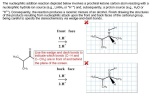 The nucleophilic addition reaction depicted below involves a
prochiral ketone carbon atom reacting with a nucleophilic hydride
ion source (e.g., LiAlH4 or \"H–\") and, subsequently, a proton
source (e.g., H2O or \"H \"). Consequently, the reaction produces a
racemic mixture of an alcohol. Finish drawing the structures of the
products resulting from nucleophilic attack upon the front and back
faces...
The nucleophilic addition reaction depicted below involves a
prochiral ketone carbon atom reacting with a nucleophilic hydride
ion source (e.g., LiAlH4 or \"H–\") and, subsequently, a proton
source (e.g., H2O or \"H \"). Consequently, the reaction produces a
racemic mixture of an alcohol. Finish drawing the structures of the
products resulting from nucleophilic attack upon the front and back
faces...
Date: 11-5-19 Instructor approval Read the lab report. 1. Write an equation for the formation of...
 Date: 11-5-19 Instructor approval Read the lab report. 1. Write an equation for the formation of the following compound using a Fishe esterification reaction. Write any additional reagents above the arrow 2. Complete the following reactions by drawing a structural formula of the products. Indicate the type of reaction. Strong(0) a. CH CH OH -OH- H2SO4 High temperature 2(H) -CH2OH...
Draw the structure of the major organic product(s) of the reaction. ohne OH 0 + -...
 Draw the structure of the major organic product(s) of the reaction. ohne OH 0 + - • You do not have to consider stereochemistry. • All carboxyl and amino groups should be drawn in the neutral form. • If no reaction occurs, draw the organic starting material. • Draw one structure per sketcher. Add additional sketchers using the drop-down menu...
 5. Carbonyl fluoride, COF2, can be prepared by the following reaction? CO2(8) + CF4(g) < + 2COF2(g) At 1000°C, K for this reaction is 0.50. What are the partial pressures of all the gases at equilibrium when the initial partial pressures of CO2 and CF4 are 0.513 atm.
 Question 3 (Mandatory) (5 points) The rate constant of a first-order decomposition reaction is 0.0147 s. If the initial concentration of reactant is 0.178 M, what is the concentration of reactant after 30.0 seconds? a) 8.72 x 10 M Ob) 0.0785 M Oc) 0,115 M O d) 0.643 M e) 0.0645 M Question 4 (Mandatory) (5 points) The reaction quotient,...
 The reaction NO(g) + 7/2 Cl_2(g) rightarrow NOCl(g) is first-order in [Cl2] and second order with respect to [NO]. Under a given set of conditions, the initial rate of this reaction is 6.20 times 10^-6 mol/L s. What is the rate of this reaction if the concentration of NO is doubled and the concentration of Cl_2 is reduced to half...
 The reactant concentration in a zero-order reaction was 0.100
M after 165 s and 2.50×10⁻²M after 345
s, and the rate constant of the reaction is 4.17*10
What was the initial reactant concentration for the reaction
described in Part A?
Express your answer with the appropriate units. Indicate the
multiplication of units, as necessary, explicitly either with a
multiplication dot...
The reactant concentration in a zero-order reaction was 0.100
M after 165 s and 2.50×10⁻²M after 345
s, and the rate constant of the reaction is 4.17*10
What was the initial reactant concentration for the reaction
described in Part A?
Express your answer with the appropriate units. Indicate the
multiplication of units, as necessary, explicitly either with a
multiplication dot...
 The nucleophilic addition reaction depicted below involves a
prochiral ketone carbon atom reacting with a nucleophilic hydride
ion source (e.g., LiAlH4 or \"H–\") and, subsequently, a proton
source (e.g., H2O or \"H \"). Consequently, the reaction produces a
racemic mixture of an alcohol. Finish drawing the structures of the
products resulting from nucleophilic attack upon the front and back
faces...
The nucleophilic addition reaction depicted below involves a
prochiral ketone carbon atom reacting with a nucleophilic hydride
ion source (e.g., LiAlH4 or \"H–\") and, subsequently, a proton
source (e.g., H2O or \"H \"). Consequently, the reaction produces a
racemic mixture of an alcohol. Finish drawing the structures of the
products resulting from nucleophilic attack upon the front and back
faces...
 Date: 11-5-19 Instructor approval Read the lab report. 1. Write an equation for the formation of the following compound using a Fishe esterification reaction. Write any additional reagents above the arrow 2. Complete the following reactions by drawing a structural formula of the products. Indicate the type of reaction. Strong(0) a. CH CH OH -OH- H2SO4 High temperature 2(H) -CH2OH...
 Draw the structure of the major organic product(s) of the reaction. ohne OH 0 + - • You do not have to consider stereochemistry. • All carboxyl and amino groups should be drawn in the neutral form. • If no reaction occurs, draw the organic starting material. • Draw one structure per sketcher. Add additional sketchers using the drop-down menu...
Most questions answered within 3 hours.