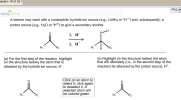
The nucleophilic addition reaction depicted below involves a prochiral ketone carbon atom reacting with a nucleophilic...
The nucleophilic addition reaction depicted below involves a
prochiral ketone carbon atom reacting with a nucleophilic hydride
ion source (e.g., LiAlH4 or \"H–\") and, subsequently, a proton
source (e.g., H2O or \"H \"). Consequently, the reaction produces a
racemic mixture of an alcohol. Finish drawing the structures of the
products resulting from nucleophilic attack upon the front and back
faces of the carbonyl group, being careful to specify the
stereochemistry via wedge-and-dash bonds. 
Homework Answers
Answer – We are given the 3-methyl2-butanone and upon the reduction with LiAlH4 there is formed alcohol, there are possible two side attack, form the back side and front side, so the when front side attack then the –CH3 gets back the plane and H is above the plane and when attack from the back side then H gets below the plane and –CH3 become above the plane. There is –OH in the plane. So the structures as follow –


Add Answer to:
The nucleophilic addition reaction depicted below involves a
prochiral ketone carbon atom reacting with a nucleophilic...
A ketone may react with a nucleophilic hydride ion source (e.g., LiAlH4 or \"H?\") and, subsequently,...
 A ketone may react with a nucleophilic hydride ion source (e.g.,
LiAlH4 or \"H?\") and, subsequently, a proton source (e.g., H2O or
\"H \") to give a secondary alcohol.
A ketone may react with a nucleophilic hydride ion source (e.g.,
LiAlH4 or \"H?\") and, subsequently, a proton source (e.g., H2O or
\"H \") to give a secondary alcohol.
5) Rationalizing the stereochemical outc ome of this reaction requires an understanding of the f borohydride...
 5) Rationalizing the stereochemical outc ome of this reaction
requires an understanding of the f borohydride borohydride lcohol.
An three-dimensional structure of benzoin and the general reaction
mechanism o reductions. As shown previously (10-1), the usual mode
of activation tor reduction occurs via an intermolecular H-bond
between the carbonyl group and an a intramolecular H-bond can
stabilize the lowest-energy conformation of benzoin (pre and serve
to activate the carbonyl for reduction, thus generating the
lowest-energyt state. a) Draw the lowest-energy,...
5) Rationalizing the stereochemical outc ome of this reaction
requires an understanding of the f borohydride borohydride lcohol.
An three-dimensional structure of benzoin and the general reaction
mechanism o reductions. As shown previously (10-1), the usual mode
of activation tor reduction occurs via an intermolecular H-bond
between the carbonyl group and an a intramolecular H-bond can
stabilize the lowest-energy conformation of benzoin (pre and serve
to activate the carbonyl for reduction, thus generating the
lowest-energyt state. a) Draw the lowest-energy,...
СО cat. H + NH2CH3 + H2CO2C CO2CH3 CO CHE Cocaine has been prepared by a...
 СО cat. H + NH2CH3 + H2CO2C CO2CH3 CO CHE Cocaine has been prepared by a sequence beginning with a Mannich reaction between dimethyl acetonedicarboxylate, methylamine, and butanedial. The mechanism involves the following steps: 1. Following initial protonation of the carbonyl oxygen, nucleophilic attack by the amine forms carbinolamine 1; 2. Proton transfer and elimination of water forms iminium ion 2; he enol form of the dicarboxylate ester attacks the iminium ion to form adduct 3; 4. Adduct 3 tautomerizes...
Grignard Reaction with a Ketone: Triphenylmethanol Introduction: The purpose of this lab is to prepare phenylmagnesium...
Grignard Reaction with a Ketone: Triphenylmethanol Introduction: The purpose of this lab is to prepare phenylmagnesium bromide, a Grignard reagent, and react it with benzophenone to give triphenylmethanol. Grignard reagents are very reactive and must be synthesized in an environment free of water or any other source of potential proton donor. Once made, the Grignard reagent will do a nucleophilic attack on the carbonyl carbon of the ketone, benzophenone. The result is an alkoxide that is then protonated to give...
 A ketone may react with a nucleophilic hydride ion source (e.g.,
LiAlH4 or \"H?\") and, subsequently, a proton source (e.g., H2O or
\"H \") to give a secondary alcohol.
A ketone may react with a nucleophilic hydride ion source (e.g.,
LiAlH4 or \"H?\") and, subsequently, a proton source (e.g., H2O or
\"H \") to give a secondary alcohol.
 5) Rationalizing the stereochemical outc ome of this reaction
requires an understanding of the f borohydride borohydride lcohol.
An three-dimensional structure of benzoin and the general reaction
mechanism o reductions. As shown previously (10-1), the usual mode
of activation tor reduction occurs via an intermolecular H-bond
between the carbonyl group and an a intramolecular H-bond can
stabilize the lowest-energy conformation of benzoin (pre and serve
to activate the carbonyl for reduction, thus generating the
lowest-energyt state. a) Draw the lowest-energy,...
5) Rationalizing the stereochemical outc ome of this reaction
requires an understanding of the f borohydride borohydride lcohol.
An three-dimensional structure of benzoin and the general reaction
mechanism o reductions. As shown previously (10-1), the usual mode
of activation tor reduction occurs via an intermolecular H-bond
between the carbonyl group and an a intramolecular H-bond can
stabilize the lowest-energy conformation of benzoin (pre and serve
to activate the carbonyl for reduction, thus generating the
lowest-energyt state. a) Draw the lowest-energy,...
 СО cat. H + NH2CH3 + H2CO2C CO2CH3 CO CHE Cocaine has been prepared by a sequence beginning with a Mannich reaction between dimethyl acetonedicarboxylate, methylamine, and butanedial. The mechanism involves the following steps: 1. Following initial protonation of the carbonyl oxygen, nucleophilic attack by the amine forms carbinolamine 1; 2. Proton transfer and elimination of water forms iminium ion 2; he enol form of the dicarboxylate ester attacks the iminium ion to form adduct 3; 4. Adduct 3 tautomerizes...
Most questions answered within 3 hours.
-
Where is the error in this code sequence?
String s1 = "Hello";
String s2 = "ello";...
asked 11 months ago -
Financial data for Joel de Paris, Inc., for last year
follow:
Joel de Paris, Inc.
Balance...
asked 11 months ago -
Consider this reaction:
Al2(SO4)3 (aq)+ BaCl3
(aq) Al2Cl6 (aq)- +
3BaSO4(s) . What is the...
asked 11 months ago -
Suppose that Savneet is considering increasing her
recent random sample from 20 car rentals to 40...
asked 11 months ago -
Trucks arrive at an unloading terminal at an average rate of 120
per hour.
Trucks arrive...
asked 11 months ago -
Why are methanol and ethanol completely soluble in water while
octanol is not very little soluble....
asked 11 months ago -
A facilities manager at a university reads in a research report
that the mean amount of...
asked 11 months ago -
When the CuSO4 is rehydrated by adding water to the anhydrous
compound, is this an endothermic...
asked 11 months ago -
A ray of sunlight is passing from diamond into crown glass; the
angle of incidence is...
asked 11 months ago -
A block of mass 0.249 kg is placed on top of a light, vertical
spring of...
asked 11 months ago -
how do the kidneys compensate in the presences of acidosis
a) trigger hyperventilate
b) reserve acid...
asked 11 months ago -
Question 501 pts
The rental rate of capital to the firm increases. Which of the
following...
asked 11 months ago