A ketone may react with a nucleophilic hydride ion source (e.g., LiAlH4 or \"H?\") and, subsequently,...
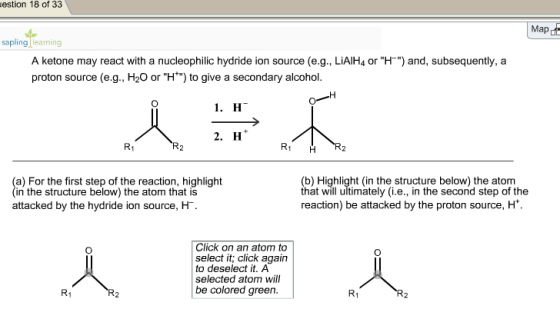
A ketone may react with a nucleophilic hydride ion source (e.g., LiAlH4 or \"H?\") and, subsequently, a proton source (e.g., H2O or \"H \") to give a secondary alcohol.
Homework Answers
The concept used to solve this problem is nucleophilic attack precedes protonation.
The hydride ion attacks the carbonyl carbon and forms a negative charge on oxygen, which is protonated using the water molecule.
Lithium aluminum hydride is a source of hydride ion, the nucleophile.
The addition of occurs across the C-O pi bond. It reduces the carbonyl group to an alcohol.
(a)
The reaction is as follows:

(b)
The reaction is as follows:

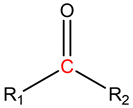
The atom that is attacked by the hydride ion is highlighted as shown below:
Add Answer to:
A ketone may react with a nucleophilic hydride ion source (e.g.,
LiAlH4 or \"H?\") and, subsequently,...
The nucleophilic addition reaction depicted below involves a prochiral ketone carbon atom reacting with a nucleophilic...
 The nucleophilic addition reaction depicted below involves a
prochiral ketone carbon atom reacting with a nucleophilic hydride
ion source (e.g., LiAlH4 or \"H–\") and, subsequently, a proton
source (e.g., H2O or \"H \"). Consequently, the reaction produces a
racemic mixture of an alcohol. Finish drawing the structures of the
products resulting from nucleophilic attack upon the front and back
faces of the carbonyl group, being careful to specify the
stereochemistry via wedge-and-dash bonds.
The nucleophilic addition reaction depicted below involves a
prochiral ketone carbon atom reacting with a nucleophilic hydride
ion source (e.g., LiAlH4 or \"H–\") and, subsequently, a proton
source (e.g., H2O or \"H \"). Consequently, the reaction produces a
racemic mixture of an alcohol. Finish drawing the structures of the
products resulting from nucleophilic attack upon the front and back
faces of the carbonyl group, being careful to specify the
stereochemistry via wedge-and-dash bonds.
please give correct answer to these 5 questions with explanations if possible, thankyou During a nucleophilic...
 please give correct answer to these 5 questions with
explanations if possible, thankyou
During a nucleophilic addition reaction between LiAlHe and a carbonyl compound, what atom is the nucleophile? Select one The proton (H) atom The hydrogen atom of the lithium aluminium hydride. The aluminium atom. The carbon atom of the carbonyl group. The oxygen atom of the carbonyl group Why do carbonyl compounds undergo nucleophilic addition reactions ? Select one: The compound the carbonyl group is reacting with is...
please give correct answer to these 5 questions with
explanations if possible, thankyou
During a nucleophilic addition reaction between LiAlHe and a carbonyl compound, what atom is the nucleophile? Select one The proton (H) atom The hydrogen atom of the lithium aluminium hydride. The aluminium atom. The carbon atom of the carbonyl group. The oxygen atom of the carbonyl group Why do carbonyl compounds undergo nucleophilic addition reactions ? Select one: The compound the carbonyl group is reacting with is...
1. Reductive amination (Carey, Section 22.10) is an important C-N bond forming strategy widely used in...
 1. Reductive amination (Carey, Section 22.10) is an important C-N bond forming strategy widely used in the synthesis of biologically active natural product. It's a powerful and reliable strategy that avoids the problem of overalkylation that often accompanies direct alkylation of amines with alkyl halides (Figure 1). secondary amine r tiary amine quemary sa Figure 1: Yields are generally poor as product amines are more nucleophilic and can also react with halide. The result is often a mixture of amines...
OH 1. Nat -:C=CR 2. H30+ Acetylide ions react with ketones to form alcohols, as shown...
 OH 1. Nat -:C=CR 2. H30+ Acetylide ions react with ketones to form alcohols, as shown in the above example. Draw the structure of the ketone that was used to synthesize the following compound: CH3 Visited u do not have to consider stereochemistry. Tou do not have to explicitly draw H atoms. • In cases where there is more than one answer, just draw one. Acetylide ions react with aldehydes and ketones to give alcohol addition products. OH 1. :C=C-R...
extra credit orgo chem NaBH MOH 1.Write two starting materials (five or fewer C's) that react...
 extra credit orgo chem
NaBH MOH 1.Write two starting materials (five or fewer C's) that react to form the target molecule starting from any carbonyl compound and any organometallic reagent. OH Part IV. Mechanistic Puzzlers (16 pts) 10. Reduction of cyclohexanone using lithium aluminum hydride gives a deuterated alcohol when D.O is used instead of H.O in the workup step. Account for this outcome with a mechanism, showing curved arrows, the key intermediate, and lone pairs and charges. (6 pts)...
extra credit orgo chem
NaBH MOH 1.Write two starting materials (five or fewer C's) that react to form the target molecule starting from any carbonyl compound and any organometallic reagent. OH Part IV. Mechanistic Puzzlers (16 pts) 10. Reduction of cyclohexanone using lithium aluminum hydride gives a deuterated alcohol when D.O is used instead of H.O in the workup step. Account for this outcome with a mechanism, showing curved arrows, the key intermediate, and lone pairs and charges. (6 pts)...
СО cat. H + NH2CH3 + H2CO2C CO2CH3 CO CHE Cocaine has been prepared by a...
 СО cat. H + NH2CH3 + H2CO2C CO2CH3 CO CHE Cocaine has been prepared by a sequence beginning with a Mannich reaction between dimethyl acetonedicarboxylate, methylamine, and butanedial. The mechanism involves the following steps: 1. Following initial protonation of the carbonyl oxygen, nucleophilic attack by the amine forms carbinolamine 1; 2. Proton transfer and elimination of water forms iminium ion 2; he enol form of the dicarboxylate ester attacks the iminium ion to form adduct 3; 4. Adduct 3 tautomerizes...
Experiment 8 - Addition to Alkenes What is Markovnikov's Rule? Chem 2321 In this experiment you...
 Experiment 8 - Addition to Alkenes What is Markovnikov's Rule? Chem 2321 In this experiment you will synthesize a brom ohydrin according to the reaction shown below. Using infrared (IR) spectroscopy and a simple chemical test, you will determine which product (Markovnikov or anti-Markovnikov) is formed. N-bromosuccinimide Br (NBS) но or н.о, THF ""сн, он "Br CH3 CH3 1-methylcyclohexene Markovnikov product anti-Markovnikov product Halogenation of alkenes is an important reaction in organic chemistry. When carried out in an aqueous solution,...
What results when a secondary alcohol is oxidized? a. a ketone d. an acid b. an...
 What results when a secondary alcohol is oxidized? a. a ketone d. an acid b. an amine e. no reaction c. an aldehyde Which of the following combinations will react spontaneously? A. 12 + Cu2+ B. Pb2+ + Ag C. Zn2+ + Mg D. Sn2+ + Ni2+ The general formula for a cycloalkane can be represented by which of the following? a. C,H, C. CH b. C.H2n+2 d. C.H21-2 In a certain reaction AH =-136 kJ and E, = 96...
Please explain what is going on in this lab for STEP 3. what are some important...
 Please explain what is going on in this lab for STEP 3. what
are some important factors?
Multistep Synthesis Preparation of 4,4-Diphenyl-3-buten-2-one! This experiment illustrates se multistep synthesis, in which the the next. This process is very common iment illustrates several important concepts of organic synthesis. It is a synthesis, in which the product of one reaction becomes the starting material of This process is very common in industry and research, and demands careful to vields and techniques. The experiment...
Please explain what is going on in this lab for STEP 3. what
are some important factors?
Multistep Synthesis Preparation of 4,4-Diphenyl-3-buten-2-one! This experiment illustrates se multistep synthesis, in which the the next. This process is very common iment illustrates several important concepts of organic synthesis. It is a synthesis, in which the product of one reaction becomes the starting material of This process is very common in industry and research, and demands careful to vields and techniques. The experiment...
Grignard Reaction with a Ketone: Triphenylmethanol Introduction: The purpose of this lab is to prepare phenylmagnesium...
Grignard Reaction with a Ketone: Triphenylmethanol Introduction: The purpose of this lab is to prepare phenylmagnesium bromide, a Grignard reagent, and react it with benzophenone to give triphenylmethanol. Grignard reagents are very reactive and must be synthesized in an environment free of water or any other source of potential proton donor. Once made, the Grignard reagent will do a nucleophilic attack on the carbonyl carbon of the ketone, benzophenone. The result is an alkoxide that is then protonated to give...
 The nucleophilic addition reaction depicted below involves a
prochiral ketone carbon atom reacting with a nucleophilic hydride
ion source (e.g., LiAlH4 or \"H–\") and, subsequently, a proton
source (e.g., H2O or \"H \"). Consequently, the reaction produces a
racemic mixture of an alcohol. Finish drawing the structures of the
products resulting from nucleophilic attack upon the front and back
faces of the carbonyl group, being careful to specify the
stereochemistry via wedge-and-dash bonds.
The nucleophilic addition reaction depicted below involves a
prochiral ketone carbon atom reacting with a nucleophilic hydride
ion source (e.g., LiAlH4 or \"H–\") and, subsequently, a proton
source (e.g., H2O or \"H \"). Consequently, the reaction produces a
racemic mixture of an alcohol. Finish drawing the structures of the
products resulting from nucleophilic attack upon the front and back
faces of the carbonyl group, being careful to specify the
stereochemistry via wedge-and-dash bonds.
 please give correct answer to these 5 questions with
explanations if possible, thankyou
During a nucleophilic addition reaction between LiAlHe and a carbonyl compound, what atom is the nucleophile? Select one The proton (H) atom The hydrogen atom of the lithium aluminium hydride. The aluminium atom. The carbon atom of the carbonyl group. The oxygen atom of the carbonyl group Why do carbonyl compounds undergo nucleophilic addition reactions ? Select one: The compound the carbonyl group is reacting with is...
please give correct answer to these 5 questions with
explanations if possible, thankyou
During a nucleophilic addition reaction between LiAlHe and a carbonyl compound, what atom is the nucleophile? Select one The proton (H) atom The hydrogen atom of the lithium aluminium hydride. The aluminium atom. The carbon atom of the carbonyl group. The oxygen atom of the carbonyl group Why do carbonyl compounds undergo nucleophilic addition reactions ? Select one: The compound the carbonyl group is reacting with is...
 1. Reductive amination (Carey, Section 22.10) is an important C-N bond forming strategy widely used in the synthesis of biologically active natural product. It's a powerful and reliable strategy that avoids the problem of overalkylation that often accompanies direct alkylation of amines with alkyl halides (Figure 1). secondary amine r tiary amine quemary sa Figure 1: Yields are generally poor as product amines are more nucleophilic and can also react with halide. The result is often a mixture of amines...
 OH 1. Nat -:C=CR 2. H30+ Acetylide ions react with ketones to form alcohols, as shown in the above example. Draw the structure of the ketone that was used to synthesize the following compound: CH3 Visited u do not have to consider stereochemistry. Tou do not have to explicitly draw H atoms. • In cases where there is more than one answer, just draw one. Acetylide ions react with aldehydes and ketones to give alcohol addition products. OH 1. :C=C-R...
 extra credit orgo chem
NaBH MOH 1.Write two starting materials (five or fewer C's) that react to form the target molecule starting from any carbonyl compound and any organometallic reagent. OH Part IV. Mechanistic Puzzlers (16 pts) 10. Reduction of cyclohexanone using lithium aluminum hydride gives a deuterated alcohol when D.O is used instead of H.O in the workup step. Account for this outcome with a mechanism, showing curved arrows, the key intermediate, and lone pairs and charges. (6 pts)...
extra credit orgo chem
NaBH MOH 1.Write two starting materials (five or fewer C's) that react to form the target molecule starting from any carbonyl compound and any organometallic reagent. OH Part IV. Mechanistic Puzzlers (16 pts) 10. Reduction of cyclohexanone using lithium aluminum hydride gives a deuterated alcohol when D.O is used instead of H.O in the workup step. Account for this outcome with a mechanism, showing curved arrows, the key intermediate, and lone pairs and charges. (6 pts)...
 СО cat. H + NH2CH3 + H2CO2C CO2CH3 CO CHE Cocaine has been prepared by a sequence beginning with a Mannich reaction between dimethyl acetonedicarboxylate, methylamine, and butanedial. The mechanism involves the following steps: 1. Following initial protonation of the carbonyl oxygen, nucleophilic attack by the amine forms carbinolamine 1; 2. Proton transfer and elimination of water forms iminium ion 2; he enol form of the dicarboxylate ester attacks the iminium ion to form adduct 3; 4. Adduct 3 tautomerizes...
 Experiment 8 - Addition to Alkenes What is Markovnikov's Rule? Chem 2321 In this experiment you will synthesize a brom ohydrin according to the reaction shown below. Using infrared (IR) spectroscopy and a simple chemical test, you will determine which product (Markovnikov or anti-Markovnikov) is formed. N-bromosuccinimide Br (NBS) но or н.о, THF ""сн, он "Br CH3 CH3 1-methylcyclohexene Markovnikov product anti-Markovnikov product Halogenation of alkenes is an important reaction in organic chemistry. When carried out in an aqueous solution,...
 What results when a secondary alcohol is oxidized? a. a ketone d. an acid b. an amine e. no reaction c. an aldehyde Which of the following combinations will react spontaneously? A. 12 + Cu2+ B. Pb2+ + Ag C. Zn2+ + Mg D. Sn2+ + Ni2+ The general formula for a cycloalkane can be represented by which of the following? a. C,H, C. CH b. C.H2n+2 d. C.H21-2 In a certain reaction AH =-136 kJ and E, = 96...
 Please explain what is going on in this lab for STEP 3. what
are some important factors?
Multistep Synthesis Preparation of 4,4-Diphenyl-3-buten-2-one! This experiment illustrates se multistep synthesis, in which the the next. This process is very common iment illustrates several important concepts of organic synthesis. It is a synthesis, in which the product of one reaction becomes the starting material of This process is very common in industry and research, and demands careful to vields and techniques. The experiment...
Please explain what is going on in this lab for STEP 3. what
are some important factors?
Multistep Synthesis Preparation of 4,4-Diphenyl-3-buten-2-one! This experiment illustrates se multistep synthesis, in which the the next. This process is very common iment illustrates several important concepts of organic synthesis. It is a synthesis, in which the product of one reaction becomes the starting material of This process is very common in industry and research, and demands careful to vields and techniques. The experiment...
Most questions answered within 3 hours.
-
Where is the error in this code sequence?
String s1 = "Hello";
String s2 = "ello";...
asked 11 months ago -
Financial data for Joel de Paris, Inc., for last year
follow:
Joel de Paris, Inc.
Balance...
asked 11 months ago -
Consider this reaction:
Al2(SO4)3 (aq)+ BaCl3
(aq) Al2Cl6 (aq)- +
3BaSO4(s) . What is the...
asked 11 months ago -
Suppose that Savneet is considering increasing her
recent random sample from 20 car rentals to 40...
asked 11 months ago -
Trucks arrive at an unloading terminal at an average rate of 120
per hour.
Trucks arrive...
asked 11 months ago -
Why are methanol and ethanol completely soluble in water while
octanol is not very little soluble....
asked 11 months ago -
A facilities manager at a university reads in a research report
that the mean amount of...
asked 11 months ago -
When the CuSO4 is rehydrated by adding water to the anhydrous
compound, is this an endothermic...
asked 11 months ago -
A ray of sunlight is passing from diamond into crown glass; the
angle of incidence is...
asked 11 months ago -
A block of mass 0.249 kg is placed on top of a light, vertical
spring of...
asked 11 months ago -
how do the kidneys compensate in the presences of acidosis
a) trigger hyperventilate
b) reserve acid...
asked 11 months ago -
Question 501 pts
The rental rate of capital to the firm increases. Which of the
following...
asked 11 months ago