CH2-O-C-(CH2) 14CH3 O CH-O-C-(CH2)7-g=-(CH2),CH3 + 3H2 POR CH2-O-C-(CH2)-=9-CH2-9 9-(CH2); CH3 Show the product or products of...
 CH2-O-C-(CH2) 14CH3 O CH-O-C-(CH2)7-g=-(CH2),CH3 + 3H2 POR CH2-O-C-(CH2)-=9-CH2-9 9-(CH2); CH3 Show the product or products of the reaction below:
help please 2. For the reaction A(g) + B(g) =C(g) + D(g) Kc has the value...
 help please
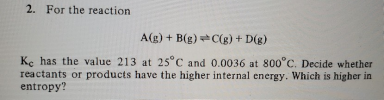
2. For the reaction A(g) + B(g) =C(g) + D(g) Kc has the value 213 at 25°C and 0.0036 at 800°C. Decide whether reactants or products have the higher internal energy. Which is higher in entropy?
help please
2. For the reaction A(g) + B(g) =C(g) + D(g) Kc has the value 213 at 25°C and 0.0036 at 800°C. Decide whether reactants or products have the higher internal energy. Which is higher in entropy?
A certain first-order reaction (A→products) has a rate constant of 1.00×10⁻² s-1 at 45 ∘C. How...
A certain first-order reaction (A→products) has a rate constant of 1.00×10⁻² s-1 at 45 ∘C. How many minutes does it take for the concentration of the reactant, [A], to drop to 6.25%% of the original concentration? Express your answer with the appropriate units.
Enzyme Specificity 1. The following cases show the products form when a reaction was carried out...
 Enzyme Specificity 1. The following cases show the products form when a reaction was carried out in soltion (non- enzymatic) and carried out enzymatically. For each case state the type of specificity exhibited by the enzyme nonenzymatic: enzymatic: nonenzymatie: Кін NH enzymatic:
15. (10 pt) Fill in the missing structures in the multistep synthesis scheme. Ignore stereochemistry H20...
 15. (10 pt) Fill in the missing structures in the multistep synthesis scheme. Ignore stereochemistry H20 i i 20 ---- 16. (10 pt) Draw a curved arrow mechanism for the following reaction. Add stereochemistry to the products. av Å — b oot
13.29) what i products would result from the following processes! Write an equation for each reaction...
 13.29) what i products would result from the following processes! Write an equation for each reaction a) 1-Butand is heated to 140°C in presence of sulfuric acid. d) 2-pentanol is heated to 180°C in the presence of subarina Sulfuric acid.
help please 6) What products would you expect to obtain from reaction of T-methylcyclohexanol with the...
 help please
6) What products would you expect to obtain from reaction of T-methylcyclohexanol with the following reagents? 4) HIBI b) Na Cro oxidizing agents) How would you prepare the following ether using a Williamson synthesis?
help please
6) What products would you expect to obtain from reaction of T-methylcyclohexanol with the following reagents? 4) HIBI b) Na Cro oxidizing agents) How would you prepare the following ether using a Williamson synthesis?
There's been more spotlight on bleach recently. Bleach is sodium hypochlorite. a) is the hypochlorite ion...
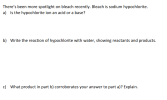 There's been more spotlight on bleach recently. Bleach is sodium hypochlorite. a) is the hypochlorite ion an acid or a base? b) Write the reaction of hypochlorite with water, showing reactants and products. c) What product in part b) corroborates your answer to part a)? Explain.
A neutralization reaction between NaOH (aq) and HBr (aq) would give which two products? -------------------- PLEASE...
A neutralization reaction between NaOH (aq) and HBr (aq) would give which two products? -------------------- PLEASE SHOW WORK NaH(s) + BrOH(aq) NaBr(s) + NaOH(aq) NaH2 (aq) + Br2(g) H20(l) + NaBr(aq)
A zero-order reaction has a constant rate of 2.40×10⁻⁴ M/s. If after 35.0 seconds the concentration...
A zero-order reaction has a constant rate of 2.40×10⁻⁴ M/s. If after 35.0 seconds the concentration has dropped to 3.50×10⁻² M, what was the initial concentration? Express your answer with the appropriate units. Learning Goal: To understand how to use integrated rate laws to solve for concentration. A car starts at mile marker 145 on a highway and drives at...
 CH2-O-C-(CH2) 14CH3 O CH-O-C-(CH2)7-g=-(CH2),CH3 + 3H2 POR CH2-O-C-(CH2)-=9-CH2-9 9-(CH2); CH3 Show the product or products of the reaction below:
 help please
2. For the reaction A(g) + B(g) =C(g) + D(g) Kc has the value 213 at 25°C and 0.0036 at 800°C. Decide whether reactants or products have the higher internal energy. Which is higher in entropy?
help please
2. For the reaction A(g) + B(g) =C(g) + D(g) Kc has the value 213 at 25°C and 0.0036 at 800°C. Decide whether reactants or products have the higher internal energy. Which is higher in entropy?
 Enzyme Specificity 1. The following cases show the products form when a reaction was carried out in soltion (non- enzymatic) and carried out enzymatically. For each case state the type of specificity exhibited by the enzyme nonenzymatic: enzymatic: nonenzymatie: Кін NH enzymatic:
 15. (10 pt) Fill in the missing structures in the multistep synthesis scheme. Ignore stereochemistry H20 i i 20 ---- 16. (10 pt) Draw a curved arrow mechanism for the following reaction. Add stereochemistry to the products. av Å — b oot
 13.29) what i products would result from the following processes! Write an equation for each reaction a) 1-Butand is heated to 140°C in presence of sulfuric acid. d) 2-pentanol is heated to 180°C in the presence of subarina Sulfuric acid.
 help please
6) What products would you expect to obtain from reaction of T-methylcyclohexanol with the following reagents? 4) HIBI b) Na Cro oxidizing agents) How would you prepare the following ether using a Williamson synthesis?
help please
6) What products would you expect to obtain from reaction of T-methylcyclohexanol with the following reagents? 4) HIBI b) Na Cro oxidizing agents) How would you prepare the following ether using a Williamson synthesis?
 There's been more spotlight on bleach recently. Bleach is sodium hypochlorite. a) is the hypochlorite ion an acid or a base? b) Write the reaction of hypochlorite with water, showing reactants and products. c) What product in part b) corroborates your answer to part a)? Explain.
Most questions answered within 3 hours.