A zero-order reaction has a constant rate of 2.40×10⁻⁴ M/s. If after 35.0 seconds the concentration...
A zero-order reaction has a constant rate of 2.40×10⁻⁴ M/s. If after 35.0 seconds the concentration has dropped to 3.50×10⁻² M, what was the initial concentration? Express your answer with the appropriate units. Learning Goal: To understand how to use integrated rate laws to solve for concentration. A car starts at mile marker 145 on a highway and drives at 55 mi/hr in the direction of decreasing marker numbers. What mile marker will the car reach after 2 hours? This problem can easily be solved by calculating how far the car travels and subtracting that distance from the starting marker of 145. 55 mi/hr×2 hr=110 miles traveled milemarker 145−110 miles=milemarker 35 If we were to write a formula for this calculation, we might express it as follows: milemarker=milemarker0−(speed×time) where milemarker is the current milemarker and milemarker0 is the initial milemarker. Similarly, the integrated rate law for a zero-order reaction is expressed as follows: [A]=[A]0−rate×time or [A]=[A]0− kt since rate= k[A]0=k A zero-order reaction (Figure 1)proceeds uniformly over time. In other words, the rate does not change as the reactant concentration changes. In contrast, first-order reaction rates (Figure 2) do change over time as the reactant concentration changes. Because the rate of a first-order reaction is nonuniform, its integrated rate law is slightly more complicated than that of a zero-order reaction. The integrated rate law for a first-order reaction is expressed as follows: [A]=[A]0e−kt where k is the rate constant for this reaction. The integrated rate law for a second-order reaction is expressed as follows: 1[A]= kt+1[A]0 where k is the rate constant for this reaction.
Homework Answers
Initial concentration = 0.0434 M
Explanation
The integrated zero order rate law is given as
[A] = [A]o - (k) * (t)
where
[A]o is the initial concentration
[A] = final concentration = 3.50 x 10⁻² M
k = rate constant = 2.40 x 10⁻⁴ M/s
t = time = 35.0 s
[A]o = [A] + (k) * (t)
[A]o = (3.50 x 10⁻² M) + (2.40 x 10⁻⁴ M/s) * (35.0 s)
[A]o = (3.50 x 10⁻² M) + (8.40 x 10⁻³ M)
[A]o = 0.0434 M
Add Answer to:
A zero-order reaction has a constant rate of 2.40×10⁻⁴ M/s. If
after 35.0 seconds the concentration...
Learning Goal: To understand how to use integrated rate laws to solve for concentration. A car...
Learning Goal: To understand how to use integrated rate laws to solve for concentration. A car starts at mile marker 145 on a highway and drives at 55 mi/hr in the direction of decreasing marker numbers. What mile marker will the car reach after 2 hours? This problem can easily be solved by calculating how far the car travels and subtracting that distance from the starting marker of 145. 55 mi/hr×2 hr=110 miles traveled milemarker 145−110 miles=milemarker 35 If we...
14.1 Question 3 Learning Goal: To understand how to use integrated rate laws to solve for...
14.1 Question 3 Learning Goal: To understand how to use integrated rate laws to solve for concentration. A car starts at mile marker 145 on a highway and drives at 55 mi/hr in the direction of decreasing marker numbers. What mile marker will the car reach after 2 hours? This problem can easily be solved by calculating how far the car travels and subtracting that distance from the starting marker of 145. 55 mi/hr×2 hr=110 miles traveled milemarker 145−110 miles=milemarker...
Week 1 Assignment: Chemical Kinetics Introduction to Integrated Rate Laws 7 of 28> solve for concentration....
 Week 1 Assignment: Chemical Kinetics Introduction to Integrated Rate Laws 7 of 28> solve for concentration. The rate constant for a certain reaction is k = 9.00x10⁻³ s-1 、 If the initial reactant concentration was 0.200 M, what will the concentration be after 19.0 minutes? A car starts at mile marker 145 on a highway and drives at 55 mi/hr in the direction of decreasing marker numbers. What mile marker will the car reach after 2 hours? Express your answer...
<HW3 (Chapter 14) Introduction to Integrated Rate Laws < 19 of 25 > A Review Constants...
 <HW3 (Chapter 14) Introduction to Integrated Rate Laws < 19 of 25 > A Review Constants Periodic Table Learning Goal: To understand how to use integrated rate laws to solve for concentration. Part A A car starts at mile marker 145 on a highway and drives at 55 mi/hr in the direction of decreasing marker numbers. What mile marker will the car reach after 2 hours? The rate constant for a certain reaction is k = 6.20-10-35-1 If the initial...
Review Constants Periodic Table Part A Learning Goal: To understand how to use integrated rate laws...
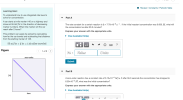 Review Constants Periodic Table Part A Learning Goal: To understand how to use integrated rate laws to solve for concentration. A car starts at mile marker 145 on a highway and drives at 55 mi/hr in the direction of decreasing marker numbers. What mile marker will the car reach after 2 hours? . If the initial reactant concentration was 0.600 M, what will The rate constant for a certain reaction is k = 7.70x10s the concentration be after 20.0 minutes?...
The reactant concentration in a zero-order reaction was 0.100 M after 165 s and 2.50×10⁻²M after...
 The reactant concentration in a zero-order reaction was 0.100
M after 165 s and 2.50×10⁻²M after 345
s, and the rate constant of the reaction is 4.17*10
What was the initial reactant concentration for the reaction
described in Part A?
Express your answer with the appropriate units. Indicate the
multiplication of units, as necessary, explicitly either with a
multiplication dot or a dash.
The integrated rate laws for zero-, first-, and second-order may be arranged such that they resemble the...
The reactant concentration in a zero-order reaction was 0.100
M after 165 s and 2.50×10⁻²M after 345
s, and the rate constant of the reaction is 4.17*10
What was the initial reactant concentration for the reaction
described in Part A?
Express your answer with the appropriate units. Indicate the
multiplication of units, as necessary, explicitly either with a
multiplication dot or a dash.
The integrated rate laws for zero-, first-, and second-order may be arranged such that they resemble the...
A zero-order reaction has a constant rate of 2.90×10⁻⁴ M/s. If after 35.0 seconds the concentration...
A zero-order reaction has a constant rate of 2.90×10⁻⁴ M/s. If after 35.0 seconds the concentration has dropped to 3.00×10⁻² M, what was the initial concentration?
The integrated rate laws for zero-, first-, and second-order reaction may be arranged such that they...
The integrated rate laws for zero-, first-, and second-order reaction may be arranged such that they resemble the equation for a straight line, y=mx+by=mx+b. Order Integrated Rate Law Graph Slope 0 [A]=−kt+[A]0[A]=−kt+[A]0 [A] vs. t[A] vs. t −k−k 1 ln[A]=−kt+ln[A]0ln[A]=−kt+ln[A]0 ln[A] vs. tln[A] vs. t −k−k 2 1[A]= kt+1[A]01[A]= kt+1[A]0 1[A] vs. t1[A] vs. t kk A.) The reactant concentration in a zero-order reaction was 0.100 MM after 165 ss and 4.00×10⁻² MM after 305 ss . What is the...
The reaction: A --> B + C is found by experiment to be zero order with...
The reaction: A --> B + C is found by experiment to be zero order with respect to A. A graph of [A] vs time for the data has a slope of –5.0 x 10⁻² M s-1. An experiment is run where the initial concentration of A is [A]0 = 1.0 x 10⁻³ M The integrated rate law can be expressed as: [A]0 – [A] = kt ln[A] – ln[A]0 = kt [A] = k t [A] / [A]0 =...
± Using Integrated Rate Laws Part A The reactant concentration in a zero-order reaction The integrated...
 ± Using Integrated Rate Laws Part A The reactant concentration in a zero-order reaction The integrated rate laws for zero-, first-, and second order reaction may be arranged such that they resemble the equation for a straight line y=mx + b was 9.00x10² M after 155 s and 3.50x10² M after 320 s. What is the rate constant for this reaction? Express your answer with the appropriate units Indicate the multiplication of units, as necessary explicitly either with a multiplication...
 Week 1 Assignment: Chemical Kinetics Introduction to Integrated Rate Laws 7 of 28> solve for concentration. The rate constant for a certain reaction is k = 9.00x10⁻³ s-1 、 If the initial reactant concentration was 0.200 M, what will the concentration be after 19.0 minutes? A car starts at mile marker 145 on a highway and drives at 55 mi/hr in the direction of decreasing marker numbers. What mile marker will the car reach after 2 hours? Express your answer...
 <HW3 (Chapter 14) Introduction to Integrated Rate Laws < 19 of 25 > A Review Constants Periodic Table Learning Goal: To understand how to use integrated rate laws to solve for concentration. Part A A car starts at mile marker 145 on a highway and drives at 55 mi/hr in the direction of decreasing marker numbers. What mile marker will the car reach after 2 hours? The rate constant for a certain reaction is k = 6.20-10-35-1 If the initial...
 Review Constants Periodic Table Part A Learning Goal: To understand how to use integrated rate laws to solve for concentration. A car starts at mile marker 145 on a highway and drives at 55 mi/hr in the direction of decreasing marker numbers. What mile marker will the car reach after 2 hours? . If the initial reactant concentration was 0.600 M, what will The rate constant for a certain reaction is k = 7.70x10s the concentration be after 20.0 minutes?...
 The reactant concentration in a zero-order reaction was 0.100
M after 165 s and 2.50×10⁻²M after 345
s, and the rate constant of the reaction is 4.17*10
What was the initial reactant concentration for the reaction
described in Part A?
Express your answer with the appropriate units. Indicate the
multiplication of units, as necessary, explicitly either with a
multiplication dot or a dash.
The integrated rate laws for zero-, first-, and second-order may be arranged such that they resemble the...
The reactant concentration in a zero-order reaction was 0.100
M after 165 s and 2.50×10⁻²M after 345
s, and the rate constant of the reaction is 4.17*10
What was the initial reactant concentration for the reaction
described in Part A?
Express your answer with the appropriate units. Indicate the
multiplication of units, as necessary, explicitly either with a
multiplication dot or a dash.
The integrated rate laws for zero-, first-, and second-order may be arranged such that they resemble the...
 ± Using Integrated Rate Laws Part A The reactant concentration in a zero-order reaction The integrated rate laws for zero-, first-, and second order reaction may be arranged such that they resemble the equation for a straight line y=mx + b was 9.00x10² M after 155 s and 3.50x10² M after 320 s. What is the rate constant for this reaction? Express your answer with the appropriate units Indicate the multiplication of units, as necessary explicitly either with a multiplication...
Most questions answered within 3 hours.
-
Where is the error in this code sequence?
String s1 = "Hello";
String s2 = "ello";...
asked 10 months ago -
Financial data for Joel de Paris, Inc., for last year
follow:
Joel de Paris, Inc.
Balance...
asked 10 months ago -
Consider this reaction:
Al2(SO4)3 (aq)+ BaCl3
(aq) Al2Cl6 (aq)- +
3BaSO4(s) . What is the...
asked 10 months ago -
Suppose that Savneet is considering increasing her
recent random sample from 20 car rentals to 40...
asked 10 months ago -
Trucks arrive at an unloading terminal at an average rate of 120
per hour.
Trucks arrive...
asked 10 months ago -
Why are methanol and ethanol completely soluble in water while
octanol is not very little soluble....
asked 10 months ago -
A facilities manager at a university reads in a research report
that the mean amount of...
asked 10 months ago -
When the CuSO4 is rehydrated by adding water to the anhydrous
compound, is this an endothermic...
asked 10 months ago -
A ray of sunlight is passing from diamond into crown glass; the
angle of incidence is...
asked 10 months ago -
A block of mass 0.249 kg is placed on top of a light, vertical
spring of...
asked 10 months ago -
how do the kidneys compensate in the presences of acidosis
a) trigger hyperventilate
b) reserve acid...
asked 10 months ago -
Question 501 pts
The rental rate of capital to the firm increases. Which of the
following...
asked 10 months ago