The reaction: A --> B + C is found by experiment to be zero order with...
The reaction: A --> B + C is found by experiment to be zero order with respect to A. A graph of [A] vs time for the data has a slope of –5.0 x 10⁻² M s-1. An experiment is run where the initial concentration of A is [A]0 = 1.0 x 10⁻³ M
The integrated rate law can be expressed as:
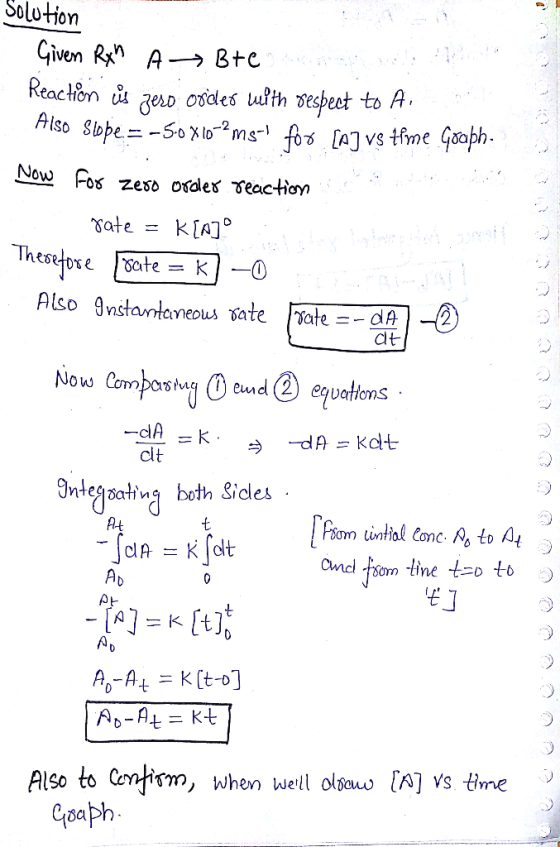
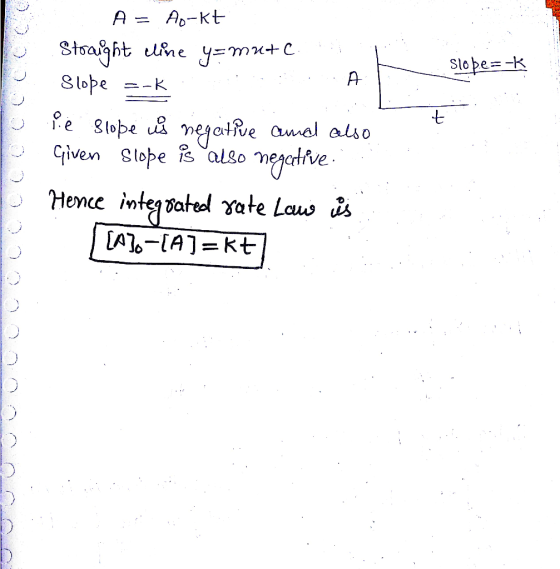
[A]0 – [A] = kt
ln[A] – ln[A]0 = kt
[A] = k t
[A] / [A]0 = k t
Homework Answers
Reaction is zero order so we'll firstly write the rate law and derive for integrated rate equation.
Add Answer to:
The reaction: A --> B + C
is found by experiment to be zero order with...
The integrated rate laws for zero-, first-, and second-order reaction may be arranged such that they...
The integrated rate laws for zero-, first-, and second-order reaction may be arranged such that they resemble the equation for a straight line, y=mx+by=mx+b. Order Integrated Rate Law Graph Slope 0 [A]=−kt+[A]0[A]=−kt+[A]0 [A] vs. t[A] vs. t −k−k 1 ln[A]=−kt+ln[A]0ln[A]=−kt+ln[A]0 ln[A] vs. tln[A] vs. t −k−k 2 1[A]= kt+1[A]01[A]= kt+1[A]0 1[A] vs. t1[A] vs. t kk A.) The reactant concentration in a zero-order reaction was 0.100 MM after 165 ss and 4.00×10⁻² MM after 305 ss . What is the...
The integrated rate laws for zero-, first-, and second-order reaction may be arranged such that they...
The integrated rate laws for zero-, first-, and second-order reaction may be arranged such that they resemble the equation for a straight line, y=mx+by=mx+b. Order Integrated Rate Law Graph Slope 0 [A]=−kt+[A]0[A]=−kt+[A]0 [A] vs. t[A] vs. t −k 1 ln[A]=−kt+ln[A]0ln[A]=−kt+ln[A]0 ln[A] vs. tln[A] vs. t −k 2 1[A]= kt+1[A]01[A]= kt+1[A]0 1[A] vs. t1[A] vs. t k Part A The reactant concentration in a zero-order reaction was 8.00×10⁻² MM after 130 ss and 4.00×10⁻² MM after 380 ss . What is...
± Using Integrated Rate Laws Part A The reactant concentration in a zero-order reaction The integrated...
 ± Using Integrated Rate Laws Part A The reactant concentration in a zero-order reaction The integrated rate laws for zero-, first-, and second order reaction may be arranged such that they resemble the equation for a straight line y=mx + b was 9.00x10² M after 155 s and 3.50x10² M after 320 s. What is the rate constant for this reaction? Express your answer with the appropriate units Indicate the multiplication of units, as necessary explicitly either with a multiplication...
3 of 19 ReviewConelants1 Pariodc Table The integrated rate laws for zero, Srst, and second-order meaction...
 3 of 19 ReviewConelants1 Pariodc Table The integrated rate laws for zero, Srst, and second-order meaction may be arranged such that they resemble the aquation for a straight line, sy me+b Part A Order Integrated Rate Law Graph Slope A t+A In A)-kt+In A In A) vs. t The reactant concentration in a zero-order reaction was 0 100 Maher 140s and 1.50-10 reaction? A vs. -A Malter 355 What is the ate contant for is 1 -k Express your answer...
A zero-order reaction has a constant rate of 2.40×10⁻⁴ M/s. If after 35.0 seconds the concentration...
A zero-order reaction has a constant rate of 2.40×10⁻⁴ M/s. If after 35.0 seconds the concentration has dropped to 3.50×10⁻² M, what was the initial concentration? Express your answer with the appropriate units. Learning Goal: To understand how to use integrated rate laws to solve for concentration. A car starts at mile marker 145 on a highway and drives at 55 mi/hr in the direction of decreasing marker numbers. What mile marker will the car reach after 2 hours? This...
+ Using Integrated Rate Laws The integrated rate laws for zero-, first-, and second-order reaction may...
 + Using Integrated Rate Laws The integrated rate laws for zero-, first-, and second-order reaction may be arranged such that they resemble the equation for a straight line, y = mx + b. Slope Order O 1 2 Integrated Rate Law Graph [A] = - kt + [A] [A] vs. t In[A] = -kt + In[A], In[A] vs. t LÀ=kt + TA LÀ vs. t -k Review Constants Periodic Table Part A The reactant concentration in a zero-order reaction was...
The reactant concentration in a zero-order reaction was 0.100 M after 165 s and 2.50×10⁻²M after...
 The reactant concentration in a zero-order reaction was 0.100
M after 165 s and 2.50×10⁻²M after 345
s, and the rate constant of the reaction is 4.17*10
What was the initial reactant concentration for the reaction
described in Part A?
Express your answer with the appropriate units. Indicate the
multiplication of units, as necessary, explicitly either with a
multiplication dot or a dash.
The integrated rate laws for zero-, first-, and second-order may be arranged such that they resemble the...
The reactant concentration in a zero-order reaction was 0.100
M after 165 s and 2.50×10⁻²M after 345
s, and the rate constant of the reaction is 4.17*10
What was the initial reactant concentration for the reaction
described in Part A?
Express your answer with the appropriate units. Indicate the
multiplication of units, as necessary, explicitly either with a
multiplication dot or a dash.
The integrated rate laws for zero-, first-, and second-order may be arranged such that they resemble the...
+ Using Integrated Rate Laws The integrated rate laws for zero-, first-, and second-order reaction may be arrang...
 + Using Integrated Rate Laws The integrated rate laws for zero-, first-, and second-order reaction may be arranged such that they resemble the equation for a straight line, y = mx + b. Slope Order O 1 2 Integrated Rate Law Graph [A] = - kt + [A] [A] vs. t In[A] = -kt + In[A], In[A] vs. t LÀ=kt + TA LÀ vs. t -k Review Constants Periodic Table Part A The reactant concentration in a zero-order reaction was...
1) A certain first order reaction has a rate constant of 0.038 min-1. How much of...
1) A certain first order reaction has a rate constant of 0.038 min-1. How much of the reactant will remain if the reaction is run for 2.5 hours and the initial concentration of the reactant is 0.35 M? 2)Which of the following correctly represents a first order integrated rate law? (Select all that are correct, there may be more than one.) A. [A]0 = [A]te-kt B. [A]t = [A]0ekt C. ln [A]t = ln [A]0 - kt D. [A]t =...
Thanks in advance please just Question A , b and c please this is chemistry based...
 Thanks in advance
please just Question A , b and c
please this is chemistry based on kinetics
there's no other subject
please if you don't know the calculation based on that
question, allow other experts to help out for the solutions
Thanks in advance
Helpful Hints: Arrhenius Equation: k =
Ae–Ea/RT Gas Constant: R = 8.314 J/mol·K
Integrated Rate Laws and Half-Lives:
• Zero order: [A] = –kt + [A]0 t1/2 = [A]0/2k
• First order: ln[A] = –kt...
Thanks in advance
please just Question A , b and c
please this is chemistry based on kinetics
there's no other subject
please if you don't know the calculation based on that
question, allow other experts to help out for the solutions
Thanks in advance
Helpful Hints: Arrhenius Equation: k =
Ae–Ea/RT Gas Constant: R = 8.314 J/mol·K
Integrated Rate Laws and Half-Lives:
• Zero order: [A] = –kt + [A]0 t1/2 = [A]0/2k
• First order: ln[A] = –kt...
 ± Using Integrated Rate Laws Part A The reactant concentration in a zero-order reaction The integrated rate laws for zero-, first-, and second order reaction may be arranged such that they resemble the equation for a straight line y=mx + b was 9.00x10² M after 155 s and 3.50x10² M after 320 s. What is the rate constant for this reaction? Express your answer with the appropriate units Indicate the multiplication of units, as necessary explicitly either with a multiplication...
 3 of 19 ReviewConelants1 Pariodc Table The integrated rate laws for zero, Srst, and second-order meaction may be arranged such that they resemble the aquation for a straight line, sy me+b Part A Order Integrated Rate Law Graph Slope A t+A In A)-kt+In A In A) vs. t The reactant concentration in a zero-order reaction was 0 100 Maher 140s and 1.50-10 reaction? A vs. -A Malter 355 What is the ate contant for is 1 -k Express your answer...
 + Using Integrated Rate Laws The integrated rate laws for zero-, first-, and second-order reaction may be arranged such that they resemble the equation for a straight line, y = mx + b. Slope Order O 1 2 Integrated Rate Law Graph [A] = - kt + [A] [A] vs. t In[A] = -kt + In[A], In[A] vs. t LÀ=kt + TA LÀ vs. t -k Review Constants Periodic Table Part A The reactant concentration in a zero-order reaction was...
 The reactant concentration in a zero-order reaction was 0.100
M after 165 s and 2.50×10⁻²M after 345
s, and the rate constant of the reaction is 4.17*10
What was the initial reactant concentration for the reaction
described in Part A?
Express your answer with the appropriate units. Indicate the
multiplication of units, as necessary, explicitly either with a
multiplication dot or a dash.
The integrated rate laws for zero-, first-, and second-order may be arranged such that they resemble the...
The reactant concentration in a zero-order reaction was 0.100
M after 165 s and 2.50×10⁻²M after 345
s, and the rate constant of the reaction is 4.17*10
What was the initial reactant concentration for the reaction
described in Part A?
Express your answer with the appropriate units. Indicate the
multiplication of units, as necessary, explicitly either with a
multiplication dot or a dash.
The integrated rate laws for zero-, first-, and second-order may be arranged such that they resemble the...
 + Using Integrated Rate Laws The integrated rate laws for zero-, first-, and second-order reaction may be arranged such that they resemble the equation for a straight line, y = mx + b. Slope Order O 1 2 Integrated Rate Law Graph [A] = - kt + [A] [A] vs. t In[A] = -kt + In[A], In[A] vs. t LÀ=kt + TA LÀ vs. t -k Review Constants Periodic Table Part A The reactant concentration in a zero-order reaction was...
 Thanks in advance
please just Question A , b and c
please this is chemistry based on kinetics
there's no other subject
please if you don't know the calculation based on that
question, allow other experts to help out for the solutions
Thanks in advance
Helpful Hints: Arrhenius Equation: k =
Ae–Ea/RT Gas Constant: R = 8.314 J/mol·K
Integrated Rate Laws and Half-Lives:
• Zero order: [A] = –kt + [A]0 t1/2 = [A]0/2k
• First order: ln[A] = –kt...
Thanks in advance
please just Question A , b and c
please this is chemistry based on kinetics
there's no other subject
please if you don't know the calculation based on that
question, allow other experts to help out for the solutions
Thanks in advance
Helpful Hints: Arrhenius Equation: k =
Ae–Ea/RT Gas Constant: R = 8.314 J/mol·K
Integrated Rate Laws and Half-Lives:
• Zero order: [A] = –kt + [A]0 t1/2 = [A]0/2k
• First order: ln[A] = –kt...
Most questions answered within 3 hours.
-
Where is the error in this code sequence?
String s1 = "Hello";
String s2 = "ello";...
asked 10 months ago -
Financial data for Joel de Paris, Inc., for last year
follow:
Joel de Paris, Inc.
Balance...
asked 10 months ago -
Consider this reaction:
Al2(SO4)3 (aq)+ BaCl3
(aq) Al2Cl6 (aq)- +
3BaSO4(s) . What is the...
asked 10 months ago -
Suppose that Savneet is considering increasing her
recent random sample from 20 car rentals to 40...
asked 10 months ago -
Trucks arrive at an unloading terminal at an average rate of 120
per hour.
Trucks arrive...
asked 10 months ago -
Why are methanol and ethanol completely soluble in water while
octanol is not very little soluble....
asked 10 months ago -
A facilities manager at a university reads in a research report
that the mean amount of...
asked 10 months ago -
When the CuSO4 is rehydrated by adding water to the anhydrous
compound, is this an endothermic...
asked 10 months ago -
A ray of sunlight is passing from diamond into crown glass; the
angle of incidence is...
asked 10 months ago -
A block of mass 0.249 kg is placed on top of a light, vertical
spring of...
asked 10 months ago -
how do the kidneys compensate in the presences of acidosis
a) trigger hyperventilate
b) reserve acid...
asked 10 months ago -
Question 501 pts
The rental rate of capital to the firm increases. Which of the
following...
asked 10 months ago