The reaction was monitored as a function of time: AB ---
The reaction was monitored as a function of time: AB ---> A+ B A plot of ln[AB] vs time yields a straight line with a slope -0.0045 s-1. If the initial concentration of AB is 0.225M, what is the concentration after 225s? Write answer to three significant figures.
Use the following data to determine the order with respect to reactant A in the reaction...
Use the following data to determine the order with respect to reactant A in the reaction 3 A + 4 B → 2 C Experiment [A] [B] Initial Rate (M/s) 1 0.20 0.50 0.32 2 0.60 0.50 2.88 3 0.20 0.25 0.040
2N_2O_5(g) rightarrow 4NO_2(g) + O_2(g) The reaction of dinitrogen pentoxide decomposed into nitrogen dioxide and O_2...
 2N_2O_5(g) rightarrow 4NO_2(g) + O_2(g) The reaction of dinitrogen pentoxide decomposed into nitrogen dioxide and O_2 is first-order and has a rate constant of k = 9.55 times 10^-4 s^-1 under a particular set of conditions. What is the concentration of N_2O_5 in this system after 10.0 min if [N_2O_5]_0 = 0.807 M? Did you use the equation that relates...
The free energy (AG) for a reaction under a set of initial conditions/concentrations is -14.3 kcal/mol....
 The free energy (AG) for a reaction under a set of initial conditions/concentrations is -14.3 kcal/mol. The standard free energy (AG°) of this reaction is -6.0 kcal/mol. Given this information, what will be the value of the ratio of the reaction quotient (Q) to the equilibrium constant (Kea)? In other words, what will Q/Keg equal? Assume a temperature of 25°C....
If the rate of the reaction A + B rightarrow C + D is measured by...
 If the rate of the reaction A + B rightarrow C + D is measured by determining the time for the concentration of A to decrease by 2.0 times 10^-3 mol/L, calculate the reaction time (sec) when the rate is 4.0 times 10^-5 mol/L-sec. Calculate the initial concentrations of I^- and S_2O_8^2- in each of the reaction mixtures in Table...
Each reactant from the following data. Show work, of co inspection) method (method of initial rat...
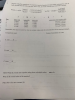 each reactant from the following data. Show work, of co inspection) method (method of initial rates), calculate the order in course! Consult your text book if needed. wherex isonder(Rotel)=(C Ratel Rate2 log a og Con) Concentrato! ) ' 12/ = log( Order = use this: A Run Initial [A] Initial IB] 2 C of E 0.20M 0.20M 0.40M 0.20M 0.20M...
Question 1 The following reaction between 2-methylbut-2-ene and hydrogen bromide (HBr) is best described as what...
 Question 1 The following reaction between 2-methylbut-2-ene and hydrogen bromide (HBr) is best described as what type of reaction? Refer to the Figure A) Addition B) Substitution C) Elimination D) Rearrangement Question 2 For the reaction in question 1, two products are possible- a major product, and a minor product. For the minor product, what is the splitting pattern for...
13a. Draw the electron pushing using arrows for 2-Bromo-2-methylbutane reacting with methanol. Consider both substitution and...
13a. Draw the electron pushing using arrows for 2-Bromo-2-methylbutane reacting with methanol. Consider both substitution and elimination mechanisms. Show the structure of products. 13b. Does cis- or trans- bromo-4-tert-butylcyclohexane react faster in an E2 reaction? Explain.
The reaction shown when run at low temperatures gives the products shown as only a minor...
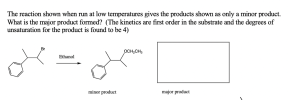 The reaction shown when run at low temperatures gives the products shown as only a minor product. What is the major product formed? (The kinetics are first order in the substrate and the degrees of unsaturation for the product is found to be 4) OCH2CH3 Ethanol o gran minor product major product
Carbo 10. Give the structure of the alkene that will yield the following products on ozonolysis;...
 Carbo 10. Give the structure of the alkene that will yield the following products on ozonolysis; a) CHỊCH-CH3CHO and HCHO, b) CH3CH(CH3)CHO and CH CHO. CH -C 6. Suggest a mechanism for the reaction summarized below. RCH=CH2 + CCl4 RCHCICH CCl3 + RCHCICH -RCHCH2CC13
 2N_2O_5(g) rightarrow 4NO_2(g) + O_2(g) The reaction of dinitrogen pentoxide decomposed into nitrogen dioxide and O_2 is first-order and has a rate constant of k = 9.55 times 10^-4 s^-1 under a particular set of conditions. What is the concentration of N_2O_5 in this system after 10.0 min if [N_2O_5]_0 = 0.807 M? Did you use the equation that relates...
 The free energy (AG) for a reaction under a set of initial conditions/concentrations is -14.3 kcal/mol. The standard free energy (AG°) of this reaction is -6.0 kcal/mol. Given this information, what will be the value of the ratio of the reaction quotient (Q) to the equilibrium constant (Kea)? In other words, what will Q/Keg equal? Assume a temperature of 25°C....
 If the rate of the reaction A + B rightarrow C + D is measured by determining the time for the concentration of A to decrease by 2.0 times 10^-3 mol/L, calculate the reaction time (sec) when the rate is 4.0 times 10^-5 mol/L-sec. Calculate the initial concentrations of I^- and S_2O_8^2- in each of the reaction mixtures in Table...
 each reactant from the following data. Show work, of co inspection) method (method of initial rates), calculate the order in course! Consult your text book if needed. wherex isonder(Rotel)=(C Ratel Rate2 log a og Con) Concentrato! ) ' 12/ = log( Order = use this: A Run Initial [A] Initial IB] 2 C of E 0.20M 0.20M 0.40M 0.20M 0.20M...
 Question 1 The following reaction between 2-methylbut-2-ene and hydrogen bromide (HBr) is best described as what type of reaction? Refer to the Figure A) Addition B) Substitution C) Elimination D) Rearrangement Question 2 For the reaction in question 1, two products are possible- a major product, and a minor product. For the minor product, what is the splitting pattern for...
 The reaction shown when run at low temperatures gives the products shown as only a minor product. What is the major product formed? (The kinetics are first order in the substrate and the degrees of unsaturation for the product is found to be 4) OCH2CH3 Ethanol o gran minor product major product
 Carbo 10. Give the structure of the alkene that will yield the following products on ozonolysis; a) CHỊCH-CH3CHO and HCHO, b) CH3CH(CH3)CHO and CH CHO. CH -C 6. Suggest a mechanism for the reaction summarized below. RCH=CH2 + CCl4 RCHCICH CCl3 + RCHCICH -RCHCH2CC13
Most questions answered within 3 hours.