Draw the structure(s) of the major organic product(s) of the following reaction. Draw the structure(s) of...
 Draw the structure(s) of the major organic product(s) of the
following reaction.
Draw the structure(s) of the major organic product(s) of the following reaction. MgBr + H3C 1. Dry Eto 2. aqueous HCl at 0° • You do not have to consider stereochemistry. • Draw one structure per sketcher. Add additional sketchers using the drop-down menu in the bottom right...
Draw the structure(s) of the major organic product(s) of the
following reaction.
Draw the structure(s) of the major organic product(s) of the following reaction. MgBr + H3C 1. Dry Eto 2. aqueous HCl at 0° • You do not have to consider stereochemistry. • Draw one structure per sketcher. Add additional sketchers using the drop-down menu in the bottom right...
Questions and Discussion Provide a balanced chemical equation of the reaction performed in this experiment. Use...
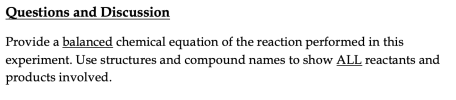 Questions and Discussion Provide a balanced chemical equation of the reaction performed in this experiment. Use structures and compound names to show ALL reactants and products involved. Baeyer-Villiger Reaction of Acetophenone Data Results • Moles of acetophenone used: (Show calculations) 0.020 moles (2.40g/120.151 g mol-1 =0.0199 moles) • Moles of mCPBA used: (Show calculations) 0.036 moles_(6.25 grams/ 172.56 g.mol-1) •...
For each of the following reactions fill in the box to give the missing product(s). If...
 For each of the following reactions fill in the box to give the
missing product(s). If no reaction occurs, write N.R. If the
reaction produces a mixture of products, such as stereoisomers or
constitutional isomers, give the structure of each product. If a
major product arises, label it as so. Be sure to show
stereochemistry when needed.
1. NaOH ОН...
For each of the following reactions fill in the box to give the
missing product(s). If no reaction occurs, write N.R. If the
reaction produces a mixture of products, such as stereoisomers or
constitutional isomers, give the structure of each product. If a
major product arises, label it as so. Be sure to show
stereochemistry when needed.
1. NaOH ОН...
Draw the structures) of the major organic produces) of the following reaction. You do not have...
 Draw the structures) of the major organic produces) of the following reaction. You do not have to consider stereochemistry. You do not have to explicitly draw H atoms. Do not include lone pairs in your answer. They will not be considered in the grading. Do not include the amine from which the cnamine was derived. If no reaction occurs, draw...
One application of Hess's Law (which works for AH, AS, and AG) is calculating the overall...
 One application of Hess's Law (which works for AH, AS, and AG) is calculating the overall energy of a reaction using standard energies of formation of products and reactants. What is the standard change in free energy for the reaction: 4 KCIO3(s) → 3 KCIO4(s) + KCl(s)? Use the following standard gibbs energies of formation: AGF(KCIO3(s)) = -295.6 kJ/mol; AGF(KCIO4(s))...
How is a nonspontaneous process made spontaneous? Check all that apply: A nonspontaneous process is coupled...
How is a nonspontaneous process made spontaneous? Check all that apply: A nonspontaneous process is coupled with a process that is highly spontaneous. Nonspontaneous reactions can be made spontaneous depending on the reaction conditions; i.e., ΔG° might be positive, but ΔG could be negative depending on the concentrations of the reactants and products. A nonspontaneous process is coupled with a...
1. Which compound below has the largest dipole moment? A. CF2Cl2 D. CF4 B. CH2Cl2 E....
 1. Which compound below has the largest dipole moment? A. CF2Cl2 D. CF4 B. CH2Cl2 E. CH Br2 C. CHF2 2. Which molecule below is polar? A. CF4 D. CS2 B. SiH4 E. CO2 C. CH2Cl2 3. What is the bond order of O2? A. 0 D. 3 B. 1 E. 1.5 C. 2 4. Which statement about a balanced...
a) n-Butane (C4H10) is burned with stoichiometric air. Heat is removed and the products of combustion...
a) n-Butane (C4H10) is burned with stoichiometric air. Heat is removed and the products of combustion are collected at 1 atm pressure and 40°C. How much heat is removed per mole of fuel, and what fraction of the water in the products is liquid? b) a) n-Butane (C4H10) is burned with an excess of air. Heat is removed and the...
5. Question 2 1 pts Suppose you are investigating the reaction: M(s) + 2 HCl(aq) →...
 5.
Question 2 1 pts Suppose you are investigating the reaction: M(s) + 2 HCl(aq) → MCl2(aq) + H2(g). You weigh out a 0.202 gram piece of metal and combine it with 62.2 mL of 1.00 M HCl in a coffee-cup calorimeter. If the molar mass of the metal is 48.51 g/mol, and you measure that the reaction absorbed 111...
5.
Question 2 1 pts Suppose you are investigating the reaction: M(s) + 2 HCl(aq) → MCl2(aq) + H2(g). You weigh out a 0.202 gram piece of metal and combine it with 62.2 mL of 1.00 M HCl in a coffee-cup calorimeter. If the molar mass of the metal is 48.51 g/mol, and you measure that the reaction absorbed 111...
Ks is the dissociation constant Note: Numbers without units are often meaningless. 1. The maximum possible...
 Ks is the dissociation
constant
Note: Numbers without units are often meaningless. 1. The maximum possible rate for a reaction between two molecules occurs when every collision results in reaction. In this case the rate is predicted to be k = (472) (D2+D2)r12 with units of Mi's! Here N is Avagadro's number (6.023 x 10²³ molecules/mole), r12 is the critical...
Ks is the dissociation
constant
Note: Numbers without units are often meaningless. 1. The maximum possible rate for a reaction between two molecules occurs when every collision results in reaction. In this case the rate is predicted to be k = (472) (D2+D2)r12 with units of Mi's! Here N is Avagadro's number (6.023 x 10²³ molecules/mole), r12 is the critical...
 Draw the structure(s) of the major organic product(s) of the
following reaction.
Draw the structure(s) of the major organic product(s) of the following reaction. MgBr + H3C 1. Dry Eto 2. aqueous HCl at 0° • You do not have to consider stereochemistry. • Draw one structure per sketcher. Add additional sketchers using the drop-down menu in the bottom right...
Draw the structure(s) of the major organic product(s) of the
following reaction.
Draw the structure(s) of the major organic product(s) of the following reaction. MgBr + H3C 1. Dry Eto 2. aqueous HCl at 0° • You do not have to consider stereochemistry. • Draw one structure per sketcher. Add additional sketchers using the drop-down menu in the bottom right...
 Questions and Discussion Provide a balanced chemical equation of the reaction performed in this experiment. Use structures and compound names to show ALL reactants and products involved. Baeyer-Villiger Reaction of Acetophenone Data Results • Moles of acetophenone used: (Show calculations) 0.020 moles (2.40g/120.151 g mol-1 =0.0199 moles) • Moles of mCPBA used: (Show calculations) 0.036 moles_(6.25 grams/ 172.56 g.mol-1) •...
 For each of the following reactions fill in the box to give the
missing product(s). If no reaction occurs, write N.R. If the
reaction produces a mixture of products, such as stereoisomers or
constitutional isomers, give the structure of each product. If a
major product arises, label it as so. Be sure to show
stereochemistry when needed.
1. NaOH ОН...
For each of the following reactions fill in the box to give the
missing product(s). If no reaction occurs, write N.R. If the
reaction produces a mixture of products, such as stereoisomers or
constitutional isomers, give the structure of each product. If a
major product arises, label it as so. Be sure to show
stereochemistry when needed.
1. NaOH ОН...
 Draw the structures) of the major organic produces) of the following reaction. You do not have to consider stereochemistry. You do not have to explicitly draw H atoms. Do not include lone pairs in your answer. They will not be considered in the grading. Do not include the amine from which the cnamine was derived. If no reaction occurs, draw...
 One application of Hess's Law (which works for AH, AS, and AG) is calculating the overall energy of a reaction using standard energies of formation of products and reactants. What is the standard change in free energy for the reaction: 4 KCIO3(s) → 3 KCIO4(s) + KCl(s)? Use the following standard gibbs energies of formation: AGF(KCIO3(s)) = -295.6 kJ/mol; AGF(KCIO4(s))...
 1. Which compound below has the largest dipole moment? A. CF2Cl2 D. CF4 B. CH2Cl2 E. CH Br2 C. CHF2 2. Which molecule below is polar? A. CF4 D. CS2 B. SiH4 E. CO2 C. CH2Cl2 3. What is the bond order of O2? A. 0 D. 3 B. 1 E. 1.5 C. 2 4. Which statement about a balanced...
 5.
Question 2 1 pts Suppose you are investigating the reaction: M(s) + 2 HCl(aq) → MCl2(aq) + H2(g). You weigh out a 0.202 gram piece of metal and combine it with 62.2 mL of 1.00 M HCl in a coffee-cup calorimeter. If the molar mass of the metal is 48.51 g/mol, and you measure that the reaction absorbed 111...
5.
Question 2 1 pts Suppose you are investigating the reaction: M(s) + 2 HCl(aq) → MCl2(aq) + H2(g). You weigh out a 0.202 gram piece of metal and combine it with 62.2 mL of 1.00 M HCl in a coffee-cup calorimeter. If the molar mass of the metal is 48.51 g/mol, and you measure that the reaction absorbed 111...
 Ks is the dissociation
constant
Note: Numbers without units are often meaningless. 1. The maximum possible rate for a reaction between two molecules occurs when every collision results in reaction. In this case the rate is predicted to be k = (472) (D2+D2)r12 with units of Mi's! Here N is Avagadro's number (6.023 x 10²³ molecules/mole), r12 is the critical...
Ks is the dissociation
constant
Note: Numbers without units are often meaningless. 1. The maximum possible rate for a reaction between two molecules occurs when every collision results in reaction. In this case the rate is predicted to be k = (472) (D2+D2)r12 with units of Mi's! Here N is Avagadro's number (6.023 x 10²³ molecules/mole), r12 is the critical...
Most questions answered within 3 hours.