Entropy/Enthalpy Questions 2. Consider the reaction: 2 BsHo (I)+ 12 O: (8) (a) Use the standard...
 Entropy/Enthalpy Questions
2. Consider the reaction: 2 BsHo (I)+ 12 O: (8) (a) Use the standard enthalpies of formation found in Appendix B of the textbook to calculate the enthalpy change of the reaction. The standard enthalpy of formation of BsH, () is 73.2 kl/mol. 5 B0, (s) + 9 HiO () s(-1272) 9-235.84)-273.2)-2(0) [-8932.56-146.47 40 78.46 (b) Predict the...
Entropy/Enthalpy Questions
2. Consider the reaction: 2 BsHo (I)+ 12 O: (8) (a) Use the standard enthalpies of formation found in Appendix B of the textbook to calculate the enthalpy change of the reaction. The standard enthalpy of formation of BsH, () is 73.2 kl/mol. 5 B0, (s) + 9 HiO () s(-1272) 9-235.84)-273.2)-2(0) [-8932.56-146.47 40 78.46 (b) Predict the...
I need help with all three please and thank you! 1. In the following reaction at...
 I need help with all three please and thank you!
1. In the following reaction at equilibrium, what will happen if more CO(g) is added? COC12(g) CO(g) + Cl2(g) A) reaction will shift to the right B) reaction will shift to the left C) nothing will happen D) the equilibrium constant will change E) not enough information given to predict...
I need help with all three please and thank you!
1. In the following reaction at equilibrium, what will happen if more CO(g) is added? COC12(g) CO(g) + Cl2(g) A) reaction will shift to the right B) reaction will shift to the left C) nothing will happen D) the equilibrium constant will change E) not enough information given to predict...
A chemical engineer is studying the following reaction: H (9)+C12(g) → 2 HCl(9) At the temperature...
 A chemical engineer is studying the following reaction: H (9)+C12(g) → 2 HCl(9) At the temperature the engineer picks, the equilibrium constant K for this reaction is 0.84. The engineer charges ("fills") three reaction vessels with hydrogen and chlorine, and lets the reaction begin. She then measures the composition inside each vessel from time to time. Her first set of...
HEAT OF REACTION : REPORT PAGES Name: Partner's name: Reaction (1) (Mg) Reaction (2) (Mgo) DATA...
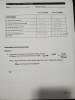 HEAT OF REACTION : REPORT PAGES Name: Partner's name: Reaction (1) (Mg) Reaction (2) (Mgo) DATA TABLE 1. Mass of the sample, & 0.51a 1.oog 2. Volume of the solution, (w), ml 3. Initial Temperature (T), °C 100 mL 22.4°C 143.8°C 43,8 -22.4= 100mL 22.2°C 29.2°C 29.2-22.2=76 4. Final Temperature (Te), °C 5. Change of temperature, C AT = T7-T;...
Using the Ideal Gas Law (PV = nRT) and the data you gathered in your experiment,...
Using the Ideal Gas Law (PV = nRT) and the data you gathered in your experiment, calculate the number of moles (n) of oxygen (O2) produced in this yeast and hydrogen peroxide reaction. (show your calculation) If you are not sure how to do it, please ask me questions before you submit the assignment. Temp of water: 23 C Room...
10. Consider the reaction A + 2B → C ne rate law for this reaction is...
 10. Consider the reaction A + 2B → C ne rate law for this reaction is on der in and and order in B if the rate constant at 25°C is 1.25x 10⁵ , find the rate of reaction when the concentration of A is 0.27M and the concentration of B is 0.32 M UMA 21 11. Consider the reaction...
Review Intelligent Tutoring Problem 6.65 A 1.000 mol sample of propane, a gas used for cooking...
 Review Intelligent Tutoring Problem 6.65 A 1.000 mol sample of propane, a gas used for cooking in many rural areas, was placed in a bomb calorimeter with excess oxygen and ignited. The initial temperature of the calorimeter was 25.000 °C and its total heat capacity was 97.13 kJ °C-1. The reaction raised the temperature of the calorimeter to 27.282 °C....
A reaction of importance in the formation of smog is that between ozone and nitrogen monoxide...
A reaction of importance in the formation of smog is that between ozone and nitrogen monoxide described by O3(g)+NO(g)⟶O2(g)+NO2(g)O3(g)+NO(g)⟶O2(g)+NO2(g) The rate law for this reaction is rate of reaction=?[O3][NO]rate of reaction=k[O3][NO] Given that ?=3.02×10⁶ M−1⋅s−1k=3.02×10⁶ M−1⋅s−1 at a certain temperature, calculate the initial reaction rate when [O3O3] and [NONO] remain essentially constant at the values [O3]0=2.65×10⁻⁶ M[O3]0=2.65×10⁻⁶ M and [NO]0=7.57×10⁻⁵...
Draw a structural formula for the major organic product of the reaction indicated. CH3CH2 CH2CH3 If...
 Draw a structural formula for the major organic product of the reaction indicated. CH3CH2 CH2CH3 If a compound is formed more than once, add another sketcher and draw it again. Alternatively, you may use the square brackets tool to add stoichiometries greater than one Draw one structure per sketcher. Add additional sketchers using the drop-down menu in the bottom right...
In an experiment in the lab, a white solid called ammonium chloride (NH4Cl) is heated and...
 In an experiment in the lab, a white solid called ammonium chloride (NH4Cl) is heated and decomposes to form two gases, hydrogen chloride (one hydrogen and one chlorine) and ammonia (one nitrogen and three hydrogens). The reaction is conducted in a closed flask to capture the gases that are produced. Observations from the experiment are recorded below: . . OBSERVATIONS...
 Entropy/Enthalpy Questions
2. Consider the reaction: 2 BsHo (I)+ 12 O: (8) (a) Use the standard enthalpies of formation found in Appendix B of the textbook to calculate the enthalpy change of the reaction. The standard enthalpy of formation of BsH, () is 73.2 kl/mol. 5 B0, (s) + 9 HiO () s(-1272) 9-235.84)-273.2)-2(0) [-8932.56-146.47 40 78.46 (b) Predict the...
Entropy/Enthalpy Questions
2. Consider the reaction: 2 BsHo (I)+ 12 O: (8) (a) Use the standard enthalpies of formation found in Appendix B of the textbook to calculate the enthalpy change of the reaction. The standard enthalpy of formation of BsH, () is 73.2 kl/mol. 5 B0, (s) + 9 HiO () s(-1272) 9-235.84)-273.2)-2(0) [-8932.56-146.47 40 78.46 (b) Predict the...
 I need help with all three please and thank you!
1. In the following reaction at equilibrium, what will happen if more CO(g) is added? COC12(g) CO(g) + Cl2(g) A) reaction will shift to the right B) reaction will shift to the left C) nothing will happen D) the equilibrium constant will change E) not enough information given to predict...
I need help with all three please and thank you!
1. In the following reaction at equilibrium, what will happen if more CO(g) is added? COC12(g) CO(g) + Cl2(g) A) reaction will shift to the right B) reaction will shift to the left C) nothing will happen D) the equilibrium constant will change E) not enough information given to predict...
 A chemical engineer is studying the following reaction: H (9)+C12(g) → 2 HCl(9) At the temperature the engineer picks, the equilibrium constant K for this reaction is 0.84. The engineer charges ("fills") three reaction vessels with hydrogen and chlorine, and lets the reaction begin. She then measures the composition inside each vessel from time to time. Her first set of...
 HEAT OF REACTION : REPORT PAGES Name: Partner's name: Reaction (1) (Mg) Reaction (2) (Mgo) DATA TABLE 1. Mass of the sample, & 0.51a 1.oog 2. Volume of the solution, (w), ml 3. Initial Temperature (T), °C 100 mL 22.4°C 143.8°C 43,8 -22.4= 100mL 22.2°C 29.2°C 29.2-22.2=76 4. Final Temperature (Te), °C 5. Change of temperature, C AT = T7-T;...
 10. Consider the reaction A + 2B → C ne rate law for this reaction is on der in and and order in B if the rate constant at 25°C is 1.25x 10⁵ , find the rate of reaction when the concentration of A is 0.27M and the concentration of B is 0.32 M UMA 21 11. Consider the reaction...
 Review Intelligent Tutoring Problem 6.65 A 1.000 mol sample of propane, a gas used for cooking in many rural areas, was placed in a bomb calorimeter with excess oxygen and ignited. The initial temperature of the calorimeter was 25.000 °C and its total heat capacity was 97.13 kJ °C-1. The reaction raised the temperature of the calorimeter to 27.282 °C....
 Draw a structural formula for the major organic product of the reaction indicated. CH3CH2 CH2CH3 If a compound is formed more than once, add another sketcher and draw it again. Alternatively, you may use the square brackets tool to add stoichiometries greater than one Draw one structure per sketcher. Add additional sketchers using the drop-down menu in the bottom right...
 In an experiment in the lab, a white solid called ammonium chloride (NH4Cl) is heated and decomposes to form two gases, hydrogen chloride (one hydrogen and one chlorine) and ammonia (one nitrogen and three hydrogens). The reaction is conducted in a closed flask to capture the gases that are produced. Observations from the experiment are recorded below: . . OBSERVATIONS...
Most questions answered within 3 hours.