
Homework Answers
Add Answer to:
I need help with all three please and thank you!
1. In the following reaction at...
1. In the following reaction at equilibrium, what will happen if more CO(g) is added? COCI:(9)...
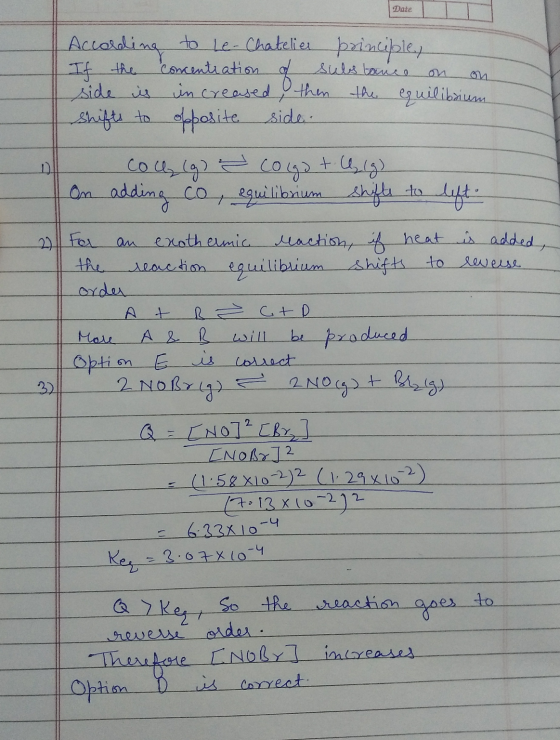
 1. In the following reaction at equilibrium, what will happen if more CO(g) is added? COCI:(9) CO(g) + Cl (9) A) reaction will shift to the right B) reaction will shift to the left C) nothing will happen D) the equilibrium constant will change E) not enough information given to predict 2. The following reaction is exothermic (with A and B reactants) and at equilibrium. What will happen if heat is added? A+B 2 C + D A) more C...
I need help with understanding the shifting stuff on these problems I know the answers for...
I need help with understanding the shifting stuff on these problems I know the answers for all of them but im trying to understand how you get there The following equilibrium was established. Predict what would happen if each of the following changes were made to the conditions of the equilibrium. (2 points each). Ba(OH)2· 8H2O(s) + 2NH4NO3 (s) ↔ Ba(NO3)2 (aq) + 3NH3 (aq) + 10H2O(g) DH = +110.2 kJ What would happen if water vapor were added to...
I need help with all three questions please and thank you! *four 4. Consider the reaction:...
 I need help with all three questions please and thank
you!
*four
4. Consider the reaction: 2 SOX) + g) = 2 50 (8) A 2.0 L flask was filled with 0.0400 moles o. 00200 moles of O. At equilibrium 0.0296 moles of so, were found what is the equilibrium constant for this reaction? A) 2.556 x 10 + B) 3.664 x 10 C) 6.953 x 10² D) 9.964 x 10² E) 3.116 x 10 5. What is a conjugate...
I need help with all three questions please and thank
you!
*four
4. Consider the reaction: 2 SOX) + g) = 2 50 (8) A 2.0 L flask was filled with 0.0400 moles o. 00200 moles of O. At equilibrium 0.0296 moles of so, were found what is the equilibrium constant for this reaction? A) 2.556 x 10 + B) 3.664 x 10 C) 6.953 x 10² D) 9.964 x 10² E) 3.116 x 10 5. What is a conjugate...
please show all steps. The decomposition reaction of COC12 is, COCldg,-CO(g) + Cl2(g) Kc = 2.2...
 please show all steps.
The decomposition reaction of COC12 is, COCldg,-CO(g) + Cl2(g) Kc = 2.2 × 10⁻¹⁰. The initial concentration of CoCl is 0.3166 M 3. the (a) At equilibrium, the concentrations of the products are concentration of reactant. (A) greater than (B) less than (D) unknown because more information is needed to determine. (C) equal to (b) Fill the ICE table below COC: Ico Initial concentration (M) Changes (M) Equilibrium concentration (M) -x (c) Calculate the equilibrium concentration...
please show all steps.
The decomposition reaction of COC12 is, COCldg,-CO(g) + Cl2(g) Kc = 2.2 × 10⁻¹⁰. The initial concentration of CoCl is 0.3166 M 3. the (a) At equilibrium, the concentrations of the products are concentration of reactant. (A) greater than (B) less than (D) unknown because more information is needed to determine. (C) equal to (b) Fill the ICE table below COC: Ico Initial concentration (M) Changes (M) Equilibrium concentration (M) -x (c) Calculate the equilibrium concentration...
please show work for these problems, correct answers are circled 26. Consider the reaction: 2HBr(g) =...
 please show work for these problems, correct answers are
circled
26. Consider the reaction: 2HBr(g) = H2(g) + Br2(g) Keq = 49.0 If 1.20 M H2, 1.20 M Br2 and 1.00 M HBr are placed into a container at 44° C, which of the following is true as equilibrium is approached? A. [Br2] decreases significantly. B. [HBr] decreases significantly. C. [H2] decreases significantly. D. [H2) remains the same. 27. Which Keq is most likely to favour the formation of reactants?...
please show work for these problems, correct answers are
circled
26. Consider the reaction: 2HBr(g) = H2(g) + Br2(g) Keq = 49.0 If 1.20 M H2, 1.20 M Br2 and 1.00 M HBr are placed into a container at 44° C, which of the following is true as equilibrium is approached? A. [Br2] decreases significantly. B. [HBr] decreases significantly. C. [H2] decreases significantly. D. [H2) remains the same. 27. Which Keq is most likely to favour the formation of reactants?...
both probelms please! show work thank you (: 1 pts Question 10 Consider the following reaction:...
 both probelms please! show work thank you (:
1 pts Question 10 Consider the following reaction: 2NOBr(g) + 2NO(g) + Bra(s) A1 L vessel is initially filled with pure NOBr. After equilibrium is reached, the volume is increased to 2L, while the temperature was kept constant. This will result in a shift in the equilibrium position to the right such that more products are made a decrease in ko an increase in Ko two of these answers are correct a...
both probelms please! show work thank you (:
1 pts Question 10 Consider the following reaction: 2NOBr(g) + 2NO(g) + Bra(s) A1 L vessel is initially filled with pure NOBr. After equilibrium is reached, the volume is increased to 2L, while the temperature was kept constant. This will result in a shift in the equilibrium position to the right such that more products are made a decrease in ko an increase in Ko two of these answers are correct a...
I need help with these please and thank you 6. For the following reaction, AGⓇ =...
 I need help with these please and thank you
6. For the following reaction, AGⓇ = -2.0 kJ/mol at 25°C. Cl2(g) + F2(g) = 2CIF(g) What is AGrx at 25 °C under the following conditions: Pci, = 1.0atm PF, = 1.0atmand Pcie = 0.50 atm? A. 1424 kJ B.-5.4 kJ C.-2600 kJ D.-2.3 kJ E. -3430 kJ 7. The following reaction is exothermic. 200(g) + O2(g) = 2C02(g) What happens to Kp with increasing temperature? A. Ko does not change....
I need help with these please and thank you
6. For the following reaction, AGⓇ = -2.0 kJ/mol at 25°C. Cl2(g) + F2(g) = 2CIF(g) What is AGrx at 25 °C under the following conditions: Pci, = 1.0atm PF, = 1.0atmand Pcie = 0.50 atm? A. 1424 kJ B.-5.4 kJ C.-2600 kJ D.-2.3 kJ E. -3430 kJ 7. The following reaction is exothermic. 200(g) + O2(g) = 2C02(g) What happens to Kp with increasing temperature? A. Ko does not change....
Practice Questions Exam 2 Fall 2019 9. The reaction profile represents the following chemical equation: AB-CD...
 Practice Questions Exam 2 Fall 2019 9. The reaction profile represents the following chemical equation: AB-CD Calculate the activation energy (Ea) and AH of the reaction at 200 K Page 2 of 5 14. Consider the following reaction at 1700*C. 2CH ) CH.(g) + 3H2(g) Initially, the reaction mixture contains only [CH] -0.320 M. At equilibrium, the mixture contains [C,H,1 -0.070 M. What is the equilibrium constant for this reaction at 1700 °C? 1200 kJ 500 kJ 200 kJ Ea...
ANSWER AS SOON AS POSSIBLE 4 10 6 points Phosgene COCl2 dissociates as follows: COC12(g) <========...
 ANSWER AS SOON AS POSSIBLE
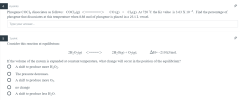
4 10 6 points Phosgene COCl2 dissociates as follows: COC12(g) <======== CO (g) + Cl2(g). At 720 °C the Kc value is 3.63 X 10 -3. Find the percentage of phosgene that dissociates at this temperature when 8.88 mol of phosgene is placed in a 25.1 L vessel. Type your answer... 5 1 point Consider this reaction at equilibrium: 2H2O2(g) 2H2O(g) + O2(g); AH=-210 kJ/mol. If the volume of the system is expanded at constant...
ANSWER AS SOON AS POSSIBLE
4 10 6 points Phosgene COCl2 dissociates as follows: COC12(g) <======== CO (g) + Cl2(g). At 720 °C the Kc value is 3.63 X 10 -3. Find the percentage of phosgene that dissociates at this temperature when 8.88 mol of phosgene is placed in a 25.1 L vessel. Type your answer... 5 1 point Consider this reaction at equilibrium: 2H2O2(g) 2H2O(g) + O2(g); AH=-210 kJ/mol. If the volume of the system is expanded at constant...
G-10 Assume the equilibrium constant K 1 for a reaction A + B 2 C. You...
 G-10 Assume the equilibrium constant K 1 for a reaction A + B 2 C. You prepare a solution that has the following initial concentrations. For each solution, calculate the reaction quotient Q and state if the concentrations of reactants and products will (increase, decrease, or stay the same). a) [A] 1 M, [B] 1M, [C] 2 M. b) [A] 2 M, [B] 1 M,(C] 1 M. Answers: Q 4 >K, [A, B] increase, [C] decreases Q=0.5 < K, [A,...
 1. In the following reaction at equilibrium, what will happen if more CO(g) is added? COCI:(9) CO(g) + Cl (9) A) reaction will shift to the right B) reaction will shift to the left C) nothing will happen D) the equilibrium constant will change E) not enough information given to predict 2. The following reaction is exothermic (with A and B reactants) and at equilibrium. What will happen if heat is added? A+B 2 C + D A) more C...
 I need help with all three questions please and thank
you!
*four
4. Consider the reaction: 2 SOX) + g) = 2 50 (8) A 2.0 L flask was filled with 0.0400 moles o. 00200 moles of O. At equilibrium 0.0296 moles of so, were found what is the equilibrium constant for this reaction? A) 2.556 x 10 + B) 3.664 x 10 C) 6.953 x 10² D) 9.964 x 10² E) 3.116 x 10 5. What is a conjugate...
I need help with all three questions please and thank
you!
*four
4. Consider the reaction: 2 SOX) + g) = 2 50 (8) A 2.0 L flask was filled with 0.0400 moles o. 00200 moles of O. At equilibrium 0.0296 moles of so, were found what is the equilibrium constant for this reaction? A) 2.556 x 10 + B) 3.664 x 10 C) 6.953 x 10² D) 9.964 x 10² E) 3.116 x 10 5. What is a conjugate...
 please show all steps.
The decomposition reaction of COC12 is, COCldg,-CO(g) + Cl2(g) Kc = 2.2 × 10⁻¹⁰. The initial concentration of CoCl is 0.3166 M 3. the (a) At equilibrium, the concentrations of the products are concentration of reactant. (A) greater than (B) less than (D) unknown because more information is needed to determine. (C) equal to (b) Fill the ICE table below COC: Ico Initial concentration (M) Changes (M) Equilibrium concentration (M) -x (c) Calculate the equilibrium concentration...
please show all steps.
The decomposition reaction of COC12 is, COCldg,-CO(g) + Cl2(g) Kc = 2.2 × 10⁻¹⁰. The initial concentration of CoCl is 0.3166 M 3. the (a) At equilibrium, the concentrations of the products are concentration of reactant. (A) greater than (B) less than (D) unknown because more information is needed to determine. (C) equal to (b) Fill the ICE table below COC: Ico Initial concentration (M) Changes (M) Equilibrium concentration (M) -x (c) Calculate the equilibrium concentration...
 please show work for these problems, correct answers are
circled
26. Consider the reaction: 2HBr(g) = H2(g) + Br2(g) Keq = 49.0 If 1.20 M H2, 1.20 M Br2 and 1.00 M HBr are placed into a container at 44° C, which of the following is true as equilibrium is approached? A. [Br2] decreases significantly. B. [HBr] decreases significantly. C. [H2] decreases significantly. D. [H2) remains the same. 27. Which Keq is most likely to favour the formation of reactants?...
please show work for these problems, correct answers are
circled
26. Consider the reaction: 2HBr(g) = H2(g) + Br2(g) Keq = 49.0 If 1.20 M H2, 1.20 M Br2 and 1.00 M HBr are placed into a container at 44° C, which of the following is true as equilibrium is approached? A. [Br2] decreases significantly. B. [HBr] decreases significantly. C. [H2] decreases significantly. D. [H2) remains the same. 27. Which Keq is most likely to favour the formation of reactants?...
 both probelms please! show work thank you (:
1 pts Question 10 Consider the following reaction: 2NOBr(g) + 2NO(g) + Bra(s) A1 L vessel is initially filled with pure NOBr. After equilibrium is reached, the volume is increased to 2L, while the temperature was kept constant. This will result in a shift in the equilibrium position to the right such that more products are made a decrease in ko an increase in Ko two of these answers are correct a...
both probelms please! show work thank you (:
1 pts Question 10 Consider the following reaction: 2NOBr(g) + 2NO(g) + Bra(s) A1 L vessel is initially filled with pure NOBr. After equilibrium is reached, the volume is increased to 2L, while the temperature was kept constant. This will result in a shift in the equilibrium position to the right such that more products are made a decrease in ko an increase in Ko two of these answers are correct a...
 I need help with these please and thank you
6. For the following reaction, AGⓇ = -2.0 kJ/mol at 25°C. Cl2(g) + F2(g) = 2CIF(g) What is AGrx at 25 °C under the following conditions: Pci, = 1.0atm PF, = 1.0atmand Pcie = 0.50 atm? A. 1424 kJ B.-5.4 kJ C.-2600 kJ D.-2.3 kJ E. -3430 kJ 7. The following reaction is exothermic. 200(g) + O2(g) = 2C02(g) What happens to Kp with increasing temperature? A. Ko does not change....
I need help with these please and thank you
6. For the following reaction, AGⓇ = -2.0 kJ/mol at 25°C. Cl2(g) + F2(g) = 2CIF(g) What is AGrx at 25 °C under the following conditions: Pci, = 1.0atm PF, = 1.0atmand Pcie = 0.50 atm? A. 1424 kJ B.-5.4 kJ C.-2600 kJ D.-2.3 kJ E. -3430 kJ 7. The following reaction is exothermic. 200(g) + O2(g) = 2C02(g) What happens to Kp with increasing temperature? A. Ko does not change....
 Practice Questions Exam 2 Fall 2019 9. The reaction profile represents the following chemical equation: AB-CD Calculate the activation energy (Ea) and AH of the reaction at 200 K Page 2 of 5 14. Consider the following reaction at 1700*C. 2CH ) CH.(g) + 3H2(g) Initially, the reaction mixture contains only [CH] -0.320 M. At equilibrium, the mixture contains [C,H,1 -0.070 M. What is the equilibrium constant for this reaction at 1700 °C? 1200 kJ 500 kJ 200 kJ Ea...
 ANSWER AS SOON AS POSSIBLE
4 10 6 points Phosgene COCl2 dissociates as follows: COC12(g) <======== CO (g) + Cl2(g). At 720 °C the Kc value is 3.63 X 10 -3. Find the percentage of phosgene that dissociates at this temperature when 8.88 mol of phosgene is placed in a 25.1 L vessel. Type your answer... 5 1 point Consider this reaction at equilibrium: 2H2O2(g) 2H2O(g) + O2(g); AH=-210 kJ/mol. If the volume of the system is expanded at constant...
ANSWER AS SOON AS POSSIBLE
4 10 6 points Phosgene COCl2 dissociates as follows: COC12(g) <======== CO (g) + Cl2(g). At 720 °C the Kc value is 3.63 X 10 -3. Find the percentage of phosgene that dissociates at this temperature when 8.88 mol of phosgene is placed in a 25.1 L vessel. Type your answer... 5 1 point Consider this reaction at equilibrium: 2H2O2(g) 2H2O(g) + O2(g); AH=-210 kJ/mol. If the volume of the system is expanded at constant...
 G-10 Assume the equilibrium constant K 1 for a reaction A + B 2 C. You prepare a solution that has the following initial concentrations. For each solution, calculate the reaction quotient Q and state if the concentrations of reactants and products will (increase, decrease, or stay the same). a) [A] 1 M, [B] 1M, [C] 2 M. b) [A] 2 M, [B] 1 M,(C] 1 M. Answers: Q 4 >K, [A, B] increase, [C] decreases Q=0.5 < K, [A,...
Most questions answered within 3 hours.
-
Where is the error in this code sequence?
String s1 = "Hello";
String s2 = "ello";...
asked 10 months ago -
Financial data for Joel de Paris, Inc., for last year
follow:
Joel de Paris, Inc.
Balance...
asked 10 months ago -
Consider this reaction:
Al2(SO4)3 (aq)+ BaCl3
(aq) Al2Cl6 (aq)- +
3BaSO4(s) . What is the...
asked 10 months ago -
Suppose that Savneet is considering increasing her
recent random sample from 20 car rentals to 40...
asked 10 months ago -
Trucks arrive at an unloading terminal at an average rate of 120
per hour.
Trucks arrive...
asked 10 months ago -
Why are methanol and ethanol completely soluble in water while
octanol is not very little soluble....
asked 10 months ago -
A facilities manager at a university reads in a research report
that the mean amount of...
asked 10 months ago -
When the CuSO4 is rehydrated by adding water to the anhydrous
compound, is this an endothermic...
asked 10 months ago -
A ray of sunlight is passing from diamond into crown glass; the
angle of incidence is...
asked 10 months ago -
A block of mass 0.249 kg is placed on top of a light, vertical
spring of...
asked 10 months ago -
how do the kidneys compensate in the presences of acidosis
a) trigger hyperventilate
b) reserve acid...
asked 10 months ago -
Question 501 pts
The rental rate of capital to the firm increases. Which of the
following...
asked 10 months ago