 ANSWER AS SOON AS POSSIBLE
Homework Answers
Add Answer to:
ANSWER AS SOON AS POSSIBLE
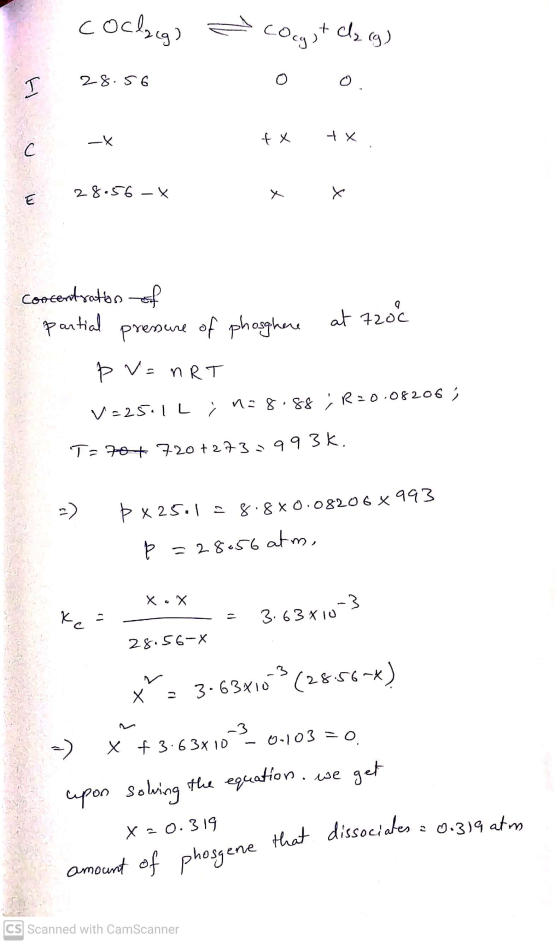
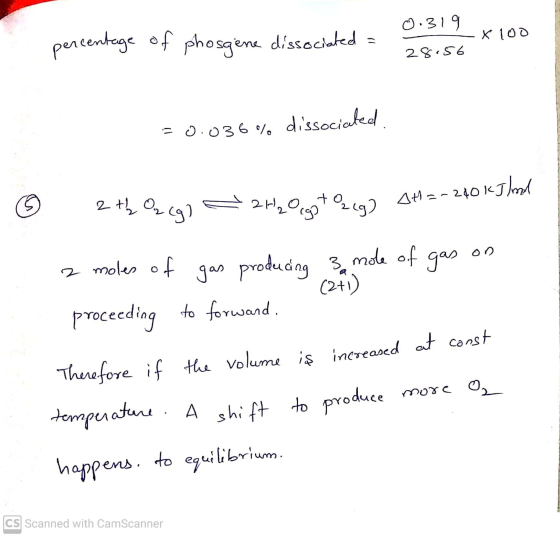
4 10 6 points Phosgene COCl2 dissociates as follows: COC12(g) <========...
Phosgene (COCl2) is a toxic substance that forms readily from carbon monoxide and chlorine at elevated...
Phosgene (COCl2) is a toxic substance that forms readily from carbon monoxide and chlorine at elevated temperatures: CO(g) + Cl2(g) ⇌ COCl2(g) If 0.390 mol of each reactant is placed in a 0.500−L flask at 600 K, what are the concentrations of all three substances at equilibrium (Kc = 4.95 at this temperature)? Substance Concentration (M) CO Cl2 COCl2
Be sure to answer all parts. The equilibrium constant Kc for the decomposition of phosgene, COCl2,...
Be sure to answer all parts. The equilibrium constant Kc for the decomposition of phosgene, COCl2, is 4.63 × 10⁻³ at 527 ° C: COCl2(g) ⇆ CO(g) + Cl2(g) Calculate the equilibrium partial pressure of all the components, starting with pure phosgene at 0.760 atm. PCOCl2 = atm PCO = atm PCl2 = atm
7) Consider the reaction: COCl2(g) ↔ CO(g) + Cl2(g) Kc = 2.2 × 10⁻⁶ COCl2 =...
7) Consider the reaction: COCl2(g) ↔ CO(g) + Cl2(g) Kc = 2.2 × 10⁻⁶ COCl2 = 98.91 g/mol CO = 28.01 g/mol Cl2 = 70.90 g/mol A reaction mixture in a 3.00 L flask at a certain temperature initially contains 93.94 g COCl2(g). Calculate the equilibrium concentrations of all species in the reaction mixture at this temperature.
Please show work Phosgene (COCl2) is a toxic substance that forms readily from carbon monoxide and...
Please show work Phosgene (COCl2) is a toxic substance that forms readily from carbon monoxide and chlorine at elevated temperatures: CO(g) + Cl2(g) ⇌ COCl2(g) If 0.410 mol of each reactant is placed in a 0.500−L flask at 600 K, what are the concentrations of all three substances at equilibrium (Kc = 4.95 at this temperature)?
Consider the following reaction: COCl2(g) = CO(g) + Cl2(8) A reaction mixture initially contains 1.6 M...
 Consider the following reaction: COCl2(g) = CO(g) + Cl2(8) A reaction mixture initially contains 1.6 M COC12. Determine the equilibrium concentrations of COCI, CO, and Cl2 if Kc for the reaction at this temperature is 8.33 x 10⁻⁴. Calculate this based on the assumption that the answer is negligible compared to 1.6. Use x is small approximation. Show Q Validity check [Cl2] = [CO]= [COCI2] = Calculate the reaction quotient, Q A % Validity Check A Calculate the A/ equilibrium...
answer all questions for rating. 1. Part A Phosgene (carbonyl chloride), COCl2, is an extremely toxic...
answer all questions for rating. 1. Part A Phosgene (carbonyl chloride), COCl2, is an extremely toxic gas that is used in manufacturing certain dyes and plastics. Phosgene can be produced by reacting carbon monoxide and chlorine gas at high temperatures: CO(g)+Cl2(g)⇌COCl2(g) Carbon monoxide and chlorine gas are allowed to react in a sealed vessel at 453 ∘C . At equilibrium, the concentrations were measured and the following results obtained: Gas Partial Pressure (atm) CO 0.800 Cl2 1.24 COCl2 0.240 What...
COCl2 (g) ⇌ CO (g) + Cl2 (g) K = 8.3 x 10⁻⁴ at 360 °C;...
COCl2 (g) ⇌ CO (g) + Cl2 (g) K = 8.3 x 10⁻⁴ at 360 °C; ΔHo rxn = 109.5 kJ/mol Initially, 2.0 moles of CoCl2 were placed in an empty 1.0 L container at 360 °C. When the system reached equilibrium, what was the equilibrium concentration of Cl2? b. After the system reached equilibrium, 0.5 mol of CO were added into the container and the temperature was increased to 500 °C. When the system re-established equilibrium, what was the...
1. 1.75 moles of H202 were placed in a 2.50 L reaction chamber at 307°C. After...
 1. 1.75 moles of H202 were placed in a 2.50 L reaction chamber at 307°C. After equilibrium was reached, 1.20 moles of H202 remained. Calculate the equilibrium constant, Kc, for the reaction. 2. Phosgene, COCl,, a poisonous gas, decomposes according to the equation COC2(g) CO(g)+ Cl2(g) Calculate Kp for this reaction if Kc- 0.083 at 900°C. K K.(PT) 3. Calculate Kc for the reaction 2HI(g) H2(g) +12(g) given that the concentrations of each species at equilibrium are as follows: [HI...
Q(1) During a chemical reaction, what defines when the concentrations of the reactants and products reach...
 Q(1) During a chemical reaction, what defines when the concentrations of the reactants and products reach a constant level? A) Elementary process B) Rate constant C) Reversible reaction D) Equilibrium E) Rate law Q(2) Which is the correct equilibrium constant expression for the following reaction? FeO(s) + H2(g) - Fe(s) + H2O(g) A) Ke = [H2O] / [H2] B) Ke=[Fe][H2O] / [Fe2O3] [H2] C) Ke=[Fe) (H20] / [Fe2O3] D) Kc = [Hz] / [H2O] E) Ke= [Fe2O3] [H2] / [Fe][H2O]...
Please answer all six thanks 1) The equilibrium constant for the following reaction is 2.90×10⁻² at...
Please answer all six thanks 1) The equilibrium constant for the following reaction is 2.90×10⁻² at 1.15×10³K. 2SO3(g) ------------------->2SO2(g) + O2(g) If an equilibrium mixture of the three gases in a 17.3 L container at 1.15×10³K contains 0.437 mol of SO3(g) and 0.422 mol of SO2, the equilibrium concentration of O2 is M. 2) A student ran the following reaction in the laboratory at 1100 K: 2SO3(g) -------------------->2SO2(g) + O2(g) When she introduced 7.74×10⁻² moles of SO3(g) into a 1.00 liter...
 Consider the following reaction: COCl2(g) = CO(g) + Cl2(8) A reaction mixture initially contains 1.6 M COC12. Determine the equilibrium concentrations of COCI, CO, and Cl2 if Kc for the reaction at this temperature is 8.33 x 10⁻⁴. Calculate this based on the assumption that the answer is negligible compared to 1.6. Use x is small approximation. Show Q Validity check [Cl2] = [CO]= [COCI2] = Calculate the reaction quotient, Q A % Validity Check A Calculate the A/ equilibrium...
 1. 1.75 moles of H202 were placed in a 2.50 L reaction chamber at 307°C. After equilibrium was reached, 1.20 moles of H202 remained. Calculate the equilibrium constant, Kc, for the reaction. 2. Phosgene, COCl,, a poisonous gas, decomposes according to the equation COC2(g) CO(g)+ Cl2(g) Calculate Kp for this reaction if Kc- 0.083 at 900°C. K K.(PT) 3. Calculate Kc for the reaction 2HI(g) H2(g) +12(g) given that the concentrations of each species at equilibrium are as follows: [HI...
 Q(1) During a chemical reaction, what defines when the concentrations of the reactants and products reach a constant level? A) Elementary process B) Rate constant C) Reversible reaction D) Equilibrium E) Rate law Q(2) Which is the correct equilibrium constant expression for the following reaction? FeO(s) + H2(g) - Fe(s) + H2O(g) A) Ke = [H2O] / [H2] B) Ke=[Fe][H2O] / [Fe2O3] [H2] C) Ke=[Fe) (H20] / [Fe2O3] D) Kc = [Hz] / [H2O] E) Ke= [Fe2O3] [H2] / [Fe][H2O]...
Most questions answered within 3 hours.
-
Where is the error in this code sequence?
String s1 = "Hello";
String s2 = "ello";...
asked 10 months ago -
Financial data for Joel de Paris, Inc., for last year
follow:
Joel de Paris, Inc.
Balance...
asked 10 months ago -
Consider this reaction:
Al2(SO4)3 (aq)+ BaCl3
(aq) Al2Cl6 (aq)- +
3BaSO4(s) . What is the...
asked 10 months ago -
Suppose that Savneet is considering increasing her
recent random sample from 20 car rentals to 40...
asked 10 months ago -
Trucks arrive at an unloading terminal at an average rate of 120
per hour.
Trucks arrive...
asked 10 months ago -
Why are methanol and ethanol completely soluble in water while
octanol is not very little soluble....
asked 10 months ago -
A facilities manager at a university reads in a research report
that the mean amount of...
asked 10 months ago -
When the CuSO4 is rehydrated by adding water to the anhydrous
compound, is this an endothermic...
asked 10 months ago -
A ray of sunlight is passing from diamond into crown glass; the
angle of incidence is...
asked 10 months ago -
A block of mass 0.249 kg is placed on top of a light, vertical
spring of...
asked 10 months ago -
how do the kidneys compensate in the presences of acidosis
a) trigger hyperventilate
b) reserve acid...
asked 10 months ago -
Question 501 pts
The rental rate of capital to the firm increases. Which of the
following...
asked 10 months ago