Part A Consider the following reaction at equilibrium. What will happen if the volume increased ?...
 Part A Consider the following reaction at equilibrium. What will happen if the volume increased ? 4FeS2(s) + 1102 (9) 2Fe2O3(s) + 8SO2 (9) The equilibrium constant will increase. The equilibrium will change in the direction of the reactants. The equilibrium will change in the direction of the products. No change in equilibrium is observed. The equilibrium constant will decrease....
Complete the following reaction by drawing the structure of the major product(s) expected. You do not...
 Complete the following reaction by drawing the structure of the major product(s) expected. You do not have to consider stereochemistry. You do not have to explicitly draw H atoms. If there is more than one major product possible, draw all of them. Separate multiple products using the + sign from the drop-down menu.
Write the reaction of benzocaine with aqueous hydrochloric acid (i.e. H3O+; the Cl– is irrelevant). Abbreviate...
Write the reaction of benzocaine with aqueous hydrochloric acid (i.e. H3O+; the Cl– is irrelevant). Abbreviate benzocaine as Ar–NH2, where Ar represents a generalized "aryl" group (in this case a phenyl with a –CO2Et group). The pKa of the conjugate acid of benzocaine is 2.5. Based on pKa values, does this acid-base equilibrium favor reactants or products?
6. Please answer the following questions related to Optical Activity: 1. Given the following experimental data...
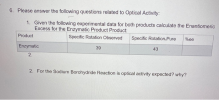 6. Please answer the following questions related to Optical Activity: 1. Given the following experimental data for both products calculate the Enantiomeric Excess for the Enzymatic Product Product: Product Specific Rotation Observed Specific Rotation.Pure See Enzymatic 39 43 2. For the Sodium Borohydride Reaction is optical activity expected? why?
The equilibrium constant, Kc, for the following reaction is 77.5 at 600 K. CO(g) + Cl2(g)...
The equilibrium constant, Kc, for the following reaction is 77.5 at 600 K. CO(g) + Cl2(g) goes to COCl2(g) . Calculate the equilibrium concentrations of reactant and products when 0.320 moles of CO and 0.320 moles of Cl2 are introduced into a 1.00 L vessel at 600 K. [CO] = ___M [Cl2] = ___M [COCl2] = ___M
21. Do Only One! Propose a multistep synthesis using the starting materials shown and any other...
 21. Do Only One! Propose a multistep synthesis using the starting materials shown and any other reagents/reactants you need. To maximize partial credit, be sure to draw out the products of each reaction you propose. You do not need to draw mechanisms for full credit. (7 points) o by OR ОMe
Draw a structural formula for the substitution product of the reaction shown below. Br CH202 HO...
 Draw a structural formula for the substitution product of the reaction shown below. Br CH202 HO Е осн • Use the wedge/hash bond tools to indicate stereochemistry where it exists. • If more than one stereoisomer of product is formed, draw both. • Separate multiple products using the + sign from the drop-down menu.
The equilibrium constant, Kc, for the following reaction is 1.29×10⁻² at 600 K. COCl2(g) goes to...
The equilibrium constant, Kc, for the following reaction is 1.29×10⁻² at 600 K. COCl2(g) goes to CO(g) + Cl2(g) . Calculate the equilibrium concentrations of reactant and products when 0.329 moles of COCl2(g) are introduced into a 1.00 L vessel at 600 K. [COCl2] = ___M [CO] = ___M [Cl2] = -__M
When calcium carbonate is added to hydrochloric acid the products are calcium chloride, carbon dioxide, and...
When calcium carbonate is added to hydrochloric acid the products are calcium chloride, carbon dioxide, and water. How many grams of calcium chloride will be produced when 29.0 g of calcium carbonate are combined with 11.0 g of hydrochloric acid? Which reactant is in excess and how many grams of this reactant will remain after the reaction is complete?
_6. A mechanism is: A. illustrated movement of nuclei E. A and D only B. used...
 _6. A mechanism is: A. illustrated movement of nuclei E. A and D only B. used to explain unusual products or effects G. B and C only C. an explanation of how electrons are moving as a reaction occurs D. not of major significance for most reactions Reference: 3.1 - 3.4 (94 - 115), 6.6 - 6.7 (242 - 248)
 Part A Consider the following reaction at equilibrium. What will happen if the volume increased ? 4FeS2(s) + 1102 (9) 2Fe2O3(s) + 8SO2 (9) The equilibrium constant will increase. The equilibrium will change in the direction of the reactants. The equilibrium will change in the direction of the products. No change in equilibrium is observed. The equilibrium constant will decrease....
 Complete the following reaction by drawing the structure of the major product(s) expected. You do not have to consider stereochemistry. You do not have to explicitly draw H atoms. If there is more than one major product possible, draw all of them. Separate multiple products using the + sign from the drop-down menu.
 6. Please answer the following questions related to Optical Activity: 1. Given the following experimental data for both products calculate the Enantiomeric Excess for the Enzymatic Product Product: Product Specific Rotation Observed Specific Rotation.Pure See Enzymatic 39 43 2. For the Sodium Borohydride Reaction is optical activity expected? why?
 21. Do Only One! Propose a multistep synthesis using the starting materials shown and any other reagents/reactants you need. To maximize partial credit, be sure to draw out the products of each reaction you propose. You do not need to draw mechanisms for full credit. (7 points) o by OR ОMe
 Draw a structural formula for the substitution product of the reaction shown below. Br CH202 HO Е осн • Use the wedge/hash bond tools to indicate stereochemistry where it exists. • If more than one stereoisomer of product is formed, draw both. • Separate multiple products using the + sign from the drop-down menu.
 _6. A mechanism is: A. illustrated movement of nuclei E. A and D only B. used to explain unusual products or effects G. B and C only C. an explanation of how electrons are moving as a reaction occurs D. not of major significance for most reactions Reference: 3.1 - 3.4 (94 - 115), 6.6 - 6.7 (242 - 248)
Most questions answered within 3 hours.