Consider the gas-phase reaction between nitric oxide and bromine at 273 ∘C 2NO(g)+Br2(g)→2NOBr(g). The following data...
Consider the gas-phase reaction between nitric oxide and bromine at 273 ∘C 2NO(g)+Br2(g)→2NOBr(g). The following data for the initial rate of appearance of NOBr were obtained: Experiment [NO](M) [Br2](M) Initial Rate of Appearance of NOBr(M/s) 1 0.10 0.20 24 2 0.25 0.20 150 3 0.10 0.50 60 4 0.35 0.50 735 What is the rate of disappearance of Br2 when...
Trial [NaOH] [CH3COOC2H5] Initial conductivity of NaOH solution (uS/cm) Initial rate (uS/cm)/s) 1 20.0 ml 2.0...
Trial [NaOH] [CH3COOC2H5] Initial conductivity of NaOH solution (uS/cm) Initial rate (uS/cm)/s) 1 20.0 ml 2.0 ml 946.2 1.825 2 40.0 ml 2.0 ml 1964.6 (this number can be fudged to make math easier) 3.48 3 20.0 ml 4.0 ml 1090.4 (this number can be fudged (changed) to make the math simpler/ easier) 1.88 Data Analysis for "The Base Hydrolysis...
Based on a Kc value of 0.140 and the initial concentrations given in the table, determine...
Based on a Kc value of 0.140 and the initial concentrations given in the table, determine in which direction the net reaction will proceed to attain equilibrium. Initial concentrations (M) Mixture [XY] [X] [Y] A 0.100 0 0 B 0.500 0.100 0.100 C 0.200 0.300 0.300 Part A Based on a Kc value of 0.140 and the given data table,...
At elevated temperatures, nitrogen dioxide decomposes to nitrogen oxide and oxygen: The reaction is second order...
At elevated temperatures, nitrogen dioxide decomposes to nitrogen oxide and oxygen: The reaction is second order in NO2 with a rate constant of 0.543 M-1 s-1 at 300°C If the initial [NO2] is 0.260 M it will take ________ seconds for the concentration to drop to 0.100 M. 11.3 8.8 × 10⁻² -0.611 3.34 0.299
At 2200 degrees C gaseous nitrous oxide is synthesized from nitrogen gas and oxygen gas where...
 At 2200 degrees C gaseous nitrous oxide is synthesized from nitrogen gas and oxygen gas where the equilibrium constant is 0.050 for the reaction. Calculate the equilibrium pressures of NO if nitrogen gas has an initial pressure of 7.46 am and oxygen gas is initially at 0.95 atm N2(g) + O2(g) - 2NO (ICE)
5 At some temperature, the value of the equilibrium constant for the reaction: SO2 (g) +...
 5 At some temperature, the value of the equilibrium constant for the reaction: SO2 (g) + NO2(g) →→ SO3(g) + NO(g) has the value K = 0.640. If all four gases are placed into a container, each with an initial partial pressure of 1.25 atm, calculate the equilibriuym partial pressure (in atm) of SO3(g) W AM
Question: The rate of change of concentration in a chemical reaction, F'Dis the sum of the...
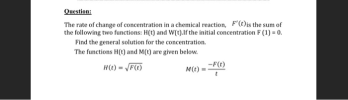 Question: The rate of change of concentration in a chemical reaction, F'Dis the sum of the following two functions: H(t) and (t).If the initial concentration F (1) = 0. Find the general solution for the concentration. The functions H(t) and M(t) are given below. H(t) = F(t) M(t) = -F(t)
Based on the data below, calculate the rate constant, k, for the reaction A + 2B...
Based on the data below, calculate the rate constant, k, for the reaction A + 2B --> C + D, if the rate law is rate = k[A]2[B]0. Experiment [A] M [B] M Initial Rate (M / s) 1 0.110 0.150 0.145 2 0.220 0.150 0.581 3 0.220 0.450 0.581
Show a sample of the ICE table that will be used to calculate Kc. For your...
 Show a sample of the ICE table that will be used to calculate Kc. For your example, use the trial one with 2.00 mL of SCN and 5.00 mL of Fets and an arbitrary absorbance value for FeSCN+2 between 0.200 -0.400. (Note: Both reactant stock solutions are 0.00200 M) Hints to consider as you are preparing the ICE table: What...
1. At a particular temperature, K 0.267 for the reaction SOg+NO SO2+NO) If all four gases...
 1. At a particular temperature, K 0.267 for the reaction SOg+NO SO2+NO) If all four gases had initial concentrations of 0.800 M, calculate the equilibrium concentrati 0.8004 267-(0.800tx ons of the gases. (6 pts) (0.800-xX0.800- NO2 S0a No S0ろ 00 80m Wom -X +X 0.8 00t 0.8 004 O.800-x10.800 -X 2. Consider the following reaction: 2 NOIBr 2 NOBrig) Kp...
 At 2200 degrees C gaseous nitrous oxide is synthesized from nitrogen gas and oxygen gas where the equilibrium constant is 0.050 for the reaction. Calculate the equilibrium pressures of NO if nitrogen gas has an initial pressure of 7.46 am and oxygen gas is initially at 0.95 atm N2(g) + O2(g) - 2NO (ICE)
 5 At some temperature, the value of the equilibrium constant for the reaction: SO2 (g) + NO2(g) →→ SO3(g) + NO(g) has the value K = 0.640. If all four gases are placed into a container, each with an initial partial pressure of 1.25 atm, calculate the equilibriuym partial pressure (in atm) of SO3(g) W AM
 Question: The rate of change of concentration in a chemical reaction, F'Dis the sum of the following two functions: H(t) and (t).If the initial concentration F (1) = 0. Find the general solution for the concentration. The functions H(t) and M(t) are given below. H(t) = F(t) M(t) = -F(t)
 Show a sample of the ICE table that will be used to calculate Kc. For your example, use the trial one with 2.00 mL of SCN and 5.00 mL of Fets and an arbitrary absorbance value for FeSCN+2 between 0.200 -0.400. (Note: Both reactant stock solutions are 0.00200 M) Hints to consider as you are preparing the ICE table: What...
 1. At a particular temperature, K 0.267 for the reaction SOg+NO SO2+NO) If all four gases had initial concentrations of 0.800 M, calculate the equilibrium concentrati 0.8004 267-(0.800tx ons of the gases. (6 pts) (0.800-xX0.800- NO2 S0a No S0ろ 00 80m Wom -X +X 0.8 00t 0.8 004 O.800-x10.800 -X 2. Consider the following reaction: 2 NOIBr 2 NOBrig) Kp...
Most questions answered within 3 hours.