Consider the gas-phase reaction between nitric oxide and bromine at 273 ∘C 2NO(g)+Br2(g)→2NOBr(g). The following data...
Consider the gas-phase reaction between nitric oxide and bromine
at 273 ∘C
2NO(g)+Br2(g)→2NOBr(g).
The following data for the initial rate of appearance of NOBr were
obtained:
| Experiment | [NO](M) | [Br2](M) | Initial Rate of Appearance of NOBr(M/s) |
| 1 | 0.10 | 0.20 | 24 |
| 2 | 0.25 | 0.20 | 150 |
| 3 | 0.10 | 0.50 | 60 |
| 4 | 0.35 | 0.50 | 735 |
What is the rate of disappearance of Br2 when [NO]= 8.1×10⁻² M and [Br2]= 0.22 M ?
Express your answer using two significant figures.
Homework Answers
The rate equation of this reaction can be written as:

Where k is the rate constant and n and m are the reaction orders. We can take experiments 1 and 2 (they have the same concentration of bromine, which cancel out) and calculate:


So, we have

Which means that n = 2.
Analogously, If we take experiments 1 and 3, we have the same concentration of NO, so we can use this:

So now we have:
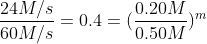

So m = 1.
Knowing n and m, we can calculate the constant k using experiment 4 and the rate equation:

So,

We can now calculate the rate of appearence of NOBr with the given concentrations:

BUT we have to bear in mind that per each 2 moles of NOBr that dissappear, one mole of Br2 is consumed, so its rate of disappearance will be half this value, and with a negative value, since bromine is a reactant.: -8.7 M/s
Add Answer to:
Consider the gas-phase reaction between nitric oxide and bromine
at 273 ∘C
2NO(g)+Br2(g)→2NOBr(g).
The following data...
What is the rate of disappearance of Br2 when [NO]= 8.6×10⁻² M and [Br2]= 0.31 M...
What is the rate of disappearance of Br2 when [NO]= 8.6×10⁻² M and [Br2]= 0.31 M ? Express your answer using two significant figures. The rate of disappearance of Br2 is half the rate of appearance of NOBr, and the initial problem was: Consider the gas-phase reaction between nitric oxide and bromine at 273 ∘C 2NO(g)+Br2(g)→2NOBr(g). The following data for the initial rate of appearance of NOBr were obtained: Experiment [NO](M) [Br2](M) Initial Rate of Appearance of NOBr(M/s) 1 0.10...
2NO(g) + Br2(g) = 2NOBr(g) Experiment [NO-] (M) [Br2] (M) Initial Rate (M s-1) 1 0.10...
2NO(g) + Br2(g) = 2NOBr(g) Experiment [NO-] (M) [Br2] (M) Initial Rate (M s-1) 1 0.10 0.20 24 2 0.25 0.20 150 3 0.10 0.50 60 4 0.35 0.50 735 1.) Determine the rate law equation for the reaction. 2.) What is the overall order of the reaction? 3.) What are the value and the units of the rate constant, k? 4.) Write the expression to show how is the rate of disappearance of bromine, Br2, related to the rate...
I understand a-c, but not d. The answer is 8.4 M/s but I do not know...
 I understand a-c, but not d.
The answer is 8.4 M/s but I do not know how to find it.
Consider the gas-phase reaction between nitric oxide and bromine at 273 °C: 2 NO(g) + Brz(8) — 2 NOBr(8). The following data for the initial rate of appearance of NOBr were obtained: Experiment Initial Rate (M/s) 24 2 [NO](M) 0.10 0.25 0.10 0.35 [Br21(M) 0.20 0.20 0.50 0.50 150 60 735 (a) Determine the rate law. (b) Calculate the average...
I understand a-c, but not d.
The answer is 8.4 M/s but I do not know how to find it.
Consider the gas-phase reaction between nitric oxide and bromine at 273 °C: 2 NO(g) + Brz(8) — 2 NOBr(8). The following data for the initial rate of appearance of NOBr were obtained: Experiment Initial Rate (M/s) 24 2 [NO](M) 0.10 0.25 0.10 0.35 [Br21(M) 0.20 0.20 0.50 0.50 150 60 735 (a) Determine the rate law. (b) Calculate the average...
The gas phase reaction of nitric oxide, NO, with bromine, Br2, to produce nitrosyl bromide, NOBr,...
 The gas phase reaction of nitric oxide, NO, with bromine, Br2,
to produce nitrosyl bromide, NOBr,
occurs according to the net reaction: A possible reaction
mechanism is:
?1
Step 1: 2 NO ⇌ N2O2
?−1
Step 2: N2O2 + Br2
2NO+Br2 → 2NOBr
2 NOBr
Neither step is faster than the other. What is the order of the
overall reaction, and what is the overall rate constant (expressed
in terms of the individual rate constants for the elementary
steps)?
9....
The gas phase reaction of nitric oxide, NO, with bromine, Br2,
to produce nitrosyl bromide, NOBr,
occurs according to the net reaction: A possible reaction
mechanism is:
?1
Step 1: 2 NO ⇌ N2O2
?−1
Step 2: N2O2 + Br2
2NO+Br2 → 2NOBr
2 NOBr
Neither step is faster than the other. What is the order of the
overall reaction, and what is the overall rate constant (expressed
in terms of the individual rate constants for the elementary
steps)?
9....
Question 20 2.5 pts The gas-phase reaction of nitric oxide (NO) with bromine (Br2), occurs by...
 Question 20 2.5 pts The gas-phase reaction of nitric oxide (NO) with bromine (Br2), occurs by the following two- step mechanism: NO(g) + NO(g) = N2O2(g) (fast, equilibrium) N202 + Br2 → 2 NOBr(g) (slow) What is the observed rate law for the overall reaction? A. Rate = k[NO] [N202][Br2] B. Rate = k[N202][Br] C. Rate = k[NO]”[Br2] D. Rate = k[NO] E. Rate = k[NO]”[N202][Br2]
1. For the decomposition of NOBr given by 2NOBr(g)⇌ 2NO(s)+Br2(g) If the equilibrium concentrations of these...
1. For the decomposition of NOBr given by 2NOBr(g)⇌ 2NO(s)+Br2(g) If the equilibrium concentrations of these three chemicals are 0.46 M , 0.10 M, and 0.30M calculate a) the value of Kc b) the value of Kp c) the value of Kc if all given concentrations are doubled 2. For the reaction; H2(g) + Br2 ⇌ 2HBr (g) If I start with 0.10 M Hydrogen and 0.20 M bromine what are the equilibrium concentrations of each if Kc = 62.5?...
A student ran the following reaction in the laboratory at 230 K: 2NOBr(g) 2NO(g) + Br2(g)...
A student ran the following reaction in the laboratory at 230 K: 2NOBr(g) 2NO(g) + Br2(g) When she introduced 0.173 moles of NOBr(g) into a 1.00 liter container, she found the equilibrium concentration of Br2(g) to be 1.80×10^-2 M. Calculate the equilibrium constant, Kc, she obtained for this reaction. Kc =
A student ran the following reaction in the laboratory at 254 K: 2NO(g) + Br2(g) ⇌ 2NOBr(g)...
A student ran the following reaction in the laboratory at 254 K: 2NO(g) + Br2(g) ⇌ 2NOBr(g) When she introduced 0.185 moles of NO(g) and 0.130 moles of Br2(g) into a 1.00 liter container, she found the equilibrium concentration of NOBr(g) to be 0.152 M. Calculate the equilibrium constant, Kc, she obtained for this reaction. Kc =
Data for the following reaction are given in the table. 2NO(g) + Br2(g)->2NOBr(g) Experiment [NO],M [Br2],M...
Data for the following reaction are given in the table. 2NO(g) + Br2(g)->2NOBr(g) Experiment [NO],M [Br2],M Initial rate, M/s 1 1.0x10⁻² 2.0 x10⁻² 2.4x10⁻² 2 4.0x10⁻² 2.0x10⁻² 0.384 3 1.0x10⁻² 5.0x10⁻² 6.0x10⁻² What is the rate law for this reaction? b. What is the overall order of the reaction? c. What is the rate constant for this reaction?
The rate constant for the second-order reaction: 2NOBr(g) → 2NO(g) + Br2(g) is 0.80/(M · s)...
The rate constant for the second-order reaction: 2NOBr(g) → 2NO(g) + Br2(g) is 0.80/(M · s) at 10°C. Starting with a concentration of 0.86 M, calculate the concentration of NOBr after 59 s.
 I understand a-c, but not d.
The answer is 8.4 M/s but I do not know how to find it.
Consider the gas-phase reaction between nitric oxide and bromine at 273 °C: 2 NO(g) + Brz(8) — 2 NOBr(8). The following data for the initial rate of appearance of NOBr were obtained: Experiment Initial Rate (M/s) 24 2 [NO](M) 0.10 0.25 0.10 0.35 [Br21(M) 0.20 0.20 0.50 0.50 150 60 735 (a) Determine the rate law. (b) Calculate the average...
I understand a-c, but not d.
The answer is 8.4 M/s but I do not know how to find it.
Consider the gas-phase reaction between nitric oxide and bromine at 273 °C: 2 NO(g) + Brz(8) — 2 NOBr(8). The following data for the initial rate of appearance of NOBr were obtained: Experiment Initial Rate (M/s) 24 2 [NO](M) 0.10 0.25 0.10 0.35 [Br21(M) 0.20 0.20 0.50 0.50 150 60 735 (a) Determine the rate law. (b) Calculate the average...
 The gas phase reaction of nitric oxide, NO, with bromine, Br2,
to produce nitrosyl bromide, NOBr,
occurs according to the net reaction: A possible reaction
mechanism is:
?1
Step 1: 2 NO ⇌ N2O2
?−1
Step 2: N2O2 + Br2
2NO+Br2 → 2NOBr
2 NOBr
Neither step is faster than the other. What is the order of the
overall reaction, and what is the overall rate constant (expressed
in terms of the individual rate constants for the elementary
steps)?
9....
The gas phase reaction of nitric oxide, NO, with bromine, Br2,
to produce nitrosyl bromide, NOBr,
occurs according to the net reaction: A possible reaction
mechanism is:
?1
Step 1: 2 NO ⇌ N2O2
?−1
Step 2: N2O2 + Br2
2NO+Br2 → 2NOBr
2 NOBr
Neither step is faster than the other. What is the order of the
overall reaction, and what is the overall rate constant (expressed
in terms of the individual rate constants for the elementary
steps)?
9....
 Question 20 2.5 pts The gas-phase reaction of nitric oxide (NO) with bromine (Br2), occurs by the following two- step mechanism: NO(g) + NO(g) = N2O2(g) (fast, equilibrium) N202 + Br2 → 2 NOBr(g) (slow) What is the observed rate law for the overall reaction? A. Rate = k[NO] [N202][Br2] B. Rate = k[N202][Br] C. Rate = k[NO]”[Br2] D. Rate = k[NO] E. Rate = k[NO]”[N202][Br2]
Most questions answered within 3 hours.
-
Where is the error in this code sequence?
String s1 = "Hello";
String s2 = "ello";...
asked 10 months ago -
Financial data for Joel de Paris, Inc., for last year
follow:
Joel de Paris, Inc.
Balance...
asked 10 months ago -
Consider this reaction:
Al2(SO4)3 (aq)+ BaCl3
(aq) Al2Cl6 (aq)- +
3BaSO4(s) . What is the...
asked 10 months ago -
Suppose that Savneet is considering increasing her
recent random sample from 20 car rentals to 40...
asked 10 months ago -
Trucks arrive at an unloading terminal at an average rate of 120
per hour.
Trucks arrive...
asked 10 months ago -
Why are methanol and ethanol completely soluble in water while
octanol is not very little soluble....
asked 10 months ago -
A facilities manager at a university reads in a research report
that the mean amount of...
asked 10 months ago -
When the CuSO4 is rehydrated by adding water to the anhydrous
compound, is this an endothermic...
asked 10 months ago -
A ray of sunlight is passing from diamond into crown glass; the
angle of incidence is...
asked 10 months ago -
A block of mass 0.249 kg is placed on top of a light, vertical
spring of...
asked 10 months ago -
how do the kidneys compensate in the presences of acidosis
a) trigger hyperventilate
b) reserve acid...
asked 10 months ago -
Question 501 pts
The rental rate of capital to the firm increases. Which of the
following...
asked 10 months ago