please explain Practice Problem 07.70a Draw the mechanism for the following reaction: Practice Problem 07.70a1 Get help...
 please explain
Practice Problem 07.70a Draw the mechanism for the following reaction: Practice Problem 07.70a1 Get help answering Molecular Drawing questions. Draw step 1 of the mechanism (include lone pairs in your answer and don't explicitly draw hydrogen atoms in the products for this step of mechanism): I - O CH; HoH + H2O : Edit
please explain
Practice Problem 07.70a Draw the mechanism for the following reaction: Practice Problem 07.70a1 Get help answering Molecular Drawing questions. Draw step 1 of the mechanism (include lone pairs in your answer and don't explicitly draw hydrogen atoms in the products for this step of mechanism): I - O CH; HoH + H2O : Edit
for D,E,F find the major products EN d. xs LAH PP f. Ph 5. (10 pts)...
 for D,E,F find the major products
EN d. xs LAH PP f. Ph 5. (10 pts) Draw the complete stepwise mechanism for the formation of the ylide from the first 2 steps, then draw the complete stepwise mechanism for the Wittig reaction. Must draw all intermediates for full credit. PPhy, nBuli
for D,E,F find the major products
EN d. xs LAH PP f. Ph 5. (10 pts) Draw the complete stepwise mechanism for the formation of the ylide from the first 2 steps, then draw the complete stepwise mechanism for the Wittig reaction. Must draw all intermediates for full credit. PPhy, nBuli
1 2 3 $ 4 % 5 & 7 ob Q W E R T Y...
 1 2 3 $ 4 % 5 & 7 ob Q W E R T Y page 11 8 9. Show all possible products (major and minor) for the reactions below. Specify if the reaction is stereospecific. NaOH CH₃ ? Br CH3-CH2-ONa Ph.. Br Base (KOH) OH CHE! H30*
Please explain with mechanism I'm so confused what mechanism I should have to use. Part III...
 Please explain with mechanism I'm so confused what mechanism I
should have to use.
Part III - Mechanism (14 marks] A. Use the curved arrow notation to draw the step-wise reaction mechanisms that account for the formation of the products shown in the transformation below. All reactants are shown. (8 MARKS] MeOH осна + -TsOH
Please explain with mechanism I'm so confused what mechanism I
should have to use.
Part III - Mechanism (14 marks] A. Use the curved arrow notation to draw the step-wise reaction mechanisms that account for the formation of the products shown in the transformation below. All reactants are shown. (8 MARKS] MeOH осна + -TsOH
Review Constants Periodic Table Part A A certain first-order reaction ( A products) has a rate constant of 4.50x10-...
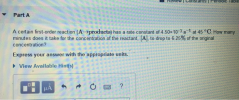 Review Constants Periodic Table Part A A certain first-order reaction ( A products) has a rate constant of 4.50x10⁻³ s at 45 °C. How many minutes does it take for the concentration of the reactant, [A], to drop to 6.25% of the original concentration? Express your answer with the appropriate units. View Available Hint(s) " HÅR O a ?
1. Provides answers for the following reaction schemes (IE multiple products are possible, please identify Kinetic...
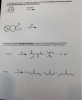 1. Provides answers for the following reaction schemes (IE multiple products are possible, please identify Kinetic and Thermodynamic): HO/Acid 2. Assign a plausible chemical structure for each of the following Molecular Formulas (Your answer should fit the given chemical and physical properties of each formula): come se foto. cooter "sxodstodondo
those I choose is wrong please help Amides are formed from the reaction of carboxylic acids...
 those I choose is wrong please help
Amides are formed from the reaction of carboxylic acids with 1° amines carboxylic acids with 2 amines carboxylic acids with 3 amines Only A and B All of the above What are the hydrolysis products of N-methylpropanamide? propanoic acid and methylamine propanoic acid, methylamine, and water propanoic acid and ammonia
those I choose is wrong please help
Amides are formed from the reaction of carboxylic acids with 1° amines carboxylic acids with 2 amines carboxylic acids with 3 amines Only A and B All of the above What are the hydrolysis products of N-methylpropanamide? propanoic acid and methylamine propanoic acid, methylamine, and water propanoic acid and ammonia
Halohydrins form when an alkene is treated with a halogen molecule in water instead of carbon tetrachloride. Understanding the mechanism will help you select the right stereo- and regiochemical outcomes. Select the correct products for the following react
 Halohydrins form when an alkene is treated with a halogen molecule in water instead of carbon tetrachloride. Understanding the mechanism will help you select the right stereo- and regiochemical outcomes. Select the correct products for the following reaction:19.2 (2).png19.2 (1).png19.2 (3).png19.2 (4).png19.2 (5).png
2. Write in all the product(s) of these reactions. Label products as "major" or "minor" if...
 2. Write in all the product(s) of these reactions. Label products as "major" or "minor" if relevant. If there is no reaction, write "N.R. H2SO4, heat CrO 3. Name this ether correctly. CH3とHCH3 4. Show the best way to make the ether in Prob. #3, using a Williamson Ether Synthesis, starting from an alcohol/phenol
1) Write the products for the following reaction H' CH,COOH+ CH CH,OH 2) Find the number...
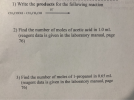 1) Write the products for the following reaction H' CH,COOH+ CH CH,OH 2) Find the number of moles of acetic acid in 1.0 mL (reagent data is given in the laboratory manual, page 76) 3) Find the number of moles of 1-propanol in 0.65 mL (reagent data is given in the laboratory manual, page 76)
 please explain
Practice Problem 07.70a Draw the mechanism for the following reaction: Practice Problem 07.70a1 Get help answering Molecular Drawing questions. Draw step 1 of the mechanism (include lone pairs in your answer and don't explicitly draw hydrogen atoms in the products for this step of mechanism): I - O CH; HoH + H2O : Edit
please explain
Practice Problem 07.70a Draw the mechanism for the following reaction: Practice Problem 07.70a1 Get help answering Molecular Drawing questions. Draw step 1 of the mechanism (include lone pairs in your answer and don't explicitly draw hydrogen atoms in the products for this step of mechanism): I - O CH; HoH + H2O : Edit
 for D,E,F find the major products
EN d. xs LAH PP f. Ph 5. (10 pts) Draw the complete stepwise mechanism for the formation of the ylide from the first 2 steps, then draw the complete stepwise mechanism for the Wittig reaction. Must draw all intermediates for full credit. PPhy, nBuli
for D,E,F find the major products
EN d. xs LAH PP f. Ph 5. (10 pts) Draw the complete stepwise mechanism for the formation of the ylide from the first 2 steps, then draw the complete stepwise mechanism for the Wittig reaction. Must draw all intermediates for full credit. PPhy, nBuli
 1 2 3 $ 4 % 5 & 7 ob Q W E R T Y page 11 8 9. Show all possible products (major and minor) for the reactions below. Specify if the reaction is stereospecific. NaOH CH₃ ? Br CH3-CH2-ONa Ph.. Br Base (KOH) OH CHE! H30*
 Please explain with mechanism I'm so confused what mechanism I
should have to use.
Part III - Mechanism (14 marks] A. Use the curved arrow notation to draw the step-wise reaction mechanisms that account for the formation of the products shown in the transformation below. All reactants are shown. (8 MARKS] MeOH осна + -TsOH
Please explain with mechanism I'm so confused what mechanism I
should have to use.
Part III - Mechanism (14 marks] A. Use the curved arrow notation to draw the step-wise reaction mechanisms that account for the formation of the products shown in the transformation below. All reactants are shown. (8 MARKS] MeOH осна + -TsOH
 Review Constants Periodic Table Part A A certain first-order reaction ( A products) has a rate constant of 4.50x10⁻³ s at 45 °C. How many minutes does it take for the concentration of the reactant, [A], to drop to 6.25% of the original concentration? Express your answer with the appropriate units. View Available Hint(s) " HÅR O a ?
 1. Provides answers for the following reaction schemes (IE multiple products are possible, please identify Kinetic and Thermodynamic): HO/Acid 2. Assign a plausible chemical structure for each of the following Molecular Formulas (Your answer should fit the given chemical and physical properties of each formula): come se foto. cooter "sxodstodondo
 those I choose is wrong please help
Amides are formed from the reaction of carboxylic acids with 1° amines carboxylic acids with 2 amines carboxylic acids with 3 amines Only A and B All of the above What are the hydrolysis products of N-methylpropanamide? propanoic acid and methylamine propanoic acid, methylamine, and water propanoic acid and ammonia
those I choose is wrong please help
Amides are formed from the reaction of carboxylic acids with 1° amines carboxylic acids with 2 amines carboxylic acids with 3 amines Only A and B All of the above What are the hydrolysis products of N-methylpropanamide? propanoic acid and methylamine propanoic acid, methylamine, and water propanoic acid and ammonia
 2. Write in all the product(s) of these reactions. Label products as "major" or "minor" if relevant. If there is no reaction, write "N.R. H2SO4, heat CrO 3. Name this ether correctly. CH3とHCH3 4. Show the best way to make the ether in Prob. #3, using a Williamson Ether Synthesis, starting from an alcohol/phenol
 1) Write the products for the following reaction H' CH,COOH+ CH CH,OH 2) Find the number of moles of acetic acid in 1.0 mL (reagent data is given in the laboratory manual, page 76) 3) Find the number of moles of 1-propanol in 0.65 mL (reagent data is given in the laboratory manual, page 76)
Most questions answered within 3 hours.