4. An monoprotic acid was isolated from an organic chemistry reaction. Titration of a sample of pure acid (1.2131 g...
 4. An monoprotic acid was isolated from an organic chemistry reaction. Titration of a sample of pure acid (1.2131 g) with NaOH (0.0944 M) to a phenolphthalein endpoint required 41.21 mL of base. What is the molecular weight of the unknown acid?
LS 197 Homework Set 8: Name: 4) Draw the enantiomer of the following molecules: 5) Draw...
 LS 197 Homework Set 8: Name: 4) Draw the enantiomer of the following molecules: 5) Draw the enantiomer and a diastereomer of the following molecule: OOH 오인 OH HOT оно L-tartaric acid 6) Predict the products of the following reactions and identify the type of reaction: OH HO HCI Catalyst ZI Sucrose CH OH O 0 CH,OH Sucrase enzyme catalyst...
Provide an explanation (with drawings) why the reaction on the below yields the Hofmann product exclusively...
 Provide an explanation (with drawings) why the reaction on the below yields the Hofmann product exclusively (no Zaitsev product at all) even though the base is not sterically hindered (bulky). Br NaOET in ELOH Predict the possible products of the following reactions and identify which product(s) will be the major product(s). You will need to evaluate to what extent substitution...
Question 27 (2 points) Predict the reactants for the following Diels-Alder product: OB 0: ES ot...
 Question 27 (2 points) Predict the reactants for the following Diels-Alder product: OB 0: ES ot O a) IV Ob) 11 Oc) d) III Question 28 (2 points) What are the expected major products of the reaction sequence shown below? 1. O3 2. H2O OH & O O=C=0 OH 11 IV V - a) I and IV Ob) II, III...
Any reaction involving a carbonyl group and a strong acid begins with the same first step,...
Any reaction involving a carbonyl group and a strong acid begins with the same first step, which is __________________ of the carbonyl oxygen. Using condensed molecular formulas (C#H#X#Y#) for your answers, predict the products of the reactions of C6H5CH2CHO (phenylacetaldehyde) with these reagents, and identify the functional group produced in the product. Note that the Tx symbol above allows you...
Predict products (name and formulas) and write... I LThes and formulas) and write balanced molecular and...
 Predict products (name and formulas) and write...
I LThes and formulas) and write balanced molecular and net ion the following double displacement reactions. "No Reaction" is an option... a. Aqueous ammonium carbonate+ aqueous iro ie cquations ns (including states) for n(II) chloride> b. Aqueous potassium sulfate + aqueous magnesium bromide- c. Aqueous sulfuric acid+ aqueous lithium hydroxide->
Predict products (name and formulas) and write...
I LThes and formulas) and write balanced molecular and net ion the following double displacement reactions. "No Reaction" is an option... a. Aqueous ammonium carbonate+ aqueous iro ie cquations ns (including states) for n(II) chloride> b. Aqueous potassium sulfate + aqueous magnesium bromide- c. Aqueous sulfuric acid+ aqueous lithium hydroxide->
Predict the major product of each of the following reaction sequences. 2. Predict the major product...
 Predict the major product of each of the following reaction
sequences.
2. Predict the major product of each of the following reaction sequences. [4 points each a) c) 1. H2CrO4 2. Fe, HCI b) HI d) NO2
Predict the major product of each of the following reaction
sequences.
2. Predict the major product of each of the following reaction sequences. [4 points each a) c) 1. H2CrO4 2. Fe, HCI b) HI d) NO2
Predict the major product of the following reaction (Diels-Alder): Predict the major product of the following reacti...
 Predict the major product of the following reaction
(Diels-Alder):
Predict the major product of the following reaction: Draw the molecule on the canvas by choosing buttons from the Tools (for bonds), Atoms, and Advanced Template toolbars. The single bond is active by default.
Predict the major product of the following reaction
(Diels-Alder):
Predict the major product of the following reaction: Draw the molecule on the canvas by choosing buttons from the Tools (for bonds), Atoms, and Advanced Template toolbars. The single bond is active by default.
Predict the major product for the following reaction sequences Klein, Organic Chemistry, 2e Assignment Gradebook ORION...
 Predict the major product for the following reaction sequences
Klein, Organic Chemistry, 2e Assignment Gradebook ORION Downloadable eTextbook Testbank, Question 039 Predict the major product for the following reaction sequence. OH Edit LINK TO TEXT
Predict the major product for the following reaction sequences
Klein, Organic Chemistry, 2e Assignment Gradebook ORION Downloadable eTextbook Testbank, Question 039 Predict the major product for the following reaction sequence. OH Edit LINK TO TEXT
Question 3 As discussed in class, the initial step of Edman degradation involves a reaction between...
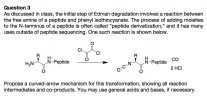 Question 3 As discussed in class, the initial step of Edman degradation involves a reaction between the free amine of a peptide and phenyl isothiocyanate. The process of adding moieties to the N-terminus of a peptide is often called "peptide derivatization," and it has many uses outside of peptide sequencing. One such reaction is shown below. CI Cl H2N N-Peptide...
 4. An monoprotic acid was isolated from an organic chemistry reaction. Titration of a sample of pure acid (1.2131 g) with NaOH (0.0944 M) to a phenolphthalein endpoint required 41.21 mL of base. What is the molecular weight of the unknown acid?
 LS 197 Homework Set 8: Name: 4) Draw the enantiomer of the following molecules: 5) Draw the enantiomer and a diastereomer of the following molecule: OOH 오인 OH HOT оно L-tartaric acid 6) Predict the products of the following reactions and identify the type of reaction: OH HO HCI Catalyst ZI Sucrose CH OH O 0 CH,OH Sucrase enzyme catalyst...
 Provide an explanation (with drawings) why the reaction on the below yields the Hofmann product exclusively (no Zaitsev product at all) even though the base is not sterically hindered (bulky). Br NaOET in ELOH Predict the possible products of the following reactions and identify which product(s) will be the major product(s). You will need to evaluate to what extent substitution...
 Question 27 (2 points) Predict the reactants for the following Diels-Alder product: OB 0: ES ot O a) IV Ob) 11 Oc) d) III Question 28 (2 points) What are the expected major products of the reaction sequence shown below? 1. O3 2. H2O OH & O O=C=0 OH 11 IV V - a) I and IV Ob) II, III...
 Predict products (name and formulas) and write...
I LThes and formulas) and write balanced molecular and net ion the following double displacement reactions. "No Reaction" is an option... a. Aqueous ammonium carbonate+ aqueous iro ie cquations ns (including states) for n(II) chloride> b. Aqueous potassium sulfate + aqueous magnesium bromide- c. Aqueous sulfuric acid+ aqueous lithium hydroxide->
Predict products (name and formulas) and write...
I LThes and formulas) and write balanced molecular and net ion the following double displacement reactions. "No Reaction" is an option... a. Aqueous ammonium carbonate+ aqueous iro ie cquations ns (including states) for n(II) chloride> b. Aqueous potassium sulfate + aqueous magnesium bromide- c. Aqueous sulfuric acid+ aqueous lithium hydroxide->
 Predict the major product of each of the following reaction
sequences.
2. Predict the major product of each of the following reaction sequences. [4 points each a) c) 1. H2CrO4 2. Fe, HCI b) HI d) NO2
Predict the major product of each of the following reaction
sequences.
2. Predict the major product of each of the following reaction sequences. [4 points each a) c) 1. H2CrO4 2. Fe, HCI b) HI d) NO2
 Predict the major product of the following reaction
(Diels-Alder):
Predict the major product of the following reaction: Draw the molecule on the canvas by choosing buttons from the Tools (for bonds), Atoms, and Advanced Template toolbars. The single bond is active by default.
Predict the major product of the following reaction
(Diels-Alder):
Predict the major product of the following reaction: Draw the molecule on the canvas by choosing buttons from the Tools (for bonds), Atoms, and Advanced Template toolbars. The single bond is active by default.
 Predict the major product for the following reaction sequences
Klein, Organic Chemistry, 2e Assignment Gradebook ORION Downloadable eTextbook Testbank, Question 039 Predict the major product for the following reaction sequence. OH Edit LINK TO TEXT
Predict the major product for the following reaction sequences
Klein, Organic Chemistry, 2e Assignment Gradebook ORION Downloadable eTextbook Testbank, Question 039 Predict the major product for the following reaction sequence. OH Edit LINK TO TEXT
 Question 3 As discussed in class, the initial step of Edman degradation involves a reaction between the free amine of a peptide and phenyl isothiocyanate. The process of adding moieties to the N-terminus of a peptide is often called "peptide derivatization," and it has many uses outside of peptide sequencing. One such reaction is shown below. CI Cl H2N N-Peptide...
Most questions answered within 3 hours.