A point charge of 3 PC is located at x = -3.0 cm, and a second...
 A point charge of 3 PC is located at x = -3.0 cm, and a second point charge of -13 C is located at x = +4.0 cm. Where should a third charge of +6.0 PC be placed so that the electric field at x = 0 is zero? x cm
Two point charges Q and +q (where q is positive) produce the net electric field shown at point P in the figure (Figure 1...
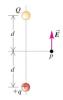 Two point charges Q and +q (where q is positive) produce the net
electric field shown at point P in the figure (Figure 1). The field
points parallel to the line connecting the two charges. What can
you conclude about the magnitude of Q?
Two point charges Q and +q (where q is positive) produce the net
electric field shown at point P in the figure (Figure 1). The field
points parallel to the line connecting the two charges. What can
you conclude about the magnitude of Q?
PRACTICE: Four identical point charges, q, are placed at the corners of a square. Each side...
 PRACTICE: Four identical point charges, q, are placed at the corners of a square. Each side of the square has length L. What is the magnitude of the electric field at the point P, the center of the square? A) O B) kq</L2 C) kq7I2L2 D) kq2/4L2
2 2. Two-point charges qi and g2 of equal magnitude (each of 5.0uC) are separated by...
 2 2. Two-point charges qi and g2 of equal magnitude (each of 5.0uC) are separated by a distance of 60.0cm in vacuum. Calculate the magnitude and direction of the electric field at point P which lies at the perpendicular bisector of distance between qi and q2 q1 60.0cm
A charge of Q = -2.0 nC is positioned at the point (0, 10) cm along...
A charge of Q = -2.0 nC is positioned at the point (0, 10) cm along the y-axis, and another charge of q = 1.0 nC is positioned at the point (0, 5) cm. Find the position along the positive x-axis where the electric potential is a minimum.
Two wires with currents of 6.00A (to the right) and 2.00A (to the left) are running in opposite d...
Two wires with currents of 6.00A (to the right) and 2.00A (to the left) are running in opposite directions. The wires are separated by 1.00cm. Point A is halfway between them and point B is 5.00mm below the bottom wire. a) find the strength and direction of magnitude of the magnetic field at point A and B. b) An electron...
Two wires with currents of 6.00A (to the right) and 2.00A (to the left) are running...
Two wires with currents of 6.00A (to the right) and 2.00A (to the left) are running in opposite directions. The wires are separated by 1.00cm. Point A is halfway between them and point B is 5.00mm below the bottom wire. a) find the strength and direction of magnitude of the magnetic field at point A and B. b) An electron...
MI.2. A dipole is placed such that its center is a distance I from the surface...
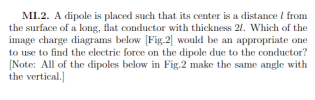 MI.2. A dipole is placed such that its center is a distance I from the surface of a long, flat conductor with thickness 21. Which of the mage charge diagrams belowF1g.2would be an appropriate one to use to find the electric force on the dipole due to the conductor? Note: All of the dipoles below in Fig.2 make the same...
Figure 23-31 shows a closed Gaussian surface in the shape of a cube of edge length...
 Figure 23-31 shows a closed Gaussian surface in the shape of a
cube of edge length 2.5 m, with one corner at x1 = 5.0 m,y1 = 3.7
m. The cube lies in a region where the electric field vector is
given by = -3.4 -4.4 y2 +2.8 N/C, with y in meters. What is the net
charge (in Coulombs)...
Figure 23-31 shows a closed Gaussian surface in the shape of a
cube of edge length 2.5 m, with one corner at x1 = 5.0 m,y1 = 3.7
m. The cube lies in a region where the electric field vector is
given by = -3.4 -4.4 y2 +2.8 N/C, with y in meters. What is the net
charge (in Coulombs)...
 A point charge of 3 PC is located at x = -3.0 cm, and a second point charge of -13 C is located at x = +4.0 cm. Where should a third charge of +6.0 PC be placed so that the electric field at x = 0 is zero? x cm
 PRACTICE: Four identical point charges, q, are placed at the corners of a square. Each side of the square has length L. What is the magnitude of the electric field at the point P, the center of the square? A) O B) kq</L2 C) kq7I2L2 D) kq2/4L2
 2 2. Two-point charges qi and g2 of equal magnitude (each of 5.0uC) are separated by a distance of 60.0cm in vacuum. Calculate the magnitude and direction of the electric field at point P which lies at the perpendicular bisector of distance between qi and q2 q1 60.0cm
 MI.2. A dipole is placed such that its center is a distance I from the surface of a long, flat conductor with thickness 21. Which of the mage charge diagrams belowF1g.2would be an appropriate one to use to find the electric force on the dipole due to the conductor? Note: All of the dipoles below in Fig.2 make the same...
 Figure 23-31 shows a closed Gaussian surface in the shape of a
cube of edge length 2.5 m, with one corner at x1 = 5.0 m,y1 = 3.7
m. The cube lies in a region where the electric field vector is
given by = -3.4 -4.4 y2 +2.8 N/C, with y in meters. What is the net
charge (in Coulombs)...
Figure 23-31 shows a closed Gaussian surface in the shape of a
cube of edge length 2.5 m, with one corner at x1 = 5.0 m,y1 = 3.7
m. The cube lies in a region where the electric field vector is
given by = -3.4 -4.4 y2 +2.8 N/C, with y in meters. What is the net
charge (in Coulombs)...
Most questions answered within 3 hours.