1. (8 marks) Predict the MAJOR product from the following reaction and draw a clear step-by-step...
 1. (8 marks) Predict the MAJOR product from the following
reaction and draw a clear step-by-step mechanism for the reaction.
Also, briefly explain why this is the major product that is
formed.
(8 marks) Predict the MAJOR product from the following reaction and draw a clear step- by-step mechanism for the reaction. Also, briefly explain why this is the major...
1. (8 marks) Predict the MAJOR product from the following
reaction and draw a clear step-by-step mechanism for the reaction.
Also, briefly explain why this is the major product that is
formed.
(8 marks) Predict the MAJOR product from the following reaction and draw a clear step- by-step mechanism for the reaction. Also, briefly explain why this is the major...
Predict the product for the following reactions. 3. Predict the products for the following reactions. (10...
 Predict the product for the following reactions.
3. Predict the products for the following reactions. (10 points) | | | EtOH MOON NaOH 2 c.worz ons gaidaug v a n wolltort NaOCH3 NH3 (2 eq.) CH3 H2O
Predict the product for the following reactions.
3. Predict the products for the following reactions. (10 points) | | | EtOH MOON NaOH 2 c.worz ons gaidaug v a n wolltort NaOCH3 NH3 (2 eq.) CH3 H2O
Hello! Can someone help me answer this please? 1. Answer the following questions about chromosomal and...
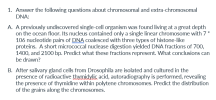 Hello! Can someone help me answer this please?
1. Answer the following questions about chromosomal and extra-chromosomal DNA: A. A previously undiscovered single-cell organism was found living at a great depth on the ocean floor. Its nucleus contained only a single linear chromosome with 7* 106 nucleotide pairs of DNA coalesced with three types of histone-like proteins. A short micrococcal...
Hello! Can someone help me answer this please?
1. Answer the following questions about chromosomal and extra-chromosomal DNA: A. A previously undiscovered single-cell organism was found living at a great depth on the ocean floor. Its nucleus contained only a single linear chromosome with 7* 106 nucleotide pairs of DNA coalesced with three types of histone-like proteins. A short micrococcal...
please answer all parts, thanks! 1. More substituted alkenes are more stable than less substituted alkenes....
 please answer all parts, thanks!
1. More substituted alkenes are more stable than less substituted alkenes. Show the orbital overlap that helps to explain this observation. 2. Why is the heat of hydrogenation for an alkene exothermic? Analyze the bonds that are changing. AH = -30 kcal/mol Explain: + H2 3. Treating alkene "A" below with HBr can lead to...
please answer all parts, thanks!
1. More substituted alkenes are more stable than less substituted alkenes. Show the orbital overlap that helps to explain this observation. 2. Why is the heat of hydrogenation for an alkene exothermic? Analyze the bonds that are changing. AH = -30 kcal/mol Explain: + H2 3. Treating alkene "A" below with HBr can lead to...
For a first-order reaction, the half-life is constant. It depends only on the rate constant k...
For a first-order reaction, the half-life is constant. It depends only on the rate constant k and not on the reactant concentration. It is expressed as t1/2=0.693kt1/2=0.693k For a second-order reaction, the half-life depends on the rate constant and the concentration of the reactant and so is expressed as t1/2=1k[A]0 Part A. A certain first-order reaction (A→products) has a rate...
Draw the mechanism arrows for the formation of the two products in the following E1 reactions....
 Draw the mechanism arrows for the formation of the two products in the following E1 reactions. Predict the major and minor product using the Zaitsev rule. (Note that S_N1 products are also formed in these reactions.)
1. Predict the major organic products formed in the following reactions. Be certain to indicate stereochemistry...
 1. Predict the major organic products formed in the following reactions. Be certain to indicate stereochemistry in your products if it is important. (12 pts) Pd/C u o H2O H2SO4
Two isolated conducting spheres are separated by a large distance. Sphere 1 has a radius of...
Two isolated conducting spheres are separated by a large distance. Sphere 1 has a radius of 20 cm and an initial charge 30 nC while Sphere 2 has a radius of 60 cm and an initial charge 70 nC. A very thin copper wire is now connected to the spheres to allow charge to flow between them. How much charge...
Question 1: Draw the expected major product for the following reactions: НІ HC CH CH₂ HBO...
 Question 1: Draw the expected major product for the following reactions: НІ HC CH CH₂ HBO ROOR Question 2: Draw a mechanism for the following transformations: a) H₃C CH3 HCI H₂C T CH3 HAC CH3 нс с Question 3: Draw the mechanism for the following transformations: нс сH3 CH3 о (H,SO4), он H₂C7 Question 4 HĄCE 1) Hg(OAC), H, 2)...
Part A In the acid-base mechanism, the base is a proton acceptor, and the acid is...
 Part A In the acid-base mechanism, the base is a proton acceptor, and the acid is the proton donor. An acid-base reaction is visualized as the reaction in which proton transfer takes place. However, in a nucleophilic substitution reaction, the nucleophile attacks a substrate (usually an electrophile), and the leaving group is removed from the substrate as a weaker nucleophile....
 1. (8 marks) Predict the MAJOR product from the following
reaction and draw a clear step-by-step mechanism for the reaction.
Also, briefly explain why this is the major product that is
formed.
(8 marks) Predict the MAJOR product from the following reaction and draw a clear step- by-step mechanism for the reaction. Also, briefly explain why this is the major...
1. (8 marks) Predict the MAJOR product from the following
reaction and draw a clear step-by-step mechanism for the reaction.
Also, briefly explain why this is the major product that is
formed.
(8 marks) Predict the MAJOR product from the following reaction and draw a clear step- by-step mechanism for the reaction. Also, briefly explain why this is the major...
 Predict the product for the following reactions.
3. Predict the products for the following reactions. (10 points) | | | EtOH MOON NaOH 2 c.worz ons gaidaug v a n wolltort NaOCH3 NH3 (2 eq.) CH3 H2O
Predict the product for the following reactions.
3. Predict the products for the following reactions. (10 points) | | | EtOH MOON NaOH 2 c.worz ons gaidaug v a n wolltort NaOCH3 NH3 (2 eq.) CH3 H2O
 Hello! Can someone help me answer this please?
1. Answer the following questions about chromosomal and extra-chromosomal DNA: A. A previously undiscovered single-cell organism was found living at a great depth on the ocean floor. Its nucleus contained only a single linear chromosome with 7* 106 nucleotide pairs of DNA coalesced with three types of histone-like proteins. A short micrococcal...
Hello! Can someone help me answer this please?
1. Answer the following questions about chromosomal and extra-chromosomal DNA: A. A previously undiscovered single-cell organism was found living at a great depth on the ocean floor. Its nucleus contained only a single linear chromosome with 7* 106 nucleotide pairs of DNA coalesced with three types of histone-like proteins. A short micrococcal...
 please answer all parts, thanks!
1. More substituted alkenes are more stable than less substituted alkenes. Show the orbital overlap that helps to explain this observation. 2. Why is the heat of hydrogenation for an alkene exothermic? Analyze the bonds that are changing. AH = -30 kcal/mol Explain: + H2 3. Treating alkene "A" below with HBr can lead to...
please answer all parts, thanks!
1. More substituted alkenes are more stable than less substituted alkenes. Show the orbital overlap that helps to explain this observation. 2. Why is the heat of hydrogenation for an alkene exothermic? Analyze the bonds that are changing. AH = -30 kcal/mol Explain: + H2 3. Treating alkene "A" below with HBr can lead to...
 Draw the mechanism arrows for the formation of the two products in the following E1 reactions. Predict the major and minor product using the Zaitsev rule. (Note that S_N1 products are also formed in these reactions.)
 1. Predict the major organic products formed in the following reactions. Be certain to indicate stereochemistry in your products if it is important. (12 pts) Pd/C u o H2O H2SO4
 Question 1: Draw the expected major product for the following reactions: НІ HC CH CH₂ HBO ROOR Question 2: Draw a mechanism for the following transformations: a) H₃C CH3 HCI H₂C T CH3 HAC CH3 нс с Question 3: Draw the mechanism for the following transformations: нс сH3 CH3 о (H,SO4), он H₂C7 Question 4 HĄCE 1) Hg(OAC), H, 2)...
 Part A In the acid-base mechanism, the base is a proton acceptor, and the acid is the proton donor. An acid-base reaction is visualized as the reaction in which proton transfer takes place. However, in a nucleophilic substitution reaction, the nucleophile attacks a substrate (usually an electrophile), and the leaving group is removed from the substrate as a weaker nucleophile....
Most questions answered within 3 hours.