Quiz 5 PVC (polyvinylichloride) is a great polymer material which can be synthetically made and is...
 Quiz 5 PVC (polyvinylichloride) is a great polymer material which can be synthetically made and is involved in numerous household items. It is made with the radical reaction of vinyl chloride (sbleroethene. Give a simplified radical reaction mechanism (nitiation, propagation, termination steps) for this substance. Use hydrogen peroxide as your radical initiator and for your propagation, limit it to at...
1) Hypochlorite ion, used as a chlorinating agent in swimming pools, can decompose exothermically, in rare occasion...
 1) Hypochlorite ion, used as a chlorinating agent in swimming pools, can decompose exothermically, in rare occasions even causing fires. The principal decomposition mechanism in aqueous solution is believed to be 2 OCl (aq) + CO2 (aq) + Cl(aq) ki, k-1 OCl(aq) + ClO2 (aq) → ClO3(aq) + Cl(aq) kz a) (3pts) What is the net overall reaction? b) (4pts)...
10. The following substrate reacts differently with each set of conditions. For each reaction give ALL...
 10. The following substrate reacts differently with each set of conditions. For each reaction give ALL of the products, the mechanism (SN 1, SN2, E1 or E2), and the rate law. You may abbreviate the alkyl halide as R-Br in your rate law. (12) Draw reaction product(s) Mechanism Rate Law NaSH acetone 11. The following compound is shown with no...
For part f iii) you should include a diagram for each step of the mechanism and...
 For part f iii) you should include a diagram for each step of
the mechanism and an explanation as this is your opportunity to
demonstrate your understanding.
e) One of the products gives a silver mirror when warmed with Tollen's reagent. State the identity of this product and state the functional group it contains. f) 2-methylpropan-1-ol is heated with...
For part f iii) you should include a diagram for each step of
the mechanism and an explanation as this is your opportunity to
demonstrate your understanding.
e) One of the products gives a silver mirror when warmed with Tollen's reagent. State the identity of this product and state the functional group it contains. f) 2-methylpropan-1-ol is heated with...
5. The equilibrium constants for the following reactions are known 2NO(g) N(g)+ O(g) Ki-2.4x 100 2NO(g)+...
 5. The equilibrium constants for the following reactions are known 2NO(g) N(g)+ O(g) Ki-2.4x 100 2NO(g)+ O:(g) in 2NO:(g) K2=2.4 102 a) Sum these reactions to obtain the reaction. (10p) N2(g)+20(g) 2NO (g) b) Use the equilibrium constants of the first two reactions to determine the equilibrium. constant for the last reaction. (10p) oitei mundil Some Formulas K,-Peosbesto P(reactants) K=...
3) Is the plot of nucleophile concentration vs. the rate of reaction (see below) a plot...
 3) Is the plot of nucleophile concentration vs. the rate of reaction (see below) a plot of a Syl or S2 reaction? Please provide an explanation for your choice. (2 points) Kaved (s) 0.0 + 0.0 0.2 0.4 0.8 1.0 1.2 0.6 [Nuc-] (Molar) 4) What is the structure of the compound with the molecular formula C10H 202? (3 points)...
As noted on page 8 of the Unit 4 lecture notes deuterium (D) and tritium (T)...
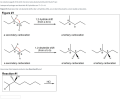 As noted on page 8 of the Unit 4 lecture notes deuterium (D) and tritium (T) are isotopes of hydrogen and that their R/S priorities are T D> H. Figure #1 illustrates that 1,2-deuteride shifts, like 1,2-hydride shifts, occur when they lead to a more stable carbocation Figure #1 1,2-hydride shift (from a to b) a a H a tertiary...
3. You eat a bowl of oatmeal and run on a treadmill. (4.5 pt) a. How...
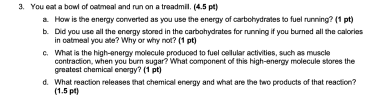 3. You eat a bowl of oatmeal and run on a treadmill. (4.5 pt) a. How is the energy converted as you use the energy of carbohydrates to fuel running? (1 pt) b. Did you use all the energy stored in the carbohydrates for running if you burned all the calories in oatmeal you ate? Why or why not? (1...
Dinitrogen oxide, commonly called laughing gas, is sometimes used as an anesthetic in dentistry. It is...
Dinitrogen oxide, commonly called laughing gas, is sometimes used as an anesthetic in dentistry. It is produced by the decomposition of ammonium nitrate. The other product of this reaction is water. A balanced equation indicates the mole ratios of reactants and products. The molar mass of a substance allows you to convert between moles and mass. ______________________________________________________________________________ Write the balanced...
Consider the degradation of glucose to pyruvate by the glycolytic pathway: glucose+2ADP+2Pi+2NAD+→2pyruvate+2ATP+2H2O+2NADH+2H+ Part A Calculate ΔG...
Consider the degradation of glucose to pyruvate by the glycolytic pathway: glucose+2ADP+2Pi+2NAD+→2pyruvate+2ATP+2H2O+2NADH+2H+ Part A Calculate ΔG for this reaction at pH=7.4 and 37 ∘C when the reactants and products are at the concentrations given below. ATP=4.00mM Pi=5.90mM ADP=220μM glucose=5.10 mM pyruvate=64.0 μM NAD+=350μM NADH=14.5μM CO2=15.0torr half reaction E∘′(V) NAD++H++2e− ⟶ NADH −0.315 2pyruvate+6H++4e− ⟶ glucose −0.590 pyruvate+NADH+2H+ ⟶ ethanol+NAD++CO2 ΔG∘′=−64.4kJ/mol...
 Quiz 5 PVC (polyvinylichloride) is a great polymer material which can be synthetically made and is involved in numerous household items. It is made with the radical reaction of vinyl chloride (sbleroethene. Give a simplified radical reaction mechanism (nitiation, propagation, termination steps) for this substance. Use hydrogen peroxide as your radical initiator and for your propagation, limit it to at...
 1) Hypochlorite ion, used as a chlorinating agent in swimming pools, can decompose exothermically, in rare occasions even causing fires. The principal decomposition mechanism in aqueous solution is believed to be 2 OCl (aq) + CO2 (aq) + Cl(aq) ki, k-1 OCl(aq) + ClO2 (aq) → ClO3(aq) + Cl(aq) kz a) (3pts) What is the net overall reaction? b) (4pts)...
 10. The following substrate reacts differently with each set of conditions. For each reaction give ALL of the products, the mechanism (SN 1, SN2, E1 or E2), and the rate law. You may abbreviate the alkyl halide as R-Br in your rate law. (12) Draw reaction product(s) Mechanism Rate Law NaSH acetone 11. The following compound is shown with no...
 For part f iii) you should include a diagram for each step of
the mechanism and an explanation as this is your opportunity to
demonstrate your understanding.
e) One of the products gives a silver mirror when warmed with Tollen's reagent. State the identity of this product and state the functional group it contains. f) 2-methylpropan-1-ol is heated with...
For part f iii) you should include a diagram for each step of
the mechanism and an explanation as this is your opportunity to
demonstrate your understanding.
e) One of the products gives a silver mirror when warmed with Tollen's reagent. State the identity of this product and state the functional group it contains. f) 2-methylpropan-1-ol is heated with...
 5. The equilibrium constants for the following reactions are known 2NO(g) N(g)+ O(g) Ki-2.4x 100 2NO(g)+ O:(g) in 2NO:(g) K2=2.4 102 a) Sum these reactions to obtain the reaction. (10p) N2(g)+20(g) 2NO (g) b) Use the equilibrium constants of the first two reactions to determine the equilibrium. constant for the last reaction. (10p) oitei mundil Some Formulas K,-Peosbesto P(reactants) K=...
 3) Is the plot of nucleophile concentration vs. the rate of reaction (see below) a plot of a Syl or S2 reaction? Please provide an explanation for your choice. (2 points) Kaved (s) 0.0 + 0.0 0.2 0.4 0.8 1.0 1.2 0.6 [Nuc-] (Molar) 4) What is the structure of the compound with the molecular formula C10H 202? (3 points)...
 As noted on page 8 of the Unit 4 lecture notes deuterium (D) and tritium (T) are isotopes of hydrogen and that their R/S priorities are T D> H. Figure #1 illustrates that 1,2-deuteride shifts, like 1,2-hydride shifts, occur when they lead to a more stable carbocation Figure #1 1,2-hydride shift (from a to b) a a H a tertiary...
 3. You eat a bowl of oatmeal and run on a treadmill. (4.5 pt) a. How is the energy converted as you use the energy of carbohydrates to fuel running? (1 pt) b. Did you use all the energy stored in the carbohydrates for running if you burned all the calories in oatmeal you ate? Why or why not? (1...
Most questions answered within 3 hours.