(Towers of Hanoi: Iterative Solution)Any program that can be implemented recursively can b...
(Towers of Hanoi: Iterative Solution)Any program that can be implemented recursively can be implemented iteratively, although sometimes with considerably more difficulty and considerably less clarity. Try writing an iterative version of the Towers of Hanoi. If you succeed, compare your iterative version with the recursive version you developed in Exercise. Investigate issues of performance, clarity, and your ability to demonstrate the correctness of the programs.
Exercise
(Towers of Hanoi)Every budding computer scientist must grapple with certain classic problems, and the Towers of Hanoi (see Fig.) is one of the most famous of these. Legend has it that in a temple in the Far East, priests are attempting to move a stack of disks from one peg to another. The initial stack had 64 disks threaded onto one peg and arranged from bottom to top by decreasing size. The priests are attempt ting to move the stack from this peg to a second peg under the constraints that exactly one disk is moved at a time, and at no time may a larger disk be placed
FigureTowers of Hanoi for the case with four disks.
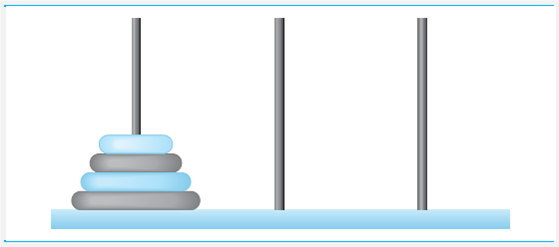
above a smaller disk. A third peg is available for temporarily holding the disks. Supposedly the world will end when the priests complete their task, so there’s little incentive for us to facilitate their efforts.
Let’s assume that the priests are attempting to move the disks from peg 1 to peg 3. We wish to develop an algorithm that will print the precise sequence of disk-to-disk peg transfers. If we were to approach this problem with conventional methods, we’d rapidly find ourselves hopelessly knotted up in managing the disks. Instead, if we attack the problem with recursion in mind, it immediately becomes tractable. Moving n disks can be viewed in terms of moving only n – 1 disks (and hence the recursion) as follows:
a) Move n – 1 disks from peg 1 to peg 2, using peg 3 as a temporary holding area.
b) Move the last disk (the largest) from peg 1 to peg 3.
c) Move the n – 1 disks from peg 2 to peg 3, using peg 1 as a temporary holding area.
The process ends when the last task involves moving n = 1 disk, i.e., the base case. This is accomplished by trivially moving the disk without the need for a temporary holding area. Write a program to solve the Towers of Hanoi problem. Use a recursive function with four parameters:
a) The number of disks to be moved
b) The peg on which these disks are initially threaded
c) The peg to which this stack of disks is to be moved
d) The peg to be used as a temporary holding area
Your program should print the precise instructions it will take to move the disks from the starting peg to the destination peg. For example, to move a stack of three disks from peg 1 to peg 3, your program should print the following series of moves:
1 → 3 (This means move one disk from peg 1 to peg 3.)
1 → 2
3 → 2
1 → 3
2 → 1
2 → 3
1 → 3
Step-by-Step Solution
Request Solution!
We need at least 10 more requests to produce the solution.
0 / 10 have requested this problem solution
The more requests, the faster the answer.
Most questions answered within 3 hours.
-
Calculating the space time for parallel reactions. m-Xylene is reacted over a ZSM-5 zeolit...
-
Determine Vo and ID for the networks of Fig. 2.160.FIG. 2.160
-
The truck travels along a circular road that has a radius of 50 m at a speed of 4 m/s. F...
-
A state legislature enacted a statute that required any motorcycle operator or passenger...
-
A 1024 × 1024 8-bit image with 5.3 bits/pixel entropy [computed from its histogram using E...
-
In Problem 3.3, we estimated the equationwhere we now report standard errors along with th...
-
In each of the following cases, deduce the nature of the light that is consistent with the...
-
Solve Example 20.5 such that the x, y, z axes move with curvilinear translation, Ω = 0 in...
-
In Fig. 6.43, if i = cos 4t and v = sin 4t, the element is:(a)a resistor(b) a capacitor(c)...
-
Sketch vo for each network of Fig. 2.181 for the input shown.FIG. 2.181
-
(Supplement B) Computing and Reporting Cash Flow Effectsof Sale of Plant and EquipmentDuri...
-
A 350-mL spherical flask contains 0.075 mol of an ideal gas at a temperature of 293 K. Wha...