An important aspect of differential equations is the dependence of solutions on initial co...
An important aspect of differential equations is the dependence of solutions on initial conditions. There are two points to be made. First, we have a theorem which says that the solutions are continuous with respect to the initial conditions. More precisely,
Theorem. Suppose that the function f(t,x) is defined in the rectangle R defined by a ≤ t ≤b and c ≤ x ≤ d. Suppose also that f and df/dx are both continuous in R, and that
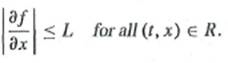
If (t0, x0) and (t0, y0) are both in R, and if
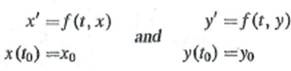
then for t > t0

as long as both solution curves remain in R.
Roughly, the theorem says that if we have initial values that are sufficiently close to each other, the solutions will remain close, at least if we restrict our view to the rectangle R. Since it is easy to make measurement mistakes, and thereby get initial values off by a little, this is reassuring.
For the second point, we notice that although the dependence on the initial condition is continuous, the term allows the solutions to get exponentially far apart as the interval between t and t0 increases. That is, the solutions can still be extremely sensitive to the initial conditions, especially over long t intervals.
Consider the differential equation x′ = x(l − x2).
a) Verify that x(t) = 0 is the solution with initial value x(0) = 0.
b) Use dfield6 to find approximately how close the initial value y0 must be to 0 so that the solution y(t) of our equation with that initial value satisfies y(t) ≤ 0.1 for 0 ≤ t ≤ tf, with tf = 2. You can use the display window 0 ≤ t ≤ 2, and 0 ≤ x ≤ 0.1, and experiment with initial values in the Options→Keyboard input window, until you get close enough. Do not try to be too precise. Two significant figures is sufficient.
c) As the length of the t interval is increased, how close must y0 he to 0 in order to insure the same accuracy? To find out, repeat part b) with tf = 4, 6, 8, and 10.
Step-by-Step Solution
Request Solution!
We need at least 10 more requests to produce the solution.
0 / 10 have requested this problem solution
The more requests, the faster the answer.
Most questions answered within 3 hours.
-
Calculating the space time for parallel reactions. m-Xylene is reacted over a ZSM-5 zeolit...
-
Determine Vo and ID for the networks of Fig. 2.160.FIG. 2.160
-
The truck travels along a circular road that has a radius of 50 m at a speed of 4 m/s. F...
-
A state legislature enacted a statute that required any motorcycle operator or passenger...
-
A 1024 × 1024 8-bit image with 5.3 bits/pixel entropy [computed from its histogram using E...
-
In Problem 3.3, we estimated the equationwhere we now report standard errors along with th...
-
In each of the following cases, deduce the nature of the light that is consistent with the...
-
Solve Example 20.5 such that the x, y, z axes move with curvilinear translation, Ω = 0 in...
-
In Fig. 6.43, if i = cos 4t and v = sin 4t, the element is:(a)a resistor(b) a capacitor(c)...
-
Sketch vo for each network of Fig. 2.181 for the input shown.FIG. 2.181
-
(Supplement B) Computing and Reporting Cash Flow Effectsof Sale of Plant and EquipmentDuri...
-
A 350-mL spherical flask contains 0.075 mol of an ideal gas at a temperature of 293 K. Wha...