Consider a generalization of the inventory model of Examples 12.2 and 12.3 in which there...
Consider a generalization of the inventory model of Examples 12.2 and 12.3 in which there are two new factors. The first of these is the inventory-evaluation interval m, which is the number of months between successive evaluations of the inventory level to determine whether an order will be placed. In the original model m = 1, but consideration is being given to changing m to 2, that is, evaluating only at the beginning of every other month. The second new factor arose since the supplier has introduced an “express” delivery option. Originally, if Z items were ordered, the ordering cost was 32 + 3Z and the delivery lag was uniformly distributed between 0.5 and 1 month. With express delivery, the supplier will cut the delivery time in half (distributed uniformly between 0.25 and 0.5 month) but will charge 48 + 4Z instead. The delivery priority P is thus either “normal” or “express” and is a qualitative factor. In this generalized model, then, there are k = 4 factors whose levels are given in the following coding chart:
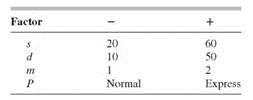
Make n = 10 replications of the 24 factorial design and construct 95 percent confidence intervals for the expected main and interaction effects. Does changing the inventory-evaluation interval, m, have much impact on average cost? (Hint: Look at the two-way interactions.) Is it worth using the express-delivery option?
Example 12.2
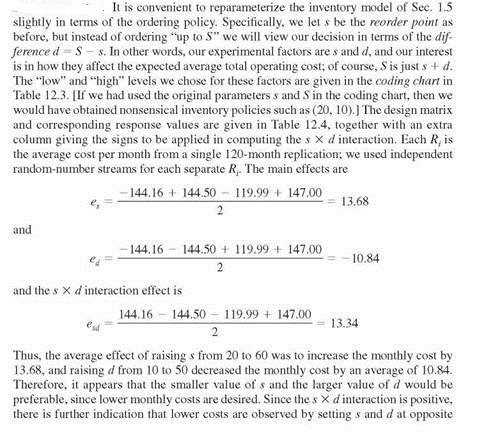
TABLE 12.4 Design matrix and simulation results for the 22 factorial design on s and d for the inventory model
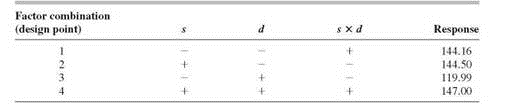


TABLE 12.5 Sample means and variances of the responses for the inventory model
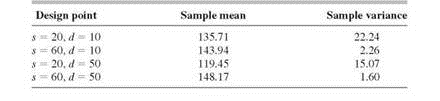
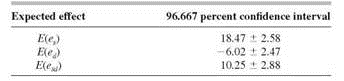
TABLE 12.6 96.667 percent confidence intervals for the expected effects, inventory model
Example 12.3

Step-by-Step Solution
Request Solution!
We need at least 10 more requests to produce the solution.
0 / 10 have requested this problem solution
The more requests, the faster the answer.
Most questions answered within 3 hours.
-
Calculating the space time for parallel reactions. m-Xylene is reacted over a ZSM-5 zeolit...
-
Determine Vo and ID for the networks of Fig. 2.160.FIG. 2.160
-
The truck travels along a circular road that has a radius of 50 m at a speed of 4 m/s. F...
-
A state legislature enacted a statute that required any motorcycle operator or passenger...
-
A 1024 × 1024 8-bit image with 5.3 bits/pixel entropy [computed from its histogram using E...
-
In Problem 3.3, we estimated the equationwhere we now report standard errors along with th...
-
In each of the following cases, deduce the nature of the light that is consistent with the...
-
Solve Example 20.5 such that the x, y, z axes move with curvilinear translation, Ω = 0 in...
-
In Fig. 6.43, if i = cos 4t and v = sin 4t, the element is:(a)a resistor(b) a capacitor(c)...
-
Sketch vo for each network of Fig. 2.181 for the input shown.FIG. 2.181
-
(Supplement B) Computing and Reporting Cash Flow Effectsof Sale of Plant and EquipmentDuri...
-
A 350-mL spherical flask contains 0.075 mol of an ideal gas at a temperature of 293 K. Wha...