In a sound interference experiment, two identical loudspeakers are placed 4.00 m apart, fa...
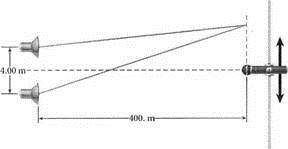
In a sound interference experiment, two identical loudspeakers are placed 4.00 m apart, facing in a direction perpendicular to the line that connects them. A microphone attached to a carrier sliding on a rail picks up the sound from the speakers at a distance of 400. m, as shown in the figure. The two speakers are driven in phase by the same signal generator at a frequency of 3400. Hz. Assume that the speed of sound in air is 340. m/s.
a) At what point(s) on the rail should the microphone be located for the sound reaching it to have maximum intensity?
b) At what point(s) should it be located for the sound reaching it to be zero?
c) What is the separation between two points of maximum intensity?
d) What is the separation between two points of zero intensity?
e) How would things change if the two loudspeakers produced sounds of the same frequency but different intensities?
Step-by-Step Solution
THINK:
We have to find the points of constructive and destructive interference along the rail from the two speakers which are in phase. The distance between the speakers is  and the distance between the speakers and far wall is
 . The frequency of the sound is
  and speed of the sound is
 .
.
SKETCH:

RESEARCH:
From the above sketch, the difference in the paths traveled by the two sound waves is

The condition for constructive interference is given by
 , Where
The condition for the destructive interference at the far wall is,
 , Where
For  , it can be seen that

SIMPLIFY:
(a)
The distance of the points of the maximum intensity is given by

Therefore, 
(b)
The distance of the points of the minimum intensity is given by

Therefore, 
(c)
Separation between the two points of the maximum intensity is given by

(d)
Separation between the two points of the minimum intensity is given by

CALCULATE:
Wavelength of the sound, 

(a)
The points of the maximum intensity on rail are given by

(b)
The points of the maximum intensity on rail are given by

(c)
Separation between two points of maximum intensity is given by

(d)
Separation between two points of minimum intensity is given by

(e)
When two speakers produce sound of different intensities then microphone cannot detect zero intensity. It detects the intensity equal to difference in the intensities from the speakers at the minimum point.
Most questions answered within 3 hours.
-
Calculating the space time for parallel reactions. m-Xylene is reacted over a ZSM-5 zeolit...
-
Determine Vo and ID for the networks of Fig. 2.160.FIG. 2.160
-
The truck travels along a circular road that has a radius of 50 m at a speed of 4 m/s. F...
-
A state legislature enacted a statute that required any motorcycle operator or passenger...
-
A 1024 × 1024 8-bit image with 5.3 bits/pixel entropy [computed from its histogram using E...
-
In Problem 3.3, we estimated the equationwhere we now report standard errors along with th...
-
In each of the following cases, deduce the nature of the light that is consistent with the...
-
Solve Example 20.5 such that the x, y, z axes move with curvilinear translation, Ω = 0 in...
-
In Fig. 6.43, if i = cos 4t and v = sin 4t, the element is:(a)a resistor(b) a capacitor(c)...
-
Sketch vo for each network of Fig. 2.181 for the input shown.FIG. 2.181
-
(Supplement B) Computing and Reporting Cash Flow Effectsof Sale of Plant and EquipmentDuri...
-
A 350-mL spherical flask contains 0.075 mol of an ideal gas at a temperature of 293 K. Wha...