Newton’s Law of Gravity specifies the magnitude of the interaction force between two point...
Newton’s Law of Gravity specifies the magnitude of the interaction force between two point masses, m1 and m2, separated by a distance r as F(r) = Gm1m2/r2. The gravitational constant G can be determined by directly measuring the interaction force (gravitational attraction) between two sets of spheres by using the apparatus constructed in the late 18th century by the English scientist Henry Cavendish. This apparatus was a torsion balance consisting of a 6.00-fl wooden rod suspended from a torsion wire, with a lead sphere having a diameter of 2.00 in and a weight of 1.61 lb attached to each end. Two 12.0-in, 348-lb lead balls were located near the smaller balls, about 9.00 in away, and held in place with a separate suspension system. Today’s accepted value for G is 6.674⋅ 10−11m3kg−ls−2. Determine the force of attraction between the larger and smaller balls that had to be measured by this balance. Compare this force to the weight of the small balls.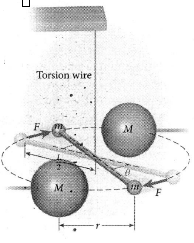
Step-by-Step Solution
THINK:
The force due to gravity between the large and small balls can be found by using Newton’s law of gravity
SKETCH:
The following diagram gravitational interaction between two planets

RESEARCH:
The force that is measured ball 
The weight of the small ball is 
SIMPLIFY:
The ratio of force of attraction between the larger and smaller balls is

CALCULATE:
Mass of the large ball is

Mass of the small ball is

Distance between the balls is

The ratio of force of attraction between the larger and the smaller balls is

Most questions answered within 3 hours.
-
Calculating the space time for parallel reactions. m-Xylene is reacted over a ZSM-5 zeolit...
-
Determine Vo and ID for the networks of Fig. 2.160.FIG. 2.160
-
The truck travels along a circular road that has a radius of 50 m at a speed of 4 m/s. F...
-
A state legislature enacted a statute that required any motorcycle operator or passenger...
-
A 1024 × 1024 8-bit image with 5.3 bits/pixel entropy [computed from its histogram using E...
-
In Problem 3.3, we estimated the equationwhere we now report standard errors along with th...
-
In each of the following cases, deduce the nature of the light that is consistent with the...
-
Solve Example 20.5 such that the x, y, z axes move with curvilinear translation, Ω = 0 in...
-
In Fig. 6.43, if i = cos 4t and v = sin 4t, the element is:(a)a resistor(b) a capacitor(c)...
-
Sketch vo for each network of Fig. 2.181 for the input shown.FIG. 2.181
-
(Supplement B) Computing and Reporting Cash Flow Effectsof Sale of Plant and EquipmentDuri...
-
A 350-mL spherical flask contains 0.075 mol of an ideal gas at a temperature of 293 K. Wha...