The variable smokes is a binary variable equal to one if a person smokes, and zero otherwi...
The variable smokes is a binary variable equal to one if a person smokes, and zero otherwise. Using the data in SMOKE.RAW, we estimate a linear probability model for smokes:
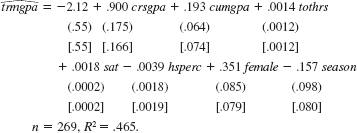
The variable white equals one if the respondent is white, and zero otherwise; the other independent variables are defined in Example 8.7. Both the usual and heteroskedasticity-robust standard errors are reported.
(i) Are there any important differences between the two sets of standard errors?
(ii) Holding other factors fixed, if education increases by four years, what happens to the estimated probability of smoking?
(iii) At what point does another year of age reduce the probability of smoking?
(iv) Interpret the coefficient on the binary variable restaurn (a dummy variable equal to one if the person lives in a state with restaurant smoking restrictions).
(v) Person number 206 in the data set has the following characteristics: cigpric = 67.44, income = 6,500, educ = 16, age = 77, restaurn = 0, white = 0, and smokes = 0. Compute the predicted probability of smoking for this person and comment on the result.
Step-by-Step Solution
Request Solution!
We need at least 10 more requests to produce the solution.
0 / 10 have requested this problem solution
The more requests, the faster the answer.
Most questions answered within 3 hours.
-
Calculating the space time for parallel reactions. m-Xylene is reacted over a ZSM-5 zeolit...
-
Determine Vo and ID for the networks of Fig. 2.160.FIG. 2.160
-
The truck travels along a circular road that has a radius of 50 m at a speed of 4 m/s. F...
-
A state legislature enacted a statute that required any motorcycle operator or passenger...
-
A 1024 × 1024 8-bit image with 5.3 bits/pixel entropy [computed from its histogram using E...
-
In Problem 3.3, we estimated the equationwhere we now report standard errors along with th...
-
In each of the following cases, deduce the nature of the light that is consistent with the...
-
Solve Example 20.5 such that the x, y, z axes move with curvilinear translation, Ω = 0 in...
-
In Fig. 6.43, if i = cos 4t and v = sin 4t, the element is:(a)a resistor(b) a capacitor(c)...
-
Sketch vo for each network of Fig. 2.181 for the input shown.FIG. 2.181
-
(Supplement B) Computing and Reporting Cash Flow Effectsof Sale of Plant and EquipmentDuri...
-
A 350-mL spherical flask contains 0.075 mol of an ideal gas at a temperature of 293 K. Wha...