Two geometrically identical cylinders of inner diameter 5.0 cm, one made of copper and the...
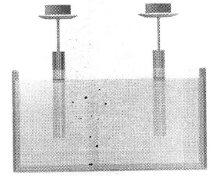
Two geometrically identical cylinders of inner diameter 5.0 cm, one made of copper and the other of Teflon, are immersed in a large-volume water tank at room temperature (20 °C), as shown in the figure. A frictionless Teflon piston with a rod and platter attached is placed in each cylinder. The mass of the piston-rod-platter assembly is 0.50 kg, and the cylinders are filled with helium gas so that initially both pistons are at equilibrium at 20.0 cm from the bottom of their respective cylinders.
a) A 5.0-kg lead block is slowly placed on each platter, and the piston is slowly lowered until it reaches its final equilibrium state. Calculate the final height of each piston (as measured from the bottom of its respective cylinder).
b) If the two lead blocks are dropped suddenly on the platters, how will the final heights of the two pistons compare?
Step-by-Step Solution
THINK:
Initially at the equilibrium there are three forces acting on the piston: the downward force due to atmospheric pressure
 , the downward force
 due to the weight of the piston-rod-platter assembly, and the upward force
 due to the initial pressure
  of the compressed helium.
After the lead is placed on the platter, at the equilibrium there are three forces acting on the piston: the downward force due to atmospheric pressure
 , the downward force
 due to the weight of the lead and the piston-rod-platter assembly, and the upward force
 due to the initial pressure
  of the compressed helium.
Using ’s second law and the Ideal Gas Law, the change in height can be calculated.
Given information:
Inner diameter of each cylinder, 

Room temperature, 
The mass of the piston-rod-platter assembly, 
Initial height from the bottom, 

Mass of the lead block, 
Atmospheric pressure, 
SKETCH:
Two geometrically identical cylinders, one made up of copper and the other of Teflon, are immersed in a large-volume water tank at room temperature as shown in the figure below.


RESEARCH:
The Ideal Gas Law is given by

For the copper cylinder, the process is isothermal process. As the temperature remains constant in isothermal process, according to Ideal Gas Law we have
 …… (1)
For the Teflon cylinder, the process is adiabatic, and for an adiabatic process
 …… (2)
As the Helium is a monatomic gas, the ratio of molar specific heats is

SIMPLIFY:
(a) Initially at the equilibrium, the net force acting on the piston is zero, so by ’s second law:
 …… (3)
After the lead block is placed on the platter, at the equilibrium, the net force acting on the piston is zero, so by ’s second law:
 …… (4)
 From the equation (1), the final height of the Copper piston is
 …… (5)
From the equation (2), the final height of the Teflon piston is
 …… (6)
CALCULATE:
(a) Substituting the given values in equation (3), the initial pressure is

Substituting the given values in equation (4), the final pressure is

Substituting the given values in equation (5), the final height of the Copper piston is

Substituting the given values in equation (6), the final height of the Teflon piston is

(b) If the blocks are dropped suddenly on their platters, the compression of helium in the copper cylinder will no longer be an isothermal process since there will be heat flow into the helium gas, and it is closer to an adiabatic change as the compression occurs more rapidly. Therefore, the final equilibrium heights will be the same as that calculated in part-(a).
Most questions answered within 3 hours.
-
Calculating the space time for parallel reactions. m-Xylene is reacted over a ZSM-5 zeolit...
-
Determine Vo and ID for the networks of Fig. 2.160.FIG. 2.160
-
The truck travels along a circular road that has a radius of 50 m at a speed of 4 m/s. F...
-
A state legislature enacted a statute that required any motorcycle operator or passenger...
-
A 1024 × 1024 8-bit image with 5.3 bits/pixel entropy [computed from its histogram using E...
-
In Problem 3.3, we estimated the equationwhere we now report standard errors along with th...
-
In each of the following cases, deduce the nature of the light that is consistent with the...
-
Solve Example 20.5 such that the x, y, z axes move with curvilinear translation, Ω = 0 in...
-
In Fig. 6.43, if i = cos 4t and v = sin 4t, the element is:(a)a resistor(b) a capacitor(c)...
-
Sketch vo for each network of Fig. 2.181 for the input shown.FIG. 2.181
-
(Supplement B) Computing and Reporting Cash Flow Effectsof Sale of Plant and EquipmentDuri...
-
A 350-mL spherical flask contains 0.075 mol of an ideal gas at a temperature of 293 K. Wha...