Project of Chapter 9 used a vector in the implementation of an iterative merge sort. In th...
Project of Chapter 9 used a vector in the implementation of an iterative merge sort. In that project, the vector was used as if it were a queue. Repeat the project, but use a queue instead of a vector.
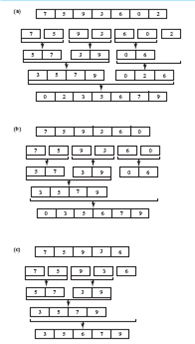
Consider the following implementation of an iterative merge sort. Scan the array from its beginning and partition it into segments that are each sorted. As you find each segment, represent it as a pair of indices and place the pair at the end of an initially empty vector.
Next, remove the first two pairs from the vector and merge the array segments they represent. Notice that these segments are adjacent in the array. The merge results in a larger segment that is sorted. Place the pair of indices that represents the resulting segment at the end of the vector. Repeat the steps in this paragraph until only one entry remains in the vector.
Sometimes during the process, the two pairs at the beginning of the vector will represent segments that are not adjacent. In this case, move the first pair to the end of the vector and continue.
a. What is the best-case performance of this algorithm?
b. What is the worst-case performance of this algorithm?
c. Implement the algorithm.
FIGURE 2 Special cases in an iterative merge sort after merging one-entry subarrays
Step-by-Step Solution
Request Solution!
We need at least 10 more requests to produce the solution.
0 / 10 have requested this problem solution
The more requests, the faster the answer.
Most questions answered within 3 hours.
-
Calculating the space time for parallel reactions. m-Xylene is reacted over a ZSM-5 zeolit...
-
Determine Vo and ID for the networks of Fig. 2.160.FIG. 2.160
-
The truck travels along a circular road that has a radius of 50 m at a speed of 4 m/s. F...
-
A state legislature enacted a statute that required any motorcycle operator or passenger...
-
A 1024 × 1024 8-bit image with 5.3 bits/pixel entropy [computed from its histogram using E...
-
In Problem 3.3, we estimated the equationwhere we now report standard errors along with th...
-
In each of the following cases, deduce the nature of the light that is consistent with the...
-
Solve Example 20.5 such that the x, y, z axes move with curvilinear translation, Ω = 0 in...
-
In Fig. 6.43, if i = cos 4t and v = sin 4t, the element is:(a)a resistor(b) a capacitor(c)...
-
Sketch vo for each network of Fig. 2.181 for the input shown.FIG. 2.181
-
(Supplement B) Computing and Reporting Cash Flow Effectsof Sale of Plant and EquipmentDuri...
-
A 350-mL spherical flask contains 0.075 mol of an ideal gas at a temperature of 293 K. Wha...