Explain how to implement the algorithm PERMUTE-BY-SQRTING to handle the case in which two...
Explain how to implement the algorithm PERMUTE-BY-SQRTING to handle the case in which two or more priorities are identical. That is, your algorithm should produce a uniform random permutation, even if two or more priorities are identical ordering of the values in positions 1 through i ‒ 1, whereas Bi depends only on whether the value in position i is greater than all the values 1 through i ‒ 1. The ordering of positions 1 through i ‒ 1 does not affect whether i is greater than all of them, and the value of i does not affect the ordering of positions 1 through i ‒ 1. Thus we can apply equation (C.15) to obtain
Pr{Si} =Pr{Bi∩Oi} = Pr{Bi}=Pr{Oi}.
The probability Pr {Bi} is clearly l/n, since the maximum is equally likely to be in any one of the n positions. For event Oi to occur, the maximum value in positions 1 through i ‒ 1 must be in one of the firstk positions, and it is equally likely to be in any of these i - 1 positions. Consequently, Pr{Oi} =k/(i ‒ 1) and Pr {Si} = k/(n(i ‒ 1)). Using equation (5.13), we have
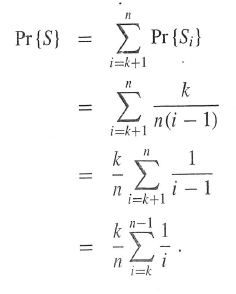
We approximate by integrals to bound this summation from above and below. By the inequalities (A. 12), we have
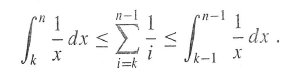
Evaluating these definite integrals gives us the bounds

which provide a rather tight bound for Pr{S}. Because we wish to maximize our probability of success, let us focus on choosing the value of k that maximizes the lower bound on Pr {S}. (Besides, the lower-bound expression is easier to maximize than the upper-bound expression.) Differentiating the expression (k/n)(Inn‒ Ink) with respect to k, we obtain
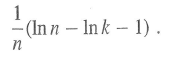
Setting this derivative equal to 0, we see that the lower bound on the probability is maximized when Ink = In n ‒ 1 = In(n/e) or, equivalently, when k = n/e, Thus, if we implement our strategy with k = n/e, we will succeed in hiring our best-qualified applicant with probability at least 1/e.
Step-by-Step Solution
Request Solution!
We need at least 10 more requests to produce the solution.
0 / 10 have requested this problem solution
The more requests, the faster the answer.
Most questions answered within 3 hours.
-
Calculating the space time for parallel reactions. m-Xylene is reacted over a ZSM-5 zeolit...
-
Determine Vo and ID for the networks of Fig. 2.160.FIG. 2.160
-
The truck travels along a circular road that has a radius of 50 m at a speed of 4 m/s. F...
-
A state legislature enacted a statute that required any motorcycle operator or passenger...
-
A 1024 × 1024 8-bit image with 5.3 bits/pixel entropy [computed from its histogram using E...
-
In Problem 3.3, we estimated the equationwhere we now report standard errors along with th...
-
In each of the following cases, deduce the nature of the light that is consistent with the...
-
Solve Example 20.5 such that the x, y, z axes move with curvilinear translation, Ω = 0 in...
-
In Fig. 6.43, if i = cos 4t and v = sin 4t, the element is:(a)a resistor(b) a capacitor(c)...
-
Sketch vo for each network of Fig. 2.181 for the input shown.FIG. 2.181
-
(Supplement B) Computing and Reporting Cash Flow Effectsof Sale of Plant and EquipmentDuri...
-
A 350-mL spherical flask contains 0.075 mol of an ideal gas at a temperature of 293 K. Wha...