An Eulerian tour in an undirected graph is a cycle that is allowed to pass through each ve...
An Eulerian tour in an undirected graph is a cycle that is allowed to pass through each vertex multiple times, but must use each edge exactly once.
This simple concept was used by Euler in 1736 to solve the famous Konigsberg bridge problem, which launched the field of graph theory. The city of Konigsberg (now called Kaliningrad, in western Russia) is the meeting point of two rivers with a small island in the middle. There are seven bridges across the rivers, and a popular recreational question of the time was to determine whether it is possible to perform a tour in which each bridge is crossed exactly once.
Euler formulated the relevant information as a graph with four nodes (denoting land masses) and seven edges (denoting bridges), as shown here.
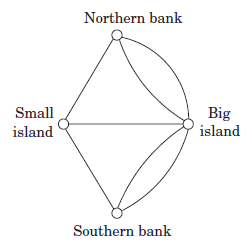
Notice an unusual feature of this problem: multiple edges between certain pairs of nodes.
(a) Show that an undirected graph has an Eulerian tour if and only if all its vertices have even degree. Conclude that there is no Eulerian tour of the Konigsberg bridges.
(b) An Eulerian path is a path which uses each edge exactly once. Can you give a similar if-and-only-if characterization of which undirected graphs have Eulerian paths?
(c) Can you give an analog of part (a) for directed graphs?
Step-by-Step Solution
Request Solution!
We need at least 10 more requests to produce the solution.
0 / 10 have requested this problem solution
The more requests, the faster the answer.
Most questions answered within 3 hours.
-
Calculating the space time for parallel reactions. m-Xylene is reacted over a ZSM-5 zeolit...
-
Determine Vo and ID for the networks of Fig. 2.160.FIG. 2.160
-
The truck travels along a circular road that has a radius of 50 m at a speed of 4 m/s. F...
-
A state legislature enacted a statute that required any motorcycle operator or passenger...
-
A 1024 × 1024 8-bit image with 5.3 bits/pixel entropy [computed from its histogram using E...
-
In Problem 3.3, we estimated the equationwhere we now report standard errors along with th...
-
In each of the following cases, deduce the nature of the light that is consistent with the...
-
Solve Example 20.5 such that the x, y, z axes move with curvilinear translation, Ω = 0 in...
-
In Fig. 6.43, if i = cos 4t and v = sin 4t, the element is:(a)a resistor(b) a capacitor(c)...
-
Sketch vo for each network of Fig. 2.181 for the input shown.FIG. 2.181
-
(Supplement B) Computing and Reporting Cash Flow Effectsof Sale of Plant and EquipmentDuri...
-
A 350-mL spherical flask contains 0.075 mol of an ideal gas at a temperature of 293 K. Wha...