(Infix-to-Postfix Converter)Stacks are used by compilers to help in the process of evaluat...
(Infix-to-Postfix Converter)Stacks are used by compilers to help in the process of evaluating expressions and generating machine language code. In this and the next exercise, we investigate how compilers evaluate arithmetic expressions consisting only of constants, operators and parentheses. Humans generally write expressions like 3 + 4 and 7 / 9 in which the operator (+ or / here) is written between its operands—this is called infix notation. Computers “prefer” postfix notation in which the operator is written to the right of its two operands. The preceding infix expressions would appear in postfix notation as 3 4 + and 7 9 /, respectively. To evaluate a complex infix expression, a compiler would first convert the expression to postfix notation, and then evaluate the postfix version. Each of these algorithms requires only a single left-to-right pass of the expression. Each algorithm uses a stack in support of its operation, and in each the stack is used for a different purpose. In this exercise, you’ll write a version of the infix-to-postfix conversion algorithm. In the next exercise, you’ll write a version of the postfix-expression evaluation algorithm. Write a program that converts an ordinary infix arithmetic expression (assume a valid expression is entered) with single-digit integers such as
(6 + 2) * 5 - 8 / 4
to a postfix expression. The postfix version of the preceding infix expression is
6 2 + 5 * 8 4 / -
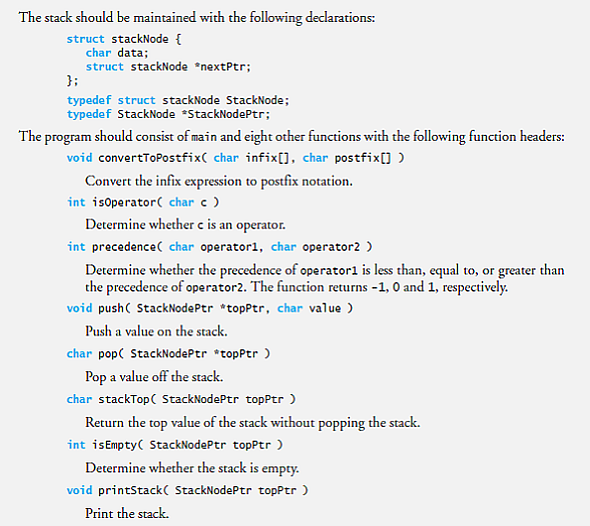
The program should read the expression into character array infix and use the stack functions implemented in this chapter to help create the postfix expression in character array postfix. The algorithm for creating a postfix expression is as follows:
1) Push a left parenthesis '(' onto the stack.
2) Append a right parenthesis ')' to the end of infix.
3) While the stack is not empty, read infix from left to right and do the following:
If the current character in infix is a digit, copy it to the next element of postfix.
If the current character in infix is a left parenthesis, push it onto the stack.
If the current character in infix is an operator,
Pop operators (if there are any) at the top of the stack while they have equal or
higher precedence than the current operator, and insert the popped
operators in postfix.
Push the current character in infix onto the stack.
If the current character in infix is a right parenthesis
Pop operators from the top of the stack and insert them in postfix until a leftparenthesis is at the top of the stack.Pop (and discard) the left parenthesis from the stack.
The following arithmetic operations are allowed in an expression:
+ addition- subtraction* multiplication/ division^ exponentiation% remainder
Step-by-Step Solution
Request Solution!
We need at least 10 more requests to produce the solution.
0 / 10 have requested this problem solution
The more requests, the faster the answer.
Most questions answered within 3 hours.
-
Calculating the space time for parallel reactions. m-Xylene is reacted over a ZSM-5 zeolit...
-
Determine Vo and ID for the networks of Fig. 2.160.FIG. 2.160
-
The truck travels along a circular road that has a radius of 50 m at a speed of 4 m/s. F...
-
A state legislature enacted a statute that required any motorcycle operator or passenger...
-
A 1024 × 1024 8-bit image with 5.3 bits/pixel entropy [computed from its histogram using E...
-
In Problem 3.3, we estimated the equationwhere we now report standard errors along with th...
-
In each of the following cases, deduce the nature of the light that is consistent with the...
-
Solve Example 20.5 such that the x, y, z axes move with curvilinear translation, Ω = 0 in...
-
In Fig. 6.43, if i = cos 4t and v = sin 4t, the element is:(a)a resistor(b) a capacitor(c)...
-
Sketch vo for each network of Fig. 2.181 for the input shown.FIG. 2.181
-
(Supplement B) Computing and Reporting Cash Flow Effectsof Sale of Plant and EquipmentDuri...
-
A 350-mL spherical flask contains 0.075 mol of an ideal gas at a temperature of 293 K. Wha...