There are many sunny days in Ithaca, New York; but this year, as it happens, the spring RO...
There are many sunny days in Ithaca, New York; but this year, as it happens, the spring ROTC picnic at Cornell has fallen on a rainy day. The ranking officer decides to postpone the picnic and must notify everyone by phone. Here is the mechanism she uses to do this.
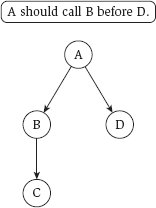
Each ROTC person on campus except the ranking officer reports to a unique superior officer. Thus the reporting hierarchy can be described by a tree T, rooted at the ranking officer, in which each other node v has a parent node u equal to his or her superior officer. Conversely, we will call v a direct subordinate of u. See Figure 1, in which A is the ranking officer, B and D are the direct subordinates of A, and C is the direct subordinate of B.
To notify everyone of the postponement, the ranking officer first calls each of her direct subordinates, one at a time. As soon as each subordinate gets the phone call, he or she must notify each of his or her direct subordinates, one at a time. The process continues this way until everyone has been notified. Note that each person in this process can only call direct subordinates on the phone; for example, in Figure 1, A would not be allowed to call C.
We can picture this process as being divided into rounds. In one round, each person who has already learned of the postponement can call one of his or her direct subordinates on the phone. The number of rounds it takes for everyone to be notified depends on the sequence in which each person calls their direct subordinates. For example, in Figure 1, it will take only two rounds if A starts by calling B, but it will take three rounds if A starts by calling D.
Give an efficient algorithm that determines the minimum number of rounds needed for everyone to be notified, and outputs a sequence of phone calls that achieves this minimum number of rounds.
Figure 1 A hierarchy with four people. The fastest broadcast scheme is for A to call B in the first round. In the second round, A calls D and B calls C. If A were to call D first, then C could not learn the news until the third round.
Step-by-Step Solution
Request Solution!
We need at least 10 more requests to produce the solution.
0 / 10 have requested this problem solution
The more requests, the faster the answer.
Most questions answered within 3 hours.
-
Calculating the space time for parallel reactions. m-Xylene is reacted over a ZSM-5 zeolit...
-
Determine Vo and ID for the networks of Fig. 2.160.FIG. 2.160
-
The truck travels along a circular road that has a radius of 50 m at a speed of 4 m/s. F...
-
A state legislature enacted a statute that required any motorcycle operator or passenger...
-
A 1024 × 1024 8-bit image with 5.3 bits/pixel entropy [computed from its histogram using E...
-
In Problem 3.3, we estimated the equationwhere we now report standard errors along with th...
-
In each of the following cases, deduce the nature of the light that is consistent with the...
-
Solve Example 20.5 such that the x, y, z axes move with curvilinear translation, Ω = 0 in...
-
In Fig. 6.43, if i = cos 4t and v = sin 4t, the element is:(a)a resistor(b) a capacitor(c)...
-
Sketch vo for each network of Fig. 2.181 for the input shown.FIG. 2.181
-
(Supplement B) Computing and Reporting Cash Flow Effectsof Sale of Plant and EquipmentDuri...
-
A 350-mL spherical flask contains 0.075 mol of an ideal gas at a temperature of 293 K. Wha...