In Figure, a goose starts in flight a miles due east of its nest. Assume that the goose ma...
In Figure, a goose starts in flight a miles due east of its nest. Assume that the goose maintains constant flight speed (relative to the air) so that it is always flying directly toward its nest. The wind is blowing due north at w miles per hour. Figure shows a coordinate frame with the nest at (0, 0) and the goose at (x, y). It is easily seen (but you should verify it yourself) that
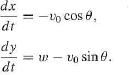
(a) Show that
where k = w/v0, the ratio of the wind speed to the speed of the goose.
Figure. The geometry in Exercise 41.
(b) Solve equation (6.43) and show that
.
(c) Three distinctly different outcomes are possible, each depending on the value of k. Find and discuss each case and use a grapher to depict a sample flight trajectory in each case.
An equation of the form F(x, y) = C defines a family of curves in the plane. Furthermore, we know these curves are the integral curves of the differential equation


 .
.
A family of curves is said to be orthogonal to a second family if each member of one family intersects all members of the other family at right angles. For example, the families y = mx and x2 + y2 = c2 are orthogonal. For a curve y = y(x) to be everywhere orthogonal to the curves defined by F(x, y) = C its derivative must be the negative reciprocal of that in (6.44), or

The family of solutions to this differential equation are orthogonal to the family defined by F(x, y) = C.
Step-by-Step Solution
Request Solution!
We need at least 10 more requests to produce the solution.
0 / 10 have requested this problem solution
The more requests, the faster the answer.
Most questions answered within 3 hours.
-
Calculating the space time for parallel reactions. m-Xylene is reacted over a ZSM-5 zeolit...
-
Determine Vo and ID for the networks of Fig. 2.160.FIG. 2.160
-
The truck travels along a circular road that has a radius of 50 m at a speed of 4 m/s. F...
-
A state legislature enacted a statute that required any motorcycle operator or passenger...
-
A 1024 × 1024 8-bit image with 5.3 bits/pixel entropy [computed from its histogram using E...
-
In Problem 3.3, we estimated the equationwhere we now report standard errors along with th...
-
In each of the following cases, deduce the nature of the light that is consistent with the...
-
Solve Example 20.5 such that the x, y, z axes move with curvilinear translation, Ω = 0 in...
-
In Fig. 6.43, if i = cos 4t and v = sin 4t, the element is:(a)a resistor(b) a capacitor(c)...
-
Sketch vo for each network of Fig. 2.181 for the input shown.FIG. 2.181
-
(Supplement B) Computing and Reporting Cash Flow Effectsof Sale of Plant and EquipmentDuri...
-
A 350-mL spherical flask contains 0.075 mol of an ideal gas at a temperature of 293 K. Wha...