Let W be a random variable giving the number of heads minus the number of tails in three tosses of a coin
3. Let W be a random variable giving the number of heads minus the number of tails in three tosses of a coin. List the elements of the sample space S for the three tosses of the coin and to each sample point assign a value w of W.
Homework Answers
Let, \(W\) be a random variable giving the number of heads minus the number of tails in three tosses of a coin
i.e., \(W=(\) Number heads \(-\) Number of tails) in throwing of a coin thrice
Here, the sample space
\(S=\{H H H, H H T, H T H, H T T, T T T, T T H, T H T, T H H\}\)
Here \(W=w\) with \(w=3,1,-1,-3\)
\(W=\left\{\begin{aligned} \text { 3, With HHH } \\ \text { 1, With HHT, HTH, THH } \\-1 \text { , With TTH, THT, HTT } \\ \text { -3, With TTT } \end{aligned}\right\}\)
Add Answer to:
Let W be a random variable giving the number of heads minus the number of tails in three tosses of a coin
Q7. (2096) Let W be a random variable giving the number of heads minus the number...
 Q7. (2096) Let W be a random variable giving the number of heads minus the number of tails in three tosses of a coin. Assume that the coin is biased so that a tail is twice as likely to occur as a head.List the elements of the sample space for the three tosses of a coin and to each sample point assign a value w of a) Find the probability distribution (p.m.f) of the random variable w. b) Find the...
Let W be a random variable giving the number of heads minus the number of fails...
 Let W be a random variable giving the number of heads minus the number of fails in three tosses of a coin Assuming that a head is one-sixth as likely to occur, find the probability distribution of the random variable W Complete the following probability distribution of W W 3 1 - 1 - 3 f(w) (Type integers or simplified fractions)
Q–2: [5+2+3 Marks] Let X be a random variable giving the number of heads minus the number of tail...
Q–2: [5+2+3 Marks] Let X be a random variable giving the number of heads minus the number of tails in three tosses of a coin. a) Find the probability distribution function of the random variable X. b) Find P(−1 ≤ X ≤ 3). c) Find E(X).
A coin is tossed twice. Let the random variable X denote the number of tails that...
 A coin is tossed twice. Let
the random variable X denote the number of tails that occur in the
two tosses. Find the P(X ≤ 1)
Question 2: A coin is tossed twice. Let the random variable X denote the number of tails that occur in the two tosses. Find the P(Xs 1) a. 0.250 b. 0.500 c. 0.750 d. 1.000 e. None of the above
A coin is tossed twice. Let
the random variable X denote the number of tails that occur in the
two tosses. Find the P(X ≤ 1)
Question 2: A coin is tossed twice. Let the random variable X denote the number of tails that occur in the two tosses. Find the P(Xs 1) a. 0.250 b. 0.500 c. 0.750 d. 1.000 e. None of the above
11. [8] The probability that the coin lands tails is 40%. Because the probability is not...
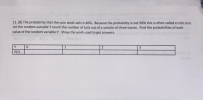 11. [8] The probability that the coin lands tails is 40%. Because the probability is not 50% this is often called a trick coin. Let the random variable y count the number of tails out of a sample of three tosses. Find the probabilities of each value of the random variable Y. Show the work used to get answers. 0 1 2 3 Y PY)
Let X represent the number of heads subtracts the number of tails obtained when a coin...
Let X represent the number of heads subtracts the number of tails obtained when a coin is tossed 3 times, i.e., X = number of heads − number of tails. (a) Find the probability mass function of X (b) Given that X is at least 0, what is the probability that X is at least 2
A fair coin is flipped independently until the first Heads is observed. Let the random variable...
 A fair coin is flipped independently until the first Heads is observed. Let the random variable K be the number of tosses until the first Heads is observed plus 1. For example, if we see TTTHTH, then K = 5. For k 1, 2, , K, let Xk be a continuous random variable that is uniform over the interval [0, 5]. The Xk are independent of one another and of the coin flips. LetX = Σ i Xo Find the...
Problem(13) (10 points) An unfair coin is tossed, and it is assumed that the chance of...
 Problem(13) (10 points) An unfair coin is tossed, and it is assumed that the chance of getting a head, H. is (Thus the chance of setting tail, T. is.) Consider a random experiment of throwing the coin 5 times. Let S denote the sample space (a) (2 point) Describe the elements in S. (b) (2 point) Let X be the random variable that corresponds to the number of the heads coming up in the four times of tons. What are...
3. (PMF – 8 points) Consider a sequence of independent trials of fair coin tossing. Let...
 3. (PMF – 8 points) Consider a sequence of independent trials of fair coin tossing. Let X denote a random variable that indicates the number of coin tosses you tried until you get heads for the first time and let y denote a random variable that indicates the number of coin tosses you tried until you get tails for the first time. For example, X = 1 and Y = 2 if you get heads on the first try and...
Extra question: Toss a coin three times. Let X denote the number of heads in the...
 Extra question: Toss a coin three times. Let X denote the number of heads in the results. Let Y denote the absolute value of the difference between the number of heads and the number of tails. What is the frequency function of (X,Y)?
 Q7. (2096) Let W be a random variable giving the number of heads minus the number of tails in three tosses of a coin. Assume that the coin is biased so that a tail is twice as likely to occur as a head.List the elements of the sample space for the three tosses of a coin and to each sample point assign a value w of a) Find the probability distribution (p.m.f) of the random variable w. b) Find the...
 Let W be a random variable giving the number of heads minus the number of fails in three tosses of a coin Assuming that a head is one-sixth as likely to occur, find the probability distribution of the random variable W Complete the following probability distribution of W W 3 1 - 1 - 3 f(w) (Type integers or simplified fractions)
 A coin is tossed twice. Let
the random variable X denote the number of tails that occur in the
two tosses. Find the P(X ≤ 1)
Question 2: A coin is tossed twice. Let the random variable X denote the number of tails that occur in the two tosses. Find the P(Xs 1) a. 0.250 b. 0.500 c. 0.750 d. 1.000 e. None of the above
A coin is tossed twice. Let
the random variable X denote the number of tails that occur in the
two tosses. Find the P(X ≤ 1)
Question 2: A coin is tossed twice. Let the random variable X denote the number of tails that occur in the two tosses. Find the P(Xs 1) a. 0.250 b. 0.500 c. 0.750 d. 1.000 e. None of the above
 11. [8] The probability that the coin lands tails is 40%. Because the probability is not 50% this is often called a trick coin. Let the random variable y count the number of tails out of a sample of three tosses. Find the probabilities of each value of the random variable Y. Show the work used to get answers. 0 1 2 3 Y PY)
 A fair coin is flipped independently until the first Heads is observed. Let the random variable K be the number of tosses until the first Heads is observed plus 1. For example, if we see TTTHTH, then K = 5. For k 1, 2, , K, let Xk be a continuous random variable that is uniform over the interval [0, 5]. The Xk are independent of one another and of the coin flips. LetX = Σ i Xo Find the...
 Problem(13) (10 points) An unfair coin is tossed, and it is assumed that the chance of getting a head, H. is (Thus the chance of setting tail, T. is.) Consider a random experiment of throwing the coin 5 times. Let S denote the sample space (a) (2 point) Describe the elements in S. (b) (2 point) Let X be the random variable that corresponds to the number of the heads coming up in the four times of tons. What are...
 3. (PMF – 8 points) Consider a sequence of independent trials of fair coin tossing. Let X denote a random variable that indicates the number of coin tosses you tried until you get heads for the first time and let y denote a random variable that indicates the number of coin tosses you tried until you get tails for the first time. For example, X = 1 and Y = 2 if you get heads on the first try and...
 Extra question: Toss a coin three times. Let X denote the number of heads in the results. Let Y denote the absolute value of the difference between the number of heads and the number of tails. What is the frequency function of (X,Y)?
Most questions answered within 3 hours.
-
Where is the error in this code sequence?
String s1 = "Hello";
String s2 = "ello";...
asked 11 months ago -
Financial data for Joel de Paris, Inc., for last year
follow:
Joel de Paris, Inc.
Balance...
asked 11 months ago -
Consider this reaction:
Al2(SO4)3 (aq)+ BaCl3
(aq) Al2Cl6 (aq)- +
3BaSO4(s) . What is the...
asked 11 months ago -
Suppose that Savneet is considering increasing her
recent random sample from 20 car rentals to 40...
asked 11 months ago -
Trucks arrive at an unloading terminal at an average rate of 120
per hour.
Trucks arrive...
asked 11 months ago -
Why are methanol and ethanol completely soluble in water while
octanol is not very little soluble....
asked 11 months ago -
A facilities manager at a university reads in a research report
that the mean amount of...
asked 11 months ago -
When the CuSO4 is rehydrated by adding water to the anhydrous
compound, is this an endothermic...
asked 11 months ago -
A ray of sunlight is passing from diamond into crown glass; the
angle of incidence is...
asked 11 months ago -
A block of mass 0.249 kg is placed on top of a light, vertical
spring of...
asked 11 months ago -
how do the kidneys compensate in the presences of acidosis
a) trigger hyperventilate
b) reserve acid...
asked 11 months ago -
Question 501 pts
The rental rate of capital to the firm increases. Which of the
following...
asked 11 months ago