Calculate Eo , E, and ΔG for the following cell reaction 3Zn(s) + 2Cr3+(aq) ⇌ 3Zn2+(aq)...
Calculate Eo , E, and ΔG for the following cell reaction
3Zn(s) + 2Cr3+(aq) ⇌
3Zn2+(aq) + 2Cr(s)
where [Cr3+] = 0.090 M and [Zn2+] =
0.0085 M
Homework Answers
1)
from data table:
Eo(Zn2+/Zn(s)) = -0.7618 V
Eo(Cr3+/Cr(s)) = -0.74 V
As per given reaction/cell notation,
cathode is (Cr3+/Cr(s))
anode is (Zn2+/Zn(s))
Eocell = Eocathode - Eoanode
= (-0.74) - (-0.7618)
= 0.0218 V
Lets find Eo 1st
from data table:
Eo(Zn2+/Zn(s)) = -0.7618 V
Eo(Cr3+/Cr(s)) = -0.74 V
As per given reaction/cell notation,
cathode is (Cr3+/Cr(s))
anode is (Zn2+/Zn(s))
Eocell = Eocathode - Eoanode
= (-0.74) - (-0.7618)
= 0.0218 V
Answer: 0.0218 V
2)
Number of electron being transferred in balanced reaction is 6
So, n = 6
use:
E = Eo - (2.303*RT/nF) log {[Zn2+]^3/[Cr3+]^2}
Here:
2.303*R*T/F
= 2.303*8.314*298.0/96500
= 0.0591
So, above expression becomes:
E = Eo - (0.0591/n) log {[Zn2+]^3/[Cr3+]^2}
E = 2.18*10^-2 - (0.0591/6) log (0.0085^3/0.09^2)
E = 2.18*10^-2-(-4.06*10^-2)
E = 6.24*10^-2 V
Answer: 6.24*10^-2 V
C)
number of electrons being transferred, n = 6
F = 96500 C
use:
ΔG = -n*F*E
= -6*96500*0.0624
= -36129.6 J/mol
= -36.1 KJ/mol
Answer: -36.1 KJ/mol
Add Answer to:
Calculate Eo , E, and ΔG for the following cell
reaction
3Zn(s) + 2Cr3+(aq) ⇌
3Zn2+(aq)...
Be sure to answer all parts. Calculate E o , E, and ΔG for the following...
Be sure to answer all parts. Calculate E o , E, and ΔG for the following cell reactions (a) Mg(s) + Sn2+(aq) ⇌ Mg2+(aq) + Sn(s) where [Mg2+] = 0.055 M and [Sn2+] = 0.050 M E o = V E = V Δ G = kJ (b) 3Zn(s) + 2Cr3+(aq) ⇌ 3Zn2+(aq) + 2Cr(s) where [Cr3+] = 0.020 M and [Zn2+] = 0.0095 M E o = V E = V Δ G = kJ
Calculate Eº, E, and AG for the following cell reactions (a) Mg(s) + Sn2+(aq) =Mg2+(aq) +...
 Calculate Eº, E, and AG for the following cell reactions (a) Mg(s) + Sn2+(aq) =Mg2+(aq) + Sn(s) where [Mg2+] = 0.040 M and [Sn2+] = 0.045 M 8° = 2.23 10 E = 2.23 AG=430390 (b) 3Zn(s) + 2Cr3+(aq) = 3Zn2+(aq) + 2Cr(s) where [Cr3+] = 0.040 M and [Zn2+] = 0.0065 M E° = 0.03 E = 0.0671 AG=-0.0389
(a) Mg(s) + Sn2+(aq) = Mg2+(aq) + Sn(s) where [Mg2+] = 0.035 M and [Sn2+] =...
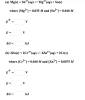 (a) Mg(s) + Sn2+(aq) = Mg2+(aq) + Sn(s) where [Mg2+] = 0.035 M and [Sn2+] = 0.040 M E = v AG= kJ (b) 3Zn(s) + 2Cr3+ (aq) = 3Zn2+(aq) + 2Cr(s) where [Cr3+] = 0.040 M and [Zn2+] = 0.0075 M E = AG=
A galvanic cell at a temperature of 25.0°C is powered by the following redox reaction: 2Cr3+(aq)...
A galvanic cell at a temperature of 25.0°C is powered by the following redox reaction: 2Cr3+(aq) + 3Ca(s) ---> 2Cr(s) + 3Ca2+(aq) Suppose the cell is prepared with 2.71 M Cr3+in one half-cell and 7.75 M Ca2+ in the other. Calculate the cell voltage under these conditions. Round your answer to 3 significant digits.
Consider the following cell reaction: 2Cr(s) + 6H*(aq) - 2Cr3+ (aq) + 3H2(g); Eºcell = 0.74V...
 Consider the following cell reaction: 2Cr(s) + 6H*(aq) - 2Cr3+ (aq) + 3H2(g); Eºcell = 0.74V Under standard-state conditions, what is Eº for the following half-reaction? C++ (aq) + 3e - Cr(s) Select one: a. -0.37 V Ob. 0.74 V Oc. -0.74 V Od 0.25V o e. 0.37 v
Determine the value of ΔG ° for the following reaction if the standard potential of the...
Determine the value of ΔG ° for the following reaction if the standard potential of the cell where that reaction occurs is E ° = + 1.08V 2Cr(s) + 3Cu2+(ac) = 2Cr3+(ac) + 3Cu(s)
A galvanic cell based on the following reactions Cu 2+ (aq) + 2e- + Cu(s) E°=0.339...
 A galvanic cell based on the following reactions Cu 2+ (aq) + 2e- + Cu(s) E°=0.339 V (AD + 14H(aq) + 6e-4 2Cr 3+(aq) + 7 H2O(1) Eo=1.330 V a) Write the overall cell reaction and determine its voltage. b) If the E value of the galvanic cell is 1.2 le of the galvanic cell is 1.254 V, calculate the pH of the cell when [Cu2+]=0.00010 M, Cr-0,2-1=0.00460 M, Cr3+1=1.0x10² M. The Nerst equation is E=E - (0.0592/n)logQ
Question 2 (1 point) What is Eºcell for the cell reaction: 2Cr(s) + 3Sn4+(aq) --> 3Sn2+(aq)...
 Question 2 (1 point) What is Eºcell for the cell reaction: 2Cr(s) + 3Sn4+(aq) --> 3Sn2+(aq) + 2Cr3+ (aq)? Given: Cr3+(aq) + 3e --> Cr(s); E° = -0.74 V Sn4+(aq) + 2e --> Sn2+(aq); E° = +0.15 V 0 +0.45 V O +0.89 V O 1.93 V 0-0.59 V 0 +0.59 V
Table 20.2 Half-reaction E° (V) Cr3+ (aq) + 3e- → Cr(s) -0.74 Fe2+ (aq) + 2e- Fe (5) -0.440 Fe3+ (aq) + e - Fe2+ (s...
 Table 20.2 Half-reaction E° (V) Cr3+ (aq) + 3e- → Cr(s) -0.74 Fe2+ (aq) + 2e- Fe (5) -0.440 Fe3+ (aq) + e - Fe2+ (s) +0.771 Sn4+ (aq) + 2e- Sn2+ (aq) +0.154 The standard cell potential (Eºcell) for the voltaic cell based on the reaction below is V. 35n4+ (aq) + 2Cr (s) → 2Cr3+ (aq) + 3Sn2+ (aq) A) +1.94 B) +0.89 C) +2.53 D) -0.59 E) -1.02
When the Cu2+ concentration is 6.58×10⁻⁴ M, the observed cell potential at 298K for an electrochemical...
When the Cu2+ concentration is 6.58×10⁻⁴ M, the observed cell potential at 298K for an electrochemical cell with the following reaction is 0.979V. What is the Cr3+ concentration? 3Cu2+(aq) + 2Cr(s)3Cu(s) + 2Cr3+(aq) Answer: M When the Cu2+ concentration is 2.71×10⁻⁴ M, the observed cell potential at 298K for an electrochemical cell with the following reaction is 0.971V. What is the Cr3+ concentration? 3Cu2+(aq) + 2Cr(s)3Cu(s) + 2Cr3+(aq) Answer: M
 Calculate Eº, E, and AG for the following cell reactions (a) Mg(s) + Sn2+(aq) =Mg2+(aq) + Sn(s) where [Mg2+] = 0.040 M and [Sn2+] = 0.045 M 8° = 2.23 10 E = 2.23 AG=430390 (b) 3Zn(s) + 2Cr3+(aq) = 3Zn2+(aq) + 2Cr(s) where [Cr3+] = 0.040 M and [Zn2+] = 0.0065 M E° = 0.03 E = 0.0671 AG=-0.0389
 (a) Mg(s) + Sn2+(aq) = Mg2+(aq) + Sn(s) where [Mg2+] = 0.035 M and [Sn2+] = 0.040 M E = v AG= kJ (b) 3Zn(s) + 2Cr3+ (aq) = 3Zn2+(aq) + 2Cr(s) where [Cr3+] = 0.040 M and [Zn2+] = 0.0075 M E = AG=
 Consider the following cell reaction: 2Cr(s) + 6H*(aq) - 2Cr3+ (aq) + 3H2(g); Eºcell = 0.74V Under standard-state conditions, what is Eº for the following half-reaction? C++ (aq) + 3e - Cr(s) Select one: a. -0.37 V Ob. 0.74 V Oc. -0.74 V Od 0.25V o e. 0.37 v
 A galvanic cell based on the following reactions Cu 2+ (aq) + 2e- + Cu(s) E°=0.339 V (AD + 14H(aq) + 6e-4 2Cr 3+(aq) + 7 H2O(1) Eo=1.330 V a) Write the overall cell reaction and determine its voltage. b) If the E value of the galvanic cell is 1.2 le of the galvanic cell is 1.254 V, calculate the pH of the cell when [Cu2+]=0.00010 M, Cr-0,2-1=0.00460 M, Cr3+1=1.0x10² M. The Nerst equation is E=E - (0.0592/n)logQ
 Question 2 (1 point) What is Eºcell for the cell reaction: 2Cr(s) + 3Sn4+(aq) --> 3Sn2+(aq) + 2Cr3+ (aq)? Given: Cr3+(aq) + 3e --> Cr(s); E° = -0.74 V Sn4+(aq) + 2e --> Sn2+(aq); E° = +0.15 V 0 +0.45 V O +0.89 V O 1.93 V 0-0.59 V 0 +0.59 V
 Table 20.2 Half-reaction E° (V) Cr3+ (aq) + 3e- → Cr(s) -0.74 Fe2+ (aq) + 2e- Fe (5) -0.440 Fe3+ (aq) + e - Fe2+ (s) +0.771 Sn4+ (aq) + 2e- Sn2+ (aq) +0.154 The standard cell potential (Eºcell) for the voltaic cell based on the reaction below is V. 35n4+ (aq) + 2Cr (s) → 2Cr3+ (aq) + 3Sn2+ (aq) A) +1.94 B) +0.89 C) +2.53 D) -0.59 E) -1.02
Most questions answered within 3 hours.
-
Where is the error in this code sequence?
String s1 = "Hello";
String s2 = "ello";...
asked 10 months ago -
Financial data for Joel de Paris, Inc., for last year
follow:
Joel de Paris, Inc.
Balance...
asked 10 months ago -
Consider this reaction:
Al2(SO4)3 (aq)+ BaCl3
(aq) Al2Cl6 (aq)- +
3BaSO4(s) . What is the...
asked 10 months ago -
Suppose that Savneet is considering increasing her
recent random sample from 20 car rentals to 40...
asked 10 months ago -
Trucks arrive at an unloading terminal at an average rate of 120
per hour.
Trucks arrive...
asked 10 months ago -
Why are methanol and ethanol completely soluble in water while
octanol is not very little soluble....
asked 10 months ago -
A facilities manager at a university reads in a research report
that the mean amount of...
asked 10 months ago -
When the CuSO4 is rehydrated by adding water to the anhydrous
compound, is this an endothermic...
asked 10 months ago -
A ray of sunlight is passing from diamond into crown glass; the
angle of incidence is...
asked 10 months ago -
A block of mass 0.249 kg is placed on top of a light, vertical
spring of...
asked 10 months ago -
how do the kidneys compensate in the presences of acidosis
a) trigger hyperventilate
b) reserve acid...
asked 10 months ago -
Question 501 pts
The rental rate of capital to the firm increases. Which of the
following...
asked 10 months ago