The reaction SO2(g)+2H2S(g)⇌3S(s)+2H2O(g) is the basis of a suggested method for removal of SO2 from power-plant...
| The reaction
SO2(g)+2H2S(g)⇌3S(s)+2H2O(g) is the basis of a suggested method for removal of SO2 from power-plant stack gases.The values below may be helpful when answering questions about the process.
|
Part A
Calculate the equilibrium constant Kp for the reaction at a temperature of 298
Part D
Using relative enthalpy and entropy values, determine how the process is affected after each of the following temperature or pressure changes? Consider that a more effective reaction produces more product or more product in a shorter amount of time.
Drag the appropriate items to their respective bins.
View Available Hint(s)
|
Reset a)Temperature increases b)Pressure decreases c)Pressure increases d)Temperature decreases More effective Less effective Equally effective |
Homework Answers

Add Answer to:
The reaction
SO2(g)+2H2S(g)⇌3S(s)+2H2O(g)
is the basis of a suggested method for removal of SO2 from
power-plant...
The reaction SO2(g)+2H2S(g) ⇌ 3 S(s)+2H2O(g) is the basis of a suggested method for removal of SO2, a pollutant that...
The reaction SO2(g)+2H2S(g) ⇌ 3 S(s)+2H2O(g) is the basis of a suggested method for removal of SO2, a pollutant that irritates airways causing coughing, from power-plant stack gases. The values below may be helpful when answering questions about the process. Substance ΔG∘f (kJ/mol) ΔH∘f (kJ/mol) H2O(g) −228.6 −241.8 H2O(l) −237.1 −285.8 SO2(g) −300.4 −296.9 SO3(g) −370.4 −395.2 H2S(g) −33.01 −20.17 S(s) 0 0 PART A: Calculate the equilibrium constant Kp for the reaction at a temperature of 298 K. Express...
The reaction SO2(g)+2H2S(g) ⇌ 3 S(s)+2H2O(g) is the basis of a suggested method for removal of...
The reaction SO2(g)+2H2S(g) ⇌ 3 S(s)+2H2O(g) is the basis of a suggested method for removal of SO2 , a pollutant that irritates airways causing coughing, from power-plant stack gases. The values below may be helpful when answering questions about the process. Substance ΔG∘f (kJ/mol) ΔH∘f (kJ/mol) H2O(g) − 228.6 − 241.8 H2O(l) − 237.1 − 285.8 SO2(g) − 300.4 − 296.9 SO3(g) − 370.4 − 395.2 H2S(g) − 33.01 − 20.17 S(s) 0 0 Assume that the partial pressure of...
34. At volcanic sites, sulfur is formed via the following reaction. 2 H2S(g) +SO2(g) = 3S(s)...
 34. At volcanic sites, sulfur is formed via the following reaction. 2 H2S(g) +SO2(g) = 3S(s) +2 H20(g) a. Calculate the equilibrium constant, K, for this reaction at 25°C. 4 Gº (kJ/mol H2S (8) SO2) H20 (8) -33.0 -300.4 -228.6 s, b. Predict whether sulfur formation becomes more or less favorable as temperature increases. Explain. C Sulfur dioxide is a pollutant released by power plants. Would this reaction be suitable for removing SO2 from power plant waste?
Consider the following reaction: 2H2S(g)+SO2(g)⇌3S(s)+2H2O(g) A reaction mixture initially containing 0.480 M H2S and 0.480 M...
Consider the following reaction: 2H2S(g)+SO2(g)⇌3S(s)+2H2O(g) A reaction mixture initially containing 0.480 M H2S and 0.480 M SO2 was found to contain 1.0×10⁻³ M H2O at a certain temperature. A second reaction mixture at the same temperature initially contains [H2S]= 0.255 M and [SO2]= 0.325 M . Calculate the equilibrium concentration of H2O in the second mixture at this temperature. Express your answer using two significant figures.
Consider the following balanced chemical equation: 2H2S(g) + SO2(g) → 3S(s) + 2H2O(g) a. How many...
Consider the following balanced chemical equation: 2H2S(g) + SO2(g) → 3S(s) + 2H2O(g) a. How many moles of H2S must react to form 4.18 moles of S? _ moles H2S b. How many moles of SO2 must react to form 4.18 moles of S? _ moles SO2 c. How many moles of H2S must react to form 4.18 moles of H2O? _ moles H2S d. How many moles of SO2 must react to form 4.18 moles of H2O? _ moles...
(1) Consider SO2 (g) + 2H2S(g) = 3(g) + 2H2O(1) AH : (i) SO2 (g) =...
 (1) Consider SO2 (g) + 2H2S(g) = 3(g) + 2H2O(1) AH : (i) SO2 (g) = -296.8 KJ/mol (ii) H2S (g) = -20.4 KJ/mol (iii) H20 (1) = -285.84 KJ/mol AH for the above reaction is: (a) 234.08 KJ (b)-234.08 KJ (c) 31.36 kJ (d) -31.36 KJ (e) None (2) The above reaction is (a) Endothermic (b) Exothermic (c) entropic (3) in k = Ae Ea/RT, Ea is (a) Activation Energy (b) 8.314 J/mol.K (c) Rate constant (4) In a...
Given the following reaction at 298 KK: 2H2S(g)+SO2(g)→38S8(s)+2H2O(g)2H2S(g)+SO2(g)→38S8(s)+2H2O(g) ΔrG∘ΔrG∘ =−102kJmol−1 Calculate ΔrGΔrG under the following conditions:...
Given the following reaction at 298 KK: 2H2S(g)+SO2(g)→38S8(s)+2H2O(g)2H2S(g)+SO2(g)→38S8(s)+2H2O(g) ΔrG∘ΔrG∘ =−102kJmol−1 Calculate ΔrGΔrG under the following conditions: PH2SPH2S = 2.00 bar; PSO2PSO2 = 0.165 bar; PH2OPH2O = 1.246 bar
6. Calculate the AG for the reaction; 2H2S (g) + SO2 (g) = 3Srhombic (s) +...
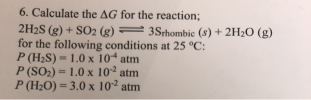 6. Calculate the AG for the reaction; 2H2S (g) + SO2 (g) = 3Srhombic (s) + 2H20 (g) for the following conditions at 25 °C: P (H2S) = 1.0 x 10⁻⁴ atm P (SO2) = 1.0 x 10⁻² atm P (H2O) = 3.0 x 10⁻² atm
Use the given data at 500 K to calculate ΔG°for the reaction 2H2S(g) + 3O2(g) →...
Use the given data at 500 K to calculate ΔG°for the reaction 2H2S(g) + 3O2(g) → 2H2O(g) + 2SO2(g) Substance H2S(g) O2(g) H2O(g) SO2(g) ΔH°f(kJ/mol) -21 0 -242 -296.8 S°(J/K·mol) 206 205 189 248
Find AH®rxn for the reaction 2Ag2S(s) + 2H2O(0) - 4Ag(s) + 2H2S(g) + O2(g). [AH°F (Ag2S(s))...
 Find AH®rxn for the reaction 2Ag2S(s) + 2H2O(0) - 4Ag(s) + 2H2S(g) + O2(g). [AH°F (Ag2S(s)) = -326 kJ/mol; AH+ (H2S(g)) = -20.5 kJ/mol; AHT (H2000) = -285.5 kJ/mol] O 575.2 kJ/mol 0 565.2 kJ/mol O None of the above O 585.2 kJ/mol 0 595.2 kJ/mol
 34. At volcanic sites, sulfur is formed via the following reaction. 2 H2S(g) +SO2(g) = 3S(s) +2 H20(g) a. Calculate the equilibrium constant, K, for this reaction at 25°C. 4 Gº (kJ/mol H2S (8) SO2) H20 (8) -33.0 -300.4 -228.6 s, b. Predict whether sulfur formation becomes more or less favorable as temperature increases. Explain. C Sulfur dioxide is a pollutant released by power plants. Would this reaction be suitable for removing SO2 from power plant waste?
 (1) Consider SO2 (g) + 2H2S(g) = 3(g) + 2H2O(1) AH : (i) SO2 (g) = -296.8 KJ/mol (ii) H2S (g) = -20.4 KJ/mol (iii) H20 (1) = -285.84 KJ/mol AH for the above reaction is: (a) 234.08 KJ (b)-234.08 KJ (c) 31.36 kJ (d) -31.36 KJ (e) None (2) The above reaction is (a) Endothermic (b) Exothermic (c) entropic (3) in k = Ae Ea/RT, Ea is (a) Activation Energy (b) 8.314 J/mol.K (c) Rate constant (4) In a...
 6. Calculate the AG for the reaction; 2H2S (g) + SO2 (g) = 3Srhombic (s) + 2H20 (g) for the following conditions at 25 °C: P (H2S) = 1.0 x 10⁻⁴ atm P (SO2) = 1.0 x 10⁻² atm P (H2O) = 3.0 x 10⁻² atm
 Find AH®rxn for the reaction 2Ag2S(s) + 2H2O(0) - 4Ag(s) + 2H2S(g) + O2(g). [AH°F (Ag2S(s)) = -326 kJ/mol; AH+ (H2S(g)) = -20.5 kJ/mol; AHT (H2000) = -285.5 kJ/mol] O 575.2 kJ/mol 0 565.2 kJ/mol O None of the above O 585.2 kJ/mol 0 595.2 kJ/mol
Most questions answered within 3 hours.
-
Where is the error in this code sequence?
String s1 = "Hello";
String s2 = "ello";...
asked 11 months ago -
Financial data for Joel de Paris, Inc., for last year
follow:
Joel de Paris, Inc.
Balance...
asked 11 months ago -
Consider this reaction:
Al2(SO4)3 (aq)+ BaCl3
(aq) Al2Cl6 (aq)- +
3BaSO4(s) . What is the...
asked 11 months ago -
Suppose that Savneet is considering increasing her
recent random sample from 20 car rentals to 40...
asked 11 months ago -
Trucks arrive at an unloading terminal at an average rate of 120
per hour.
Trucks arrive...
asked 11 months ago -
Why are methanol and ethanol completely soluble in water while
octanol is not very little soluble....
asked 11 months ago -
A facilities manager at a university reads in a research report
that the mean amount of...
asked 11 months ago -
When the CuSO4 is rehydrated by adding water to the anhydrous
compound, is this an endothermic...
asked 11 months ago -
A ray of sunlight is passing from diamond into crown glass; the
angle of incidence is...
asked 11 months ago -
A block of mass 0.249 kg is placed on top of a light, vertical
spring of...
asked 11 months ago -
how do the kidneys compensate in the presences of acidosis
a) trigger hyperventilate
b) reserve acid...
asked 11 months ago -
Question 501 pts
The rental rate of capital to the firm increases. Which of the
following...
asked 11 months ago