The reaction SO2(g)+2H2S(g) ⇌ 3 S(s)+2H2O(g) is the basis of a suggested method for removal of...
|
The reaction SO2(g)+2H2S(g) ⇌ 3 S(s)+2H2O(g) is the basis of a suggested method for removal of SO2 , a pollutant that irritates airways causing coughing, from power-plant stack gases. The values below may be helpful when answering questions about the process.
|
Assume that the partial pressure of sulfur dioxide, PSO2, is equal to the partial pressure of dihydrogen sulfide, PH2S, and therefore PSO2=PH2S. If the vapor pressure of water is 22 torr , calculate the equilibrium partial pressure of SO2 (PSO2) in the system at 298 K.
Express the pressure in atmospheres to two significant figures.
Homework Answers
Calculate ΔG0rxn as below.
ΔG0rxn = ∑n.ΔG0f(products) - ∑n.ΔG0f(reactants)
where n denotes the number of mol(s) of reactant and product molecules. Therefore,
ΔG0rxn = [(3 mol S)*ΔG0f(S, s) + (2 mol H2O)*ΔG0f(H2O, g)] – [(1 mol SO2)*ΔG0f(SO2, g) + (2 mol H2S)*ΔG0f(H2S)]
= [(3 mol)*(0 kJ/mol) + (2 mol)*(-228.6 kJ/mol)] – [(1 mol)*(-300.4 kJ/mol) + (2 mol)*(-33.01 kJ/mol)]
= (-457.2 kJ) – (-300.4 kJ – 66.02 kJ)
= (-457.2 kJ) – (-366.42 kJ)
= -90.78 kJ
Determine the equilibrium constant for the reaction as
ΔG0rxn = -RTln Kp
where T = 298 K is the temperature of the reaction and Kp is the equilibrium constant for the reaction.
Plug in values and obtain
-90.78 kJ = -(8.314 J/mol.K)*(298 K)*ln Kp
======> (-90.78 kJ)*(1000 J)/(1 kJ) = -(2477.572 J/mol )*ln Kp
======> -9078 J = -(2477.572 J/mol)*ln Kp
======> ln Kp =(-9078 J)/(-2477.572 J/mol)
======> ln Kp = 3.6641 (ignore units)
======> Kp = exp(3.6641)
======> Kp = 39.02
Write down the expression for Kp as
Kp = (PH2O)2/(PSO2)(PH2S)2
Given the relation and PH2O = 22 torr (ignore units), we can write
39.02 = (22)2/(P)(P)2 (denote PSO2 = PH2S = P)
=====> 39.02 = (484)/(P)3
=====> P3 = 484/39.02 = 12.40
=====> P = 2.314 ≈ 2.3 (correct to 2 sig. figs)
The partial pressure of SO2 is 2.3 torr (ans).
Add Answer to:
The reaction
SO2(g)+2H2S(g) ⇌ 3 S(s)+2H2O(g)
is the basis of a suggested method for removal of...
The reaction SO2(g)+2H2S(g) ⇌ 3 S(s)+2H2O(g) is the basis of a suggested method for removal of SO2, a pollutant that...
The reaction SO2(g)+2H2S(g) ⇌ 3 S(s)+2H2O(g) is the basis of a suggested method for removal of SO2, a pollutant that irritates airways causing coughing, from power-plant stack gases. The values below may be helpful when answering questions about the process. Substance ΔG∘f (kJ/mol) ΔH∘f (kJ/mol) H2O(g) −228.6 −241.8 H2O(l) −237.1 −285.8 SO2(g) −300.4 −296.9 SO3(g) −370.4 −395.2 H2S(g) −33.01 −20.17 S(s) 0 0 PART A: Calculate the equilibrium constant Kp for the reaction at a temperature of 298 K. Express...
The reaction SO2(g)+2H2S(g)⇌3S(s)+2H2O(g) is the basis of a suggested method for removal of SO2 from power-plant...
The reaction SO2(g)+2H2S(g)⇌3S(s)+2H2O(g) is the basis of a suggested method for removal of SO2 from power-plant stack gases. The values below may be helpful when answering questions about the process. Substance ΔG∘f (kJ/mol) ΔH∘f (kJ/mol) H2O(g) − 228.6 − 241.8 H2O(l) − 237.1 − 285.8 SO2(g) − 300.4 − 296.9 SO3(g) − 370.4 − 395.2 H2S(g) − 33.01 − 20.17 S(s) 0 0 Part A Calculate the equilibrium constant Kp for the reaction at a temperature of 298 Part D...
3. Entropy a. Rank the following systems in order of increasing entropy. i. 1 mol of Ne (g) at 27...
 3. Entropy a. Rank the following systems in order of increasing entropy. i. 1 mol of Ne (g) at 273 K and 20 L ii. 0.5 mol of Ne (g) at 100 K and 20 L ii. 0.5 mol of Ne () at 100 K iv. I mol of CClh (g) at 273 K and 40 L Lowest Entropy: Highest Entropy: The reaction below is the basis of a suggested method for removal of SOs, a pollutant that irritates airways...
34. At volcanic sites, sulfur is formed via the following reaction. 2 H2S(g) +SO2(g) = 3S(s)...
 34. At volcanic sites, sulfur is formed via the following reaction. 2 H2S(g) +SO2(g) = 3S(s) +2 H20(g) a. Calculate the equilibrium constant, K, for this reaction at 25°C. 4 Gº (kJ/mol H2S (8) SO2) H20 (8) -33.0 -300.4 -228.6 s, b. Predict whether sulfur formation becomes more or less favorable as temperature increases. Explain. C Sulfur dioxide is a pollutant released by power plants. Would this reaction be suitable for removing SO2 from power plant waste?
(1) Consider SO2 (g) + 2H2S(g) = 3(g) + 2H2O(1) AH : (i) SO2 (g) =...
 (1) Consider SO2 (g) + 2H2S(g) = 3(g) + 2H2O(1) AH : (i) SO2 (g) = -296.8 KJ/mol (ii) H2S (g) = -20.4 KJ/mol (iii) H20 (1) = -285.84 KJ/mol AH for the above reaction is: (a) 234.08 KJ (b)-234.08 KJ (c) 31.36 kJ (d) -31.36 KJ (e) None (2) The above reaction is (a) Endothermic (b) Exothermic (c) entropic (3) in k = Ae Ea/RT, Ea is (a) Activation Energy (b) 8.314 J/mol.K (c) Rate constant (4) In a...
Given the following reaction at 298 KK: 2H2S(g)+SO2(g)→38S8(s)+2H2O(g)2H2S(g)+SO2(g)→38S8(s)+2H2O(g) ΔrG∘ΔrG∘ =−102kJmol−1 Calculate ΔrGΔrG under the following conditions:...
Given the following reaction at 298 KK: 2H2S(g)+SO2(g)→38S8(s)+2H2O(g)2H2S(g)+SO2(g)→38S8(s)+2H2O(g) ΔrG∘ΔrG∘ =−102kJmol−1 Calculate ΔrGΔrG under the following conditions: PH2SPH2S = 2.00 bar; PSO2PSO2 = 0.165 bar; PH2OPH2O = 1.246 bar
Calculate the entropy of the following reaction, using the table below. Enter your answer without units...
Calculate the entropy of the following reaction, using the table below. Enter your answer without units to one decimal. 2C6H6(g) + 15O2 (g) → 12CO2 (g) + 6H2O (g) Substance ΔHf° (kJ/mol) ΔGf° (kJ/mol) S° (J/mol∙K) CH3COOH (g) -484.3 -389.9 159.8 (CH3)2O (g) -184.1 -112.6 266.4 C2H6 (g) -84.0 -32.0 229.2 C2H5OH (g) -234.8 -167.9 281.6 C6H6 (g) 82.9 129.7 269.2 CO2 (g) -393.5 -394.4 213.8 H2O (g) -241.8 -228.6 188.8 H2O (l) -285.8 -237.1 70 O2 (g) 0.0 0.0...
Consider the following balanced chemical equation: 2H2S(g) + SO2(g) → 3S(s) + 2H2O(g) a. How many...
Consider the following balanced chemical equation: 2H2S(g) + SO2(g) → 3S(s) + 2H2O(g) a. How many moles of H2S must react to form 4.18 moles of S? _ moles H2S b. How many moles of SO2 must react to form 4.18 moles of S? _ moles SO2 c. How many moles of H2S must react to form 4.18 moles of H2O? _ moles H2S d. How many moles of SO2 must react to form 4.18 moles of H2O? _ moles...
6. Calculate the AG for the reaction; 2H2S (g) + SO2 (g) = 3Srhombic (s) +...
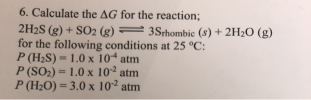 6. Calculate the AG for the reaction; 2H2S (g) + SO2 (g) = 3Srhombic (s) + 2H20 (g) for the following conditions at 25 °C: P (H2S) = 1.0 x 10⁻⁴ atm P (SO2) = 1.0 x 10⁻² atm P (H2O) = 3.0 x 10⁻² atm
Consider the following reaction: 2H2S(g)+SO2(g)⇌3S(s)+2H2O(g) A reaction mixture initially containing 0.480 M H2S and 0.480 M...
Consider the following reaction: 2H2S(g)+SO2(g)⇌3S(s)+2H2O(g) A reaction mixture initially containing 0.480 M H2S and 0.480 M SO2 was found to contain 1.0×10⁻³ M H2O at a certain temperature. A second reaction mixture at the same temperature initially contains [H2S]= 0.255 M and [SO2]= 0.325 M . Calculate the equilibrium concentration of H2O in the second mixture at this temperature. Express your answer using two significant figures.
 3. Entropy a. Rank the following systems in order of increasing entropy. i. 1 mol of Ne (g) at 273 K and 20 L ii. 0.5 mol of Ne (g) at 100 K and 20 L ii. 0.5 mol of Ne () at 100 K iv. I mol of CClh (g) at 273 K and 40 L Lowest Entropy: Highest Entropy: The reaction below is the basis of a suggested method for removal of SOs, a pollutant that irritates airways...
 34. At volcanic sites, sulfur is formed via the following reaction. 2 H2S(g) +SO2(g) = 3S(s) +2 H20(g) a. Calculate the equilibrium constant, K, for this reaction at 25°C. 4 Gº (kJ/mol H2S (8) SO2) H20 (8) -33.0 -300.4 -228.6 s, b. Predict whether sulfur formation becomes more or less favorable as temperature increases. Explain. C Sulfur dioxide is a pollutant released by power plants. Would this reaction be suitable for removing SO2 from power plant waste?
 (1) Consider SO2 (g) + 2H2S(g) = 3(g) + 2H2O(1) AH : (i) SO2 (g) = -296.8 KJ/mol (ii) H2S (g) = -20.4 KJ/mol (iii) H20 (1) = -285.84 KJ/mol AH for the above reaction is: (a) 234.08 KJ (b)-234.08 KJ (c) 31.36 kJ (d) -31.36 KJ (e) None (2) The above reaction is (a) Endothermic (b) Exothermic (c) entropic (3) in k = Ae Ea/RT, Ea is (a) Activation Energy (b) 8.314 J/mol.K (c) Rate constant (4) In a...
 6. Calculate the AG for the reaction; 2H2S (g) + SO2 (g) = 3Srhombic (s) + 2H20 (g) for the following conditions at 25 °C: P (H2S) = 1.0 x 10⁻⁴ atm P (SO2) = 1.0 x 10⁻² atm P (H2O) = 3.0 x 10⁻² atm
Most questions answered within 3 hours.
-
Where is the error in this code sequence?
String s1 = "Hello";
String s2 = "ello";...
asked 11 months ago -
Financial data for Joel de Paris, Inc., for last year
follow:
Joel de Paris, Inc.
Balance...
asked 11 months ago -
Consider this reaction:
Al2(SO4)3 (aq)+ BaCl3
(aq) Al2Cl6 (aq)- +
3BaSO4(s) . What is the...
asked 11 months ago -
Suppose that Savneet is considering increasing her
recent random sample from 20 car rentals to 40...
asked 11 months ago -
Trucks arrive at an unloading terminal at an average rate of 120
per hour.
Trucks arrive...
asked 11 months ago -
Why are methanol and ethanol completely soluble in water while
octanol is not very little soluble....
asked 11 months ago -
A facilities manager at a university reads in a research report
that the mean amount of...
asked 11 months ago -
When the CuSO4 is rehydrated by adding water to the anhydrous
compound, is this an endothermic...
asked 11 months ago -
A ray of sunlight is passing from diamond into crown glass; the
angle of incidence is...
asked 11 months ago -
A block of mass 0.249 kg is placed on top of a light, vertical
spring of...
asked 11 months ago -
how do the kidneys compensate in the presences of acidosis
a) trigger hyperventilate
b) reserve acid...
asked 11 months ago -
Question 501 pts
The rental rate of capital to the firm increases. Which of the
following...
asked 11 months ago