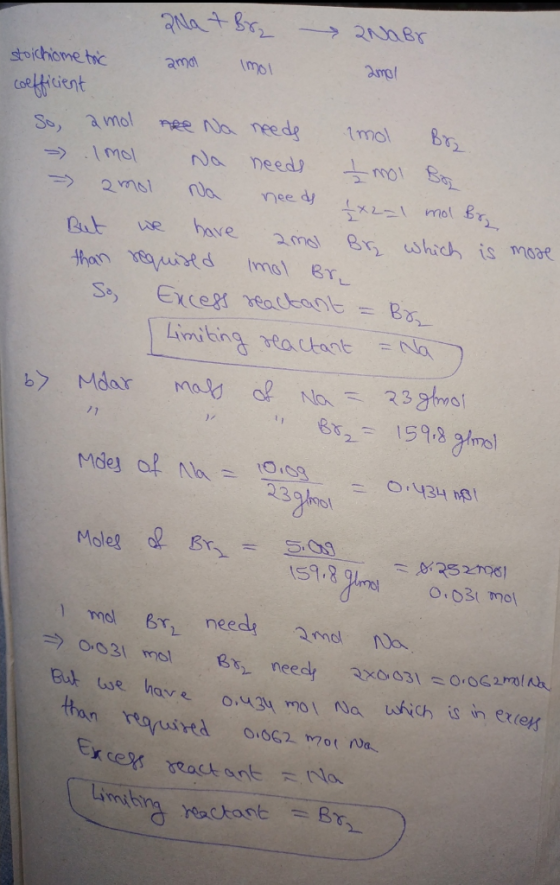
Find the limiting reactant for each of the following. 2Na + Br2 —> 2NaBr (a) 2...
Homework Answers
Add Answer to:
Find the limiting reactant for each of the following.
2Na + Br2 —> 2NaBr
(a) 2...
2. ( pls.) Limiting Reactant and Theoretical Yield (7 pts.) 2Na (s) + Cl2 (g) →...
 2. ( pls.) Limiting Reactant and Theoretical Yield (7 pts.) 2Na (s) + Cl2 (g) → 2NaCl (s) You are given 84.9 g Na and 53.2 g Cl2. Find the limiting reactant, and calculate the theoretical yield in grams from the reaction shown above. (Box your answers!) Na = 22.990 g/mol; CI = 35.453 g/mol PACA
2. (7 pts.) Limiting Reactant and Theoretical Yield (7 pts.) 2Na (s) + Cl2 (g) -...
 2. (7 pts.) Limiting Reactant and Theoretical Yield (7 pts.) 2Na (s) + Cl2 (g) - 2NaCl (s) You are given 84.9 g Na and 53.2 g Cl2. Find the limiting reactant, and calculate the theoretical yield in grams from the reaction shown above. (Box your answers!) Na = 22.990 g/mol; CI = 35.453 g/mol 22.990 mo lng & Appoy angl nach 229909x imoina Trimorol mol Nad mol 8Hana 2 molNG =0.265 35.453 g/mol x Imola x 2 mol Nach...
5 Mol Na, 5 mol Br2 and 2.3 mol Na, 1.9 mol Br2 2.5 mol Na,...
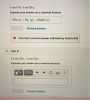 5 Mol Na, 5 mol Br2 and 2.3 mol Na, 1.9 mol Br2
2.5 mol Na, 1 mol Br2 and 11.8 mol Na, 6.9 mol Br2
5 mol Na, 5 mol Br2 Express your answer as a chemical formula. 2Na (s) + Br2 (g) +2NaBr (s) Submit Previous Answers X Incorrect; correct answer withheld by instructor Part B 2.3 mol Na, 1.9 mol Br2 Express your answer as a chemical formula. 0 ΑΣΦ ? Submit Previous Answers for 2.5 mol...
5 Mol Na, 5 mol Br2 and 2.3 mol Na, 1.9 mol Br2
2.5 mol Na, 1 mol Br2 and 11.8 mol Na, 6.9 mol Br2
5 mol Na, 5 mol Br2 Express your answer as a chemical formula. 2Na (s) + Br2 (g) +2NaBr (s) Submit Previous Answers X Incorrect; correct answer withheld by instructor Part B 2.3 mol Na, 1.9 mol Br2 Express your answer as a chemical formula. 0 ΑΣΦ ? Submit Previous Answers for 2.5 mol...
for the reaction shown, find the limiting reactant for each of the following initial amounts of...
for the reaction shown, find the limiting reactant for each of the following initial amounts of reactants. 4Al(s)+3O2(g)->2Al2O3(s) -11.4 mol Al,9.5 mol O2 -1 mol Al,1 mol O2 -20 mol Al,16 mol O2 -4mol Al,2.6 mol O2
23) In the following equations, determine which reactant is the limiting reactant and which reactant is...
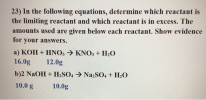 23) In the following equations, determine which reactant is the limiting reactant and which reactant is in excess. The amounts used are given below each reactant. Show evidence for your answers. a) KOH + HNO3 → KNO3 + H2O 16.0g 12.0g b)2 NaOH + H2SO4 → Na2SO4 + H2O 10.0 g 10.0g
Thanks 14. For the reaction shown, find the limiting reactant for each of the initial amounts...
 Thanks
14. For the reaction shown, find the limiting reactant for each of the initial amounts of reactants. 4 Al(s) + 3 O2(g) → 2 Al2O3(s) a. ImolAl, 1mol02 b. 4molA1,2.6mol02 c. 16molAl,13mol02 d. 7.4 mol Al, 6.5 mol O2
Thanks
14. For the reaction shown, find the limiting reactant for each of the initial amounts of reactants. 4 Al(s) + 3 O2(g) → 2 Al2O3(s) a. ImolAl, 1mol02 b. 4molA1,2.6mol02 c. 16molAl,13mol02 d. 7.4 mol Al, 6.5 mol O2
NAME 1) For the reaction shown, find the limiting reactant and the theoretical yield in moles...
 NAME 1) For the reaction shown, find the limiting reactant and the theoretical yield in moles of potassium chloride (CI) with the following initial quantities of reactants: 14.6 mol K, 7.8 mol Cla 2 K{s} + Cla(g) – 2 KCl(s) 2) For the reaction shown, find the limiting reactant and the theoretical yield of the product (LiF) in grams for the following initial quantities of reactants: 10.5g Li and 37.2g F2 2 Li(s) + F2(g) → 2 Lif(s) 3) Consider...
For the reaction shown, find the limiting reactant for each of the following initial amounts of...
For the reaction shown, find the limiting reactant for each of the following initial amounts of reactants. 4Al(s)+3O2(g)?2Al2O3(s) In which is Al limiting and which is O2 limiting? 1.) 1 mole Al and 1 mole O2 2.) 4 mole Al and 2.6 mole O2 3.) 11.4 mole Al and 9.5 mole O2 4.)24 mole Al and 19 mole O2
4. Consider the chemical equation for the synthesis of sodium chloride. (0.5 points per blank) 2Na...
4. Consider the chemical equation for the synthesis of sodium chloride. (0.5 points per blank) 2Na (s) + Cl2 (g) -----> 2NaCl(g) How many moles of NaCl can be formed from 2 moles of Na and 1 mole of Cl2? ______mol NaCl If you have 8 moles of Na and 5 moles of Cl2, how many moles of NaCl could be produced? Which reactant limits the amount of product? ________ mol NaCl __________ is the limiting reactant. How many moles...
3. Determine the limiting reactant and the mass of AlCl3 produced by reacting 15.0 g of...
 3. Determine the limiting reactant and the mass of AlCl3 produced by reacting 15.0 g of Al with 30.0 g of Cly according to the following chemical equation. The molar mass of AICI is 133.33 g/mol. A1 = 26.98 g/mol 2 Al(s) + 3 Cl2 (g) → 2 AlCl3(s) C1 = 35.45 g/mol A) Al is the limiting reactant, 32.4 g of AlCl3 produced. B) Al is the limiting reactant, 74.1 g of AlCl3 produced. C) Cl2 is the limiting...
 2. ( pls.) Limiting Reactant and Theoretical Yield (7 pts.) 2Na (s) + Cl2 (g) → 2NaCl (s) You are given 84.9 g Na and 53.2 g Cl2. Find the limiting reactant, and calculate the theoretical yield in grams from the reaction shown above. (Box your answers!) Na = 22.990 g/mol; CI = 35.453 g/mol PACA
 2. (7 pts.) Limiting Reactant and Theoretical Yield (7 pts.) 2Na (s) + Cl2 (g) - 2NaCl (s) You are given 84.9 g Na and 53.2 g Cl2. Find the limiting reactant, and calculate the theoretical yield in grams from the reaction shown above. (Box your answers!) Na = 22.990 g/mol; CI = 35.453 g/mol 22.990 mo lng & Appoy angl nach 229909x imoina Trimorol mol Nad mol 8Hana 2 molNG =0.265 35.453 g/mol x Imola x 2 mol Nach...
 5 Mol Na, 5 mol Br2 and 2.3 mol Na, 1.9 mol Br2
2.5 mol Na, 1 mol Br2 and 11.8 mol Na, 6.9 mol Br2
5 mol Na, 5 mol Br2 Express your answer as a chemical formula. 2Na (s) + Br2 (g) +2NaBr (s) Submit Previous Answers X Incorrect; correct answer withheld by instructor Part B 2.3 mol Na, 1.9 mol Br2 Express your answer as a chemical formula. 0 ΑΣΦ ? Submit Previous Answers for 2.5 mol...
5 Mol Na, 5 mol Br2 and 2.3 mol Na, 1.9 mol Br2
2.5 mol Na, 1 mol Br2 and 11.8 mol Na, 6.9 mol Br2
5 mol Na, 5 mol Br2 Express your answer as a chemical formula. 2Na (s) + Br2 (g) +2NaBr (s) Submit Previous Answers X Incorrect; correct answer withheld by instructor Part B 2.3 mol Na, 1.9 mol Br2 Express your answer as a chemical formula. 0 ΑΣΦ ? Submit Previous Answers for 2.5 mol...
 23) In the following equations, determine which reactant is the limiting reactant and which reactant is in excess. The amounts used are given below each reactant. Show evidence for your answers. a) KOH + HNO3 → KNO3 + H2O 16.0g 12.0g b)2 NaOH + H2SO4 → Na2SO4 + H2O 10.0 g 10.0g
 Thanks
14. For the reaction shown, find the limiting reactant for each of the initial amounts of reactants. 4 Al(s) + 3 O2(g) → 2 Al2O3(s) a. ImolAl, 1mol02 b. 4molA1,2.6mol02 c. 16molAl,13mol02 d. 7.4 mol Al, 6.5 mol O2
Thanks
14. For the reaction shown, find the limiting reactant for each of the initial amounts of reactants. 4 Al(s) + 3 O2(g) → 2 Al2O3(s) a. ImolAl, 1mol02 b. 4molA1,2.6mol02 c. 16molAl,13mol02 d. 7.4 mol Al, 6.5 mol O2
 NAME 1) For the reaction shown, find the limiting reactant and the theoretical yield in moles of potassium chloride (CI) with the following initial quantities of reactants: 14.6 mol K, 7.8 mol Cla 2 K{s} + Cla(g) – 2 KCl(s) 2) For the reaction shown, find the limiting reactant and the theoretical yield of the product (LiF) in grams for the following initial quantities of reactants: 10.5g Li and 37.2g F2 2 Li(s) + F2(g) → 2 Lif(s) 3) Consider...
 3. Determine the limiting reactant and the mass of AlCl3 produced by reacting 15.0 g of Al with 30.0 g of Cly according to the following chemical equation. The molar mass of AICI is 133.33 g/mol. A1 = 26.98 g/mol 2 Al(s) + 3 Cl2 (g) → 2 AlCl3(s) C1 = 35.45 g/mol A) Al is the limiting reactant, 32.4 g of AlCl3 produced. B) Al is the limiting reactant, 74.1 g of AlCl3 produced. C) Cl2 is the limiting...
Most questions answered within 3 hours.
-
Where is the error in this code sequence?
String s1 = "Hello";
String s2 = "ello";...
asked 10 months ago -
Financial data for Joel de Paris, Inc., for last year
follow:
Joel de Paris, Inc.
Balance...
asked 10 months ago -
Consider this reaction:
Al2(SO4)3 (aq)+ BaCl3
(aq) Al2Cl6 (aq)- +
3BaSO4(s) . What is the...
asked 10 months ago -
Suppose that Savneet is considering increasing her
recent random sample from 20 car rentals to 40...
asked 10 months ago -
Trucks arrive at an unloading terminal at an average rate of 120
per hour.
Trucks arrive...
asked 10 months ago -
Why are methanol and ethanol completely soluble in water while
octanol is not very little soluble....
asked 10 months ago -
A facilities manager at a university reads in a research report
that the mean amount of...
asked 10 months ago -
When the CuSO4 is rehydrated by adding water to the anhydrous
compound, is this an endothermic...
asked 10 months ago -
A ray of sunlight is passing from diamond into crown glass; the
angle of incidence is...
asked 10 months ago -
A block of mass 0.249 kg is placed on top of a light, vertical
spring of...
asked 10 months ago -
how do the kidneys compensate in the presences of acidosis
a) trigger hyperventilate
b) reserve acid...
asked 10 months ago -
Question 501 pts
The rental rate of capital to the firm increases. Which of the
following...
asked 10 months ago