Complete these structures by adding dots as needed. Complete these structures by adding dots as needed.
Complete these structures by adding dots as needed.

Homework Answers
Structure of a molecule can be drawn based on valance of the atoms involved in the structure.
An atom form maximum number of bonds in order to get octet configuration.
Consider the atoms present in the structures; connect them to satisfying their valance. Place the nonbonding electrons on the atoms in the structure.
Special orientation of atoms present in a molecule is called molecular structure.
Electrons that do not involved in the bond formation are called as non-bonding electrons. The on bonding electrons are generally represented with dots.
Hydrogen forms only one bond with other atoms. Fluorine can also form a single bond to complete its octet. Fluorine belongs to Group 7A of the periodic table, its valance is 1.
Structure of is as follows:

Hydrogen forms only one bond with other atoms. Oxygen can form two bonds to get octet configuration. Oxygen belongs to Group 6A of the periodic table, its valance is 2.
Complete structure is shown below.

Oxygen can form two bonds to get octet configuration. Oxygen belongs to Group 6A of the periodic table, its valance is 2.
Nitrogen can form three bonds to complete its octet configuration. Nitrogen belongs to Group 5A of the periodic table, its valance is 3.
Complete structure is shown below.

The complete structure is as follows:
Add Answer to:
Complete these structures by adding dots as needed.
Complete these structures by adding dots as needed.
Complete these structures by adding electron dots as needed. Complete these structures by adding electron dots...
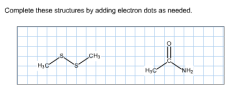 Complete these structures by adding electron dots as
needed.
Complete these structures by adding electron dots as needed.
Complete these structures by adding electron dots as
needed.
Complete these structures by adding electron dots as needed.
Complete these structures by adding electrons, in the form of dots, as needed.
Complete these structures by adding electrons, in the form of dots, as needed.
Complete these structures by adding electrons, in the form of dots, as needed. HF H2O
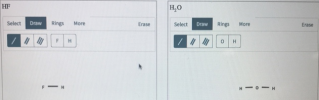 Complete these structures by adding electrons, in the form of dots, as needed. HF H2O
Complete these structures by adding electron dots as needed. You can clear your work by clicking...
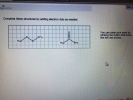 Complete these structures by adding electron dots as needed. You can clear your work by clicking the button that looks like two red arrows.
complete the lewis structures of the atoms and ions by adding electrons, as needed. a) Li...
complete the lewis structures of the atoms and ions by adding electrons, as needed. a) Li B) Na C) Na+ D) F-
Complete these structures by adding bonds and lone pairs as necessary. Then, determine the nitrogen-to-oxygen bond...
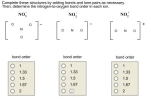 Complete these structures by adding bonds and lone pairs as
necessary. Then, determine the nitrogen-to-oxygen bond order in
each ion.
Complete these structures by adding bonds and lone pairs as
necessary. Then, determine the nitrogen-to-oxygen bond order in
each ion.
13. Complete the structures by adding the atoms, to produce a distinct isomer in every case....
 13. Complete the structures by adding the atoms, to produce a distinct isomer in every case. Assign a symmetry point group to every structure. ****** [TeOCIF4 TeOCIFA) [TeOCI2F31 [TeocleFar
14. Complete the structures by adding the atoms, to produce a distinct isomer in every case....
 14. Complete the structures by adding the atoms, to produce a distinct isomer in every case. Assign a symmetry point group to every structure. a AMF FF Fina F Fma Ficc F a F F aa a SCI2F4 SCI2F4 SCI3F3 C SC13F3
An experiment consists of rolling two fair dice and adding the dots on the two sides...
 An experiment consists of rolling two fair dice and adding the dots on the two sides facing up. Using the sample space provided below and assuming each simple event is as likely as any other, find the probability that the sum of the dots is 9 or 11 Click the icon to view the sample space. The probability the sum of the two die is either 9 or 11 is (Type an integer or a simplified fraction.)
An experiment consists of rolling two fair dice and adding the dots on the two sides...
 An experiment consists of rolling two fair dice and adding the dots on the two sides facing up. Using the sample space provided below and assuming each simple event is as likely as any other, find the probability that the sum of the dots is 7 or 6 Click the icon to view the sample space. The probability the sum of the two die is either 7 or 6 is a (Type an integer or a simplified fraction)
 Complete these structures by adding electron dots as
needed.
Complete these structures by adding electron dots as needed.
Complete these structures by adding electron dots as
needed.
Complete these structures by adding electron dots as needed.
 Complete these structures by adding electron dots as needed. You can clear your work by clicking the button that looks like two red arrows.
 Complete these structures by adding bonds and lone pairs as
necessary. Then, determine the nitrogen-to-oxygen bond order in
each ion.
Complete these structures by adding bonds and lone pairs as
necessary. Then, determine the nitrogen-to-oxygen bond order in
each ion.
 13. Complete the structures by adding the atoms, to produce a distinct isomer in every case. Assign a symmetry point group to every structure. ****** [TeOCIF4 TeOCIFA) [TeOCI2F31 [TeocleFar
 14. Complete the structures by adding the atoms, to produce a distinct isomer in every case. Assign a symmetry point group to every structure. a AMF FF Fina F Fma Ficc F a F F aa a SCI2F4 SCI2F4 SCI3F3 C SC13F3
 An experiment consists of rolling two fair dice and adding the dots on the two sides facing up. Using the sample space provided below and assuming each simple event is as likely as any other, find the probability that the sum of the dots is 9 or 11 Click the icon to view the sample space. The probability the sum of the two die is either 9 or 11 is (Type an integer or a simplified fraction.)
 An experiment consists of rolling two fair dice and adding the dots on the two sides facing up. Using the sample space provided below and assuming each simple event is as likely as any other, find the probability that the sum of the dots is 7 or 6 Click the icon to view the sample space. The probability the sum of the two die is either 7 or 6 is a (Type an integer or a simplified fraction)
Most questions answered within 3 hours.
-
Where is the error in this code sequence?
String s1 = "Hello";
String s2 = "ello";...
asked 11 months ago -
Financial data for Joel de Paris, Inc., for last year
follow:
Joel de Paris, Inc.
Balance...
asked 11 months ago -
Consider this reaction:
Al2(SO4)3 (aq)+ BaCl3
(aq) Al2Cl6 (aq)- +
3BaSO4(s) . What is the...
asked 11 months ago -
Suppose that Savneet is considering increasing her
recent random sample from 20 car rentals to 40...
asked 11 months ago -
Trucks arrive at an unloading terminal at an average rate of 120
per hour.
Trucks arrive...
asked 11 months ago -
Why are methanol and ethanol completely soluble in water while
octanol is not very little soluble....
asked 11 months ago -
A facilities manager at a university reads in a research report
that the mean amount of...
asked 11 months ago -
When the CuSO4 is rehydrated by adding water to the anhydrous
compound, is this an endothermic...
asked 11 months ago -
A ray of sunlight is passing from diamond into crown glass; the
angle of incidence is...
asked 11 months ago -
A block of mass 0.249 kg is placed on top of a light, vertical
spring of...
asked 11 months ago -
how do the kidneys compensate in the presences of acidosis
a) trigger hyperventilate
b) reserve acid...
asked 11 months ago -
Question 501 pts
The rental rate of capital to the firm increases. Which of the
following...
asked 11 months ago