complete the lewis structures of the atoms and ions by adding electrons, as needed. a) Li...
complete the lewis structures of the atoms and ions by adding electrons, as needed.
a) Li
B) Na
C) Na+
D) F-
Homework Answers
The concept used in solving this problem is the formation of bonds amongst the atoms and the possible electron lone pairs of a molecule, which forms Lewis structures. The excess number of electrons that helps in the formation of lone pairs can be represented as the pairs of dots, thus, can be placed next to an atom.
Lewis structures are also known as Lewis dot structures, formulas or diagrams. They are the diagrams that are used to define a bond between the lone pair of electrons and the atoms that are present in a molecule. The chemical symbol of a molecule is used in the Lewis structure to represent the atoms and their positions in a molecule.
Part a
A chemical element having the atomic number three and symbol  is known as lithium. It consists of only one valence electron, which can be given easily thereby forming a cation. Lithium has its wide industrial applications.
Lithium falls in Group one of the periodic table, which means it has one valence electron. When the Lewis structure of lithium has been drawn, a single dot is put next to the symbol of lithium, which represents its one valence electron. Thus, one electron in the outer orbital of lithium can complete its Lewis structure. The Lewis structure of lithium is shown below:
 .
.
Sodium falls in Group one of the periodic table, which means it has one valence electron. When the Lewis structure of sodium has been drawn, a single dot is put next to the symbol of sodium, which represents its one valence electron. Thus, one electron in the outer orbital of sodium can complete its Lewis structure. The Lewis structure of sodium is shown below:

Sodium falls in Group one of the periodic table, which means it has one valence electron. This electron is donated thereby forming the cation of sodium, . This form of sodium defines that it has lost its electron. Sodium has only one electron to begin and losing of that electron makes its Lewis structure without any dots. Thus, the absence of electrons in the outer most orbital completes its Lewis structure.

Fluorine falls in Group seven of the periodic table, which means it has seven valence electrons. The formation of fluoride occurs through the reduction of fluorine atom. The negative charge defines that it requires eight electrons in its outer most orbital to complete its Lewis structure. Thus, eight electrons in the outer orbital of  completing its Lewis structure can be shown as:

The complete Lewis structure of lithium is:
The complete Lewis structure of sodium is:
The complete Lewis structure of sodium is:
The complete Lewis structure of fluorine is:
Add Answer to:
complete the lewis structures of the atoms and ions by adding
electrons, as needed.
a) Li...
Complete these structures by adding electrons, in the form of dots, as needed.
Complete these structures by adding electrons, in the form of dots, as needed.
Complete these structures by adding electrons, in the form of dots, as needed. HF H2O
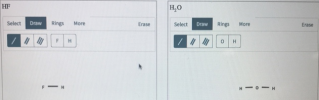 Complete these structures by adding electrons, in the form of dots, as needed. HF H2O
Complete these structures by adding dots as needed. Complete these structures by adding dots as needed.
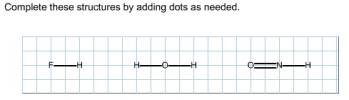 Complete these structures by adding dots as needed.
Complete these structures by adding dots as needed.
Complete these structures by adding dots as needed.
(8) 13. Draw Lewis dot structures for the following atoms and ions: a. a calcium ion...
 (8) 13. Draw Lewis dot structures for the following atoms and ions: a. a calcium ion b. an iodine atom c. a nitride ion d. a berylium atom e. a xenon atom
Complete these structures by adding electron dots as needed. Complete these structures by adding electron dots...
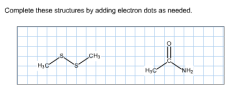 Complete these structures by adding electron dots as
needed.
Complete these structures by adding electron dots as needed.
Complete these structures by adding electron dots as
needed.
Complete these structures by adding electron dots as needed.
Complete the Lewis dot (electron-dot) structure for the given neutral atoms. Magnesium Sulfur Select Draw Rings...
 Complete the Lewis dot (electron-dot) structure for the given neutral atoms. Magnesium Sulfur Select Draw Rings More Select Draw Complete these structures by adding electrons, in the form of dots, as needed. HF HO Select Draw Rings More Erase Select Draw Rings More Erase / HO - H about us careers privacy policy terms of use contact
3. Place two electrons in each bond 4. Complete the octets of the atoms attached to...
 3. Place two electrons in each bond 4. Complete the octets of the atoms attached to the central atom by adding e in pairs. 5. Place any remaining electrons on the central atom in pairs. 6. If the central atom has less than an octet, form double bonds. If necessary, form triple bonds. 13) Draw the Lewis structures for: a. AsCla b. ClO2 C. HNO2 d. XeF2 Skill 23: Formal Charge (section 8.7) For determining formal charge: 1) For each...
14. Complete the structures by adding the atoms, to produce a distinct isomer in every case....
 14. Complete the structures by adding the atoms, to produce a distinct isomer in every case. Assign a symmetry point group to every structure. a AMF FF Fina F Fma Ficc F a F F aa a SCI2F4 SCI2F4 SCI3F3 C SC13F3
2. Add the e appropriate number of lone pairs to these Lewis structures of polyatomic ions:...
 2. Add the e appropriate number of lone pairs to these Lewis structures of polyatomic ions: IF-CI-FI IF-CI-FI F-CI-F Choose the most likely identity for the central atom, X, for each of the following Lewis Structures from the following list: Li, Be, B, C, o, F, P, S, Xe 3. CI-X-CI: CI-X-Cl Draw the Lewis Structure for HCOOH. Identify the bond angles and the molecular geometry and hybridization around each central atom. bonds present in the molecule. 4. Finally, identify...
c. Mg ules for drawing Lewis Structures: Count up all the valence electrons and add them...
 c. Mg ules for drawing Lewis Structures: Count up all the valence electrons and add them up. Arrange atoms in a bonding conf round the outside. guration. Least electronegative atom typically goes in the midle. H gets arra g . Put the electron in- 2 electrons for each single bond between atoms. Put extra electrons ut any extra there. on outer atoms that can accept them as lone pairs. Hydrogen can only have two electrons so . Check that each...
 Complete these structures by adding dots as needed.
Complete these structures by adding dots as needed.
Complete these structures by adding dots as needed.
 (8) 13. Draw Lewis dot structures for the following atoms and ions: a. a calcium ion b. an iodine atom c. a nitride ion d. a berylium atom e. a xenon atom
 Complete these structures by adding electron dots as
needed.
Complete these structures by adding electron dots as needed.
Complete these structures by adding electron dots as
needed.
Complete these structures by adding electron dots as needed.
 Complete the Lewis dot (electron-dot) structure for the given neutral atoms. Magnesium Sulfur Select Draw Rings More Select Draw Complete these structures by adding electrons, in the form of dots, as needed. HF HO Select Draw Rings More Erase Select Draw Rings More Erase / HO - H about us careers privacy policy terms of use contact
 3. Place two electrons in each bond 4. Complete the octets of the atoms attached to the central atom by adding e in pairs. 5. Place any remaining electrons on the central atom in pairs. 6. If the central atom has less than an octet, form double bonds. If necessary, form triple bonds. 13) Draw the Lewis structures for: a. AsCla b. ClO2 C. HNO2 d. XeF2 Skill 23: Formal Charge (section 8.7) For determining formal charge: 1) For each...
 14. Complete the structures by adding the atoms, to produce a distinct isomer in every case. Assign a symmetry point group to every structure. a AMF FF Fina F Fma Ficc F a F F aa a SCI2F4 SCI2F4 SCI3F3 C SC13F3
 2. Add the e appropriate number of lone pairs to these Lewis structures of polyatomic ions: IF-CI-FI IF-CI-FI F-CI-F Choose the most likely identity for the central atom, X, for each of the following Lewis Structures from the following list: Li, Be, B, C, o, F, P, S, Xe 3. CI-X-CI: CI-X-Cl Draw the Lewis Structure for HCOOH. Identify the bond angles and the molecular geometry and hybridization around each central atom. bonds present in the molecule. 4. Finally, identify...
 c. Mg ules for drawing Lewis Structures: Count up all the valence electrons and add them up. Arrange atoms in a bonding conf round the outside. guration. Least electronegative atom typically goes in the midle. H gets arra g . Put the electron in- 2 electrons for each single bond between atoms. Put extra electrons ut any extra there. on outer atoms that can accept them as lone pairs. Hydrogen can only have two electrons so . Check that each...
Most questions answered within 3 hours.
-
Where is the error in this code sequence?
String s1 = "Hello";
String s2 = "ello";...
asked 11 months ago -
Financial data for Joel de Paris, Inc., for last year
follow:
Joel de Paris, Inc.
Balance...
asked 11 months ago -
Consider this reaction:
Al2(SO4)3 (aq)+ BaCl3
(aq) Al2Cl6 (aq)- +
3BaSO4(s) . What is the...
asked 11 months ago -
Suppose that Savneet is considering increasing her
recent random sample from 20 car rentals to 40...
asked 11 months ago -
Trucks arrive at an unloading terminal at an average rate of 120
per hour.
Trucks arrive...
asked 11 months ago -
Why are methanol and ethanol completely soluble in water while
octanol is not very little soluble....
asked 11 months ago -
A facilities manager at a university reads in a research report
that the mean amount of...
asked 11 months ago -
When the CuSO4 is rehydrated by adding water to the anhydrous
compound, is this an endothermic...
asked 11 months ago -
A ray of sunlight is passing from diamond into crown glass; the
angle of incidence is...
asked 11 months ago -
A block of mass 0.249 kg is placed on top of a light, vertical
spring of...
asked 11 months ago -
how do the kidneys compensate in the presences of acidosis
a) trigger hyperventilate
b) reserve acid...
asked 11 months ago -
Question 501 pts
The rental rate of capital to the firm increases. Which of the
following...
asked 11 months ago