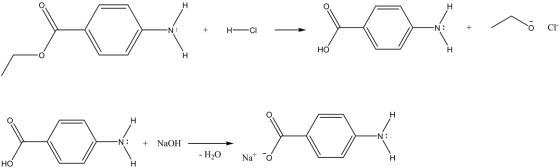
What is the equation for ethyl 4-aminobenzoate + HCl and then that + NaOH?
What is the equation for ethyl 4-aminobenzoate + HCl and then that + NaOH?
Homework Answers
According to Bronsted-Lowry acid base theory, bases can deprotonate the acid. So acids are defined as proton acceptors and bases are proton donors.
Base: The compounds, which readily accept the proton or having atoms with lone pair of electrons, are base
Acid: the compounds, which readily donate the proton or have an empty orbital to accept lone pair of electrons.
Given reactants are ethyl-4-aminobenzoate and .
In 4-aminobenzoate two functional groups are present; one is ester group and the other is amine group.
This compound is soluble in acid solutions because of the basic nature of 4-aminobenzoate due to the presence amine functional group.
Reaction between ethyl-4-aminpobenzoate and

It is also possible,

The salt formed in step1 ethyl-4-ammoniumbenzoate salt act as acid and reacts with strong base leads to ethyl-4-aminobenzoate.

Ethyl-4-aminobenzoate+ and then that+ ?
Add Answer to:
What is the equation for ethyl 4-aminobenzoate + HCl and then
that + NaOH?
1)ethyl -4-aminobenzoate + HCL followed by NaOH 2) adding dry MgSO4 to 1- Chlorobutane and toluene...
1)ethyl -4-aminobenzoate + HCL followed by NaOH 2) adding dry MgSO4 to 1- Chlorobutane and toluene mixture When we add a drying agent to the mixture water is out, then by distillation we can separate the two mixtures, what i want to know is how MgSO4 is removing the water from the solution.
Separating ethyl-4-aminobenzoate, phenanthrene, and salicylic acid in a solution. Don't know the concentrations of any of...
Separating ethyl-4-aminobenzoate, phenanthrene, and salicylic acid in a solution. Don't know the concentrations of any of them. Planning to use HCl to precipitate the salicylic acid out, but will have access to 6 M and 1 M and I'm not sure which to use. Then adding NaOH to organic layer to precipitate out the ethyl-4-aminobenzoate, but again I'm not sure what molarity to use between the 1 M and 6 M (we will have access to 1 M and 6...
Experiment: A mixture of equal proportions of benzoic acid, ethyl 4-aminobenzoate, and 1,4-dimethoxybenzene are to be...
Experiment: A mixture of equal proportions of benzoic acid, ethyl 4-aminobenzoate, and 1,4-dimethoxybenzene are to be separated by extraction using the solvent diethyl ether. Day 1: Part A. Isolation of the basic component: In a small beaker, dissolve 3 g of the mixture (benzoic acid, ethyl 4-aminobenzoate, and 1,4-dimethoxybenzene) in 30 mL of diethyl ether and transfer the mixture to a 125- mL separatory funnel (see Fig. 1) using a little diethyl ether to complete the transfer. Add 10 mL...
Okay, so we had solid benzoic acid, ethyl 4- aminobenzoate, and 9-fluorenone all dissolved in diethyl...
Okay, so we had solid benzoic acid, ethyl 4- aminobenzoate, and 9-fluorenone all dissolved in diethyl ether (4ml). We separated the basic component by adding 3M HCl, we separated the acidic component by adding 3M NaOH. I don't understand what happens here. To isolate the acidic solution, we added 6 M NaOH and used the vacuum to recover the solid. To isolate the basic solution we added 6M HCl. Here are the questions I am having trouble with... • Why...
Which is the least soluble in chloroform? Benzoic acid, 9-fluorenone, or ethyl 4-aminobenzoate?
Which is the least soluble in chloroform? Benzoic acid, 9-fluorenone, or ethyl 4-aminobenzoate?
Flow sheet: Show how the three compounds were seperated from one another. ethyl 4-aminobenzoate 2-chlorobenzoic biphenyl
Flow sheet: Show how the three compounds were seperated from one another. ethyl 4-aminobenzoate 2-chlorobenzoic biphenyl
Draw the structures of the following carbonyl compounds: 4-hydroxypentanoic acid ethyl ethanoate methyl 2-aminobenzoate 4-bromocyclohexanone 1-bromo-2-chloro-cyclopentane...
Draw the structures of the following carbonyl compounds: 4-hydroxypentanoic acid ethyl ethanoate methyl 2-aminobenzoate 4-bromocyclohexanone 1-bromo-2-chloro-cyclopentane carboxylic acid
HCl and NaOH react according to the following equation: HCl (aq) + NaOH → Na+(aq) +...
HCl and NaOH react according to the following equation: HCl (aq) + NaOH → Na+(aq) + Cl-(aq) + H2O(l) In a coffee cup calorimeter, 50mL of 2.00 M HCl was combined with 50mL of 2.05 M NaOH. The temperature of the solution rises from 22 degree C to 36 degrees C. What is the enthalpy change for the reaction (delta H rxn)? What is the molar enthalpy for the reaction? Given: The heat capacity of the calorimeter (Cc) is 14.0...
whats the ionic equation for HCl ans NaOH
whats the ionic equation for HCl ans NaOH
separation of a three-component mixture by extraction, lab report help, the compounds are benzoic acid ,9-fluorene , and ethyl-4- aminobenzoate. I need help to write Discussion about this lab report a...
separation of a three-component mixture by extraction, lab report help, the compounds are benzoic acid ,9-fluorene , and ethyl-4- aminobenzoate. I need help to write Discussion about this lab report and I dont know what should I write.I got 25% recovary for benzoic acid ,32% for ethyl-4- aminobenzoate and 50 % recovary for 9-fluorene.( by the way I lost some product of benzoic acid). please help me full paper as you could for discussion and what is the source of...
Most questions answered within 3 hours.
-
Where is the error in this code sequence?
String s1 = "Hello";
String s2 = "ello";...
asked 11 months ago -
Financial data for Joel de Paris, Inc., for last year
follow:
Joel de Paris, Inc.
Balance...
asked 11 months ago -
Consider this reaction:
Al2(SO4)3 (aq)+ BaCl3
(aq) Al2Cl6 (aq)- +
3BaSO4(s) . What is the...
asked 11 months ago -
Suppose that Savneet is considering increasing her
recent random sample from 20 car rentals to 40...
asked 11 months ago -
Trucks arrive at an unloading terminal at an average rate of 120
per hour.
Trucks arrive...
asked 11 months ago -
Why are methanol and ethanol completely soluble in water while
octanol is not very little soluble....
asked 11 months ago -
A facilities manager at a university reads in a research report
that the mean amount of...
asked 11 months ago -
When the CuSO4 is rehydrated by adding water to the anhydrous
compound, is this an endothermic...
asked 11 months ago -
A ray of sunlight is passing from diamond into crown glass; the
angle of incidence is...
asked 11 months ago -
A block of mass 0.249 kg is placed on top of a light, vertical
spring of...
asked 11 months ago -
how do the kidneys compensate in the presences of acidosis
a) trigger hyperventilate
b) reserve acid...
asked 11 months ago -
Question 501 pts
The rental rate of capital to the firm increases. Which of the
following...
asked 11 months ago