A 2-coloring of an undirected graph with n vertices and m edges is the assignment of one of two colors (say, red or green) to each vertex of the graph
A 2-coloring of an undirected graph with n vertices and m edges is the assignment of one of two colors (say, red or green) to each vertex of the graph, so that no two adjacent nodes have the same color. So, if there is an edge (u,v) in the graph, either node u is red and v is green or vice versa. Give an O(n + m) time algorithm (pseudocode!) to 2-colour a graph or determine that no such coloring exists. (Hint: Use BFS)
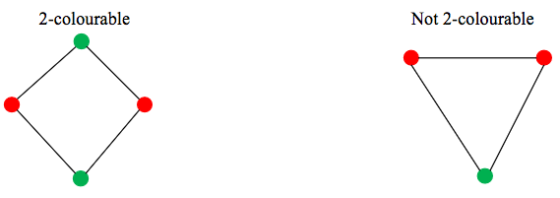
The following shows examples of graphs that are and are not 2-colourable:
Homework Answers
Algorithm to find out whether a given graph is Birpartite or not
(2-colorable or not )using Breadth First Search (BFS).
step 1. Assign RED color to the source vertex (putting into set
U).
step 2. Color all the neighbors with GREEN color (putting into set
V).
step 3. Color all neighbor's neighbor with RED color (putting into
set U).
step 4. This way, assign color to all vertices such that it
satisfies all the constraints of m way coloring problem where m =
2.
step 5. While assigning colors, if we find a neighbor which is
colored with same color as current vertex,
then the graph cannot be colored with 2 vertices (or graph is not
Bipartite)
As,we are using BFS, Time complexity is O(m+n) where m is number of
vertices and n is number of edges.
Add Answer to:
A 2-coloring of an undirected graph with n vertices and m edges is the assignment of one of two colors (say, red or green) to each vertex of the graph
B-1 Graph coloring Given an undirected graph G (V. E), a k-coloring of G is a function c : V → {0, 1, . . . ,k-1}
B-1 Graph coloring Given an undirected graph G (V. E), a k-coloring of G is a function c : V → {0, 1, . . . ,k-1} such that c(u)≠c(v) for every edge (u, v) ∈ E. In other words, the numbers 0.1,... k-1 represent the k colors, and adjacent vertices different colors. must havec. Let d be the maximum degree of any vertex in a graph G. Prove that we can color G with d +1 colors.
2. Let G = (V, E) be an undirected connected graph with n vertices and with...
2. Let G = (V, E) be an undirected connected graph with n vertices and with an edge-weight function w : E → Z. An edge (u, v) ∈ E is sparkling if it is contained in some minimum spanning tree (MST) of G. The computational problem is to return the set of all sparkling edges in E. Describe an efficient algorithm for this computational problem. You do not need to use pseudocode. What is the asymptotic time complexity of...
An undirected bipartite graph has n vertices and m edges. a) If the graph is connected,...
An undirected bipartite graph has n vertices and m edges. a) If the graph is connected, what is the minimum number of edges? b) If the graph is disconnected, what is the maximum number of edges? c) What is the longest single path? d) If the path can pass through a vertex and not any edges more than once, What is the longest path? Kindly provide me with an example for me to relate
Question 1: Given an undirected connected graph so that every edge belongs to at least one...
Question 1: Given an undirected connected graph so that every edge belongs to at least one simple cycle (a cycle is simple if be vertex appears more than once). Show that we can give a direction to every edge so that the graph will be strongly connected. Question 2: Given a graph G(V, E) a set I is an independent set if for every uv el, u #v, uv & E. A Matching is a collection of edges {ei} so...
(2) Recall the following fact: In any planar graph, there exists a vertex whose degree is s 5 Use...
 (2) Recall the following fact: In any planar graph, there exists a vertex whose degree is s 5 Use this fact to prove the six-color theorem: for any planar graph there exists a coloring with six colors, i.e. an assignment of six given colors (e.g. red, orange, yellow, green, blue, purple) to the vertices such that any two vertices connected by an edge have different colors. (Hint: use induction, and in the inductive step remove some verter and all edges...
Let G (V, E) be a directed graph with n vertices and m edges. It is known that in dfsTrace of G t...
 Let G (V, E) be a directed graph with n vertices and m edges. It is known that in dfsTrace of G the function dfs is called n times, once for each vertex It is also seen that dfs contains a loop whose body gets executed while visiting v once for each vertex w adjacent to v; that is the body gets executed once for each edge (v, w). In the worst case there are n adjacent vertices. What do...
Say that we have an undirected graph G(V, E) and a pair of vertices s, t and a vertex v that we call a a desired middle vertex . We wish to find out if there exists a simple path (every vertex appears...
Say that we have an undirected graph G(V, E) and a pair of vertices s, t and a vertex v that we call a a desired middle vertex . We wish to find out if there exists a simple path (every vertex appears at most once) from s to t that goes via v. Create a flow network by making v a source. Add a new vertex Z as a sink. Join s, t with two directed edges of capacity...
2) Let G ME) be an undirected Graph. A node cover of G is a subset...
 2) Let G ME) be an undirected Graph. A node cover of G is a subset U of the vertex set V such that every edge in E is incident to at least one vertex in U. A minimum node cover MNC) is one with the lowest number of vertices. For example {1,3,5,6is a node cover for the following graph, but 2,3,5} is a min node cover Consider the following Greedy algorithm for this problem: Algorithm NodeCover (V,E) Uempty While...
2. Consider the (undirected) graph G having the following vertex set Vand edge set E. V-0,1,2,3,4,5,6,7,8,9...
 2. Consider the (undirected) graph G having the following vertex set Vand edge set E. V-0,1,2,3,4,5,6,7,8,9 E- 0,1,10,2), 11,2;, 12,4), 12,3), 13,4), (4,5), {5.6,, 14,6, 2,7) e) [8pts] Show the action of BFS starting at vertex 2. Show action of queue, parent array implementation of BFS spanning tree and display nodes in order they are traversed. Choose next node as it occurs in the adjacency list.
Long paths in undirected graphs In this question m is the number of edges in an...
Long paths in undirected graphs In this question m is the number of edges in an undirected graph. 1. Show that if the degree of every vertex is at least k, then the graph has a simple path of length at least k. Hint: consider the longest simple path in the graph say from x to y. Show that the endpoints x and y do not have edges to vertices outside the path. Thus all the neighbors of x, y...
 (2) Recall the following fact: In any planar graph, there exists a vertex whose degree is s 5 Use this fact to prove the six-color theorem: for any planar graph there exists a coloring with six colors, i.e. an assignment of six given colors (e.g. red, orange, yellow, green, blue, purple) to the vertices such that any two vertices connected by an edge have different colors. (Hint: use induction, and in the inductive step remove some verter and all edges...
 Let G (V, E) be a directed graph with n vertices and m edges. It is known that in dfsTrace of G the function dfs is called n times, once for each vertex It is also seen that dfs contains a loop whose body gets executed while visiting v once for each vertex w adjacent to v; that is the body gets executed once for each edge (v, w). In the worst case there are n adjacent vertices. What do...
 2) Let G ME) be an undirected Graph. A node cover of G is a subset U of the vertex set V such that every edge in E is incident to at least one vertex in U. A minimum node cover MNC) is one with the lowest number of vertices. For example {1,3,5,6is a node cover for the following graph, but 2,3,5} is a min node cover Consider the following Greedy algorithm for this problem: Algorithm NodeCover (V,E) Uempty While...
 2. Consider the (undirected) graph G having the following vertex set Vand edge set E. V-0,1,2,3,4,5,6,7,8,9 E- 0,1,10,2), 11,2;, 12,4), 12,3), 13,4), (4,5), {5.6,, 14,6, 2,7) e) [8pts] Show the action of BFS starting at vertex 2. Show action of queue, parent array implementation of BFS spanning tree and display nodes in order they are traversed. Choose next node as it occurs in the adjacency list.
Most questions answered within 3 hours.
-
Where is the error in this code sequence?
String s1 = "Hello";
String s2 = "ello";...
asked 10 months ago -
Financial data for Joel de Paris, Inc., for last year
follow:
Joel de Paris, Inc.
Balance...
asked 10 months ago -
Consider this reaction:
Al2(SO4)3 (aq)+ BaCl3
(aq) Al2Cl6 (aq)- +
3BaSO4(s) . What is the...
asked 10 months ago -
Suppose that Savneet is considering increasing her
recent random sample from 20 car rentals to 40...
asked 10 months ago -
Trucks arrive at an unloading terminal at an average rate of 120
per hour.
Trucks arrive...
asked 10 months ago -
Why are methanol and ethanol completely soluble in water while
octanol is not very little soluble....
asked 10 months ago -
A facilities manager at a university reads in a research report
that the mean amount of...
asked 10 months ago -
When the CuSO4 is rehydrated by adding water to the anhydrous
compound, is this an endothermic...
asked 10 months ago -
A ray of sunlight is passing from diamond into crown glass; the
angle of incidence is...
asked 10 months ago -
A block of mass 0.249 kg is placed on top of a light, vertical
spring of...
asked 10 months ago -
how do the kidneys compensate in the presences of acidosis
a) trigger hyperventilate
b) reserve acid...
asked 10 months ago -
Question 501 pts
The rental rate of capital to the firm increases. Which of the
following...
asked 10 months ago