Suppose Zambia is open to free trade in the world market for oranges. Because of Zambia's small size, the demand for and supply of oranges in Zambia do not affect the world price.
3. Welfare effects of a tariff in a small country
Suppose Zambia is open to free trade in the world market for oranges. Because of Zambia's small size, the demand for and supply of oranges in Zambia do not affect the world price. The following graph shows the domestic oranges market in Zambia. The world price of oranges is Pw = $800 per ton.
On the following graph, use the green triangle (triangle symbols) to shade the area representing consumer surplus (CS) when the economy is at the free-trade equilibrium. Then, use the purple triangle (diamond symbols) to shade the area representing producer surplus (PS).
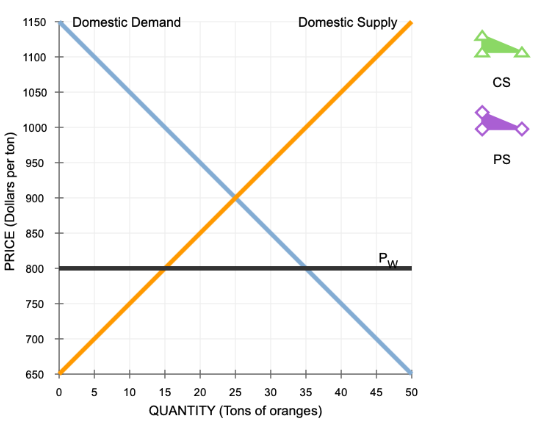
If Zambia allows international trade in the market for oranges, it will import _______ tons of oranges.
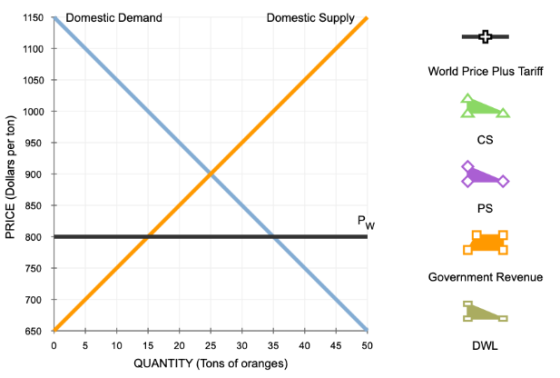
Now suppose the Zambian government decides to impose a tariff of $50 on each imported ton of oranges. After the tariff, the price Zambian consumers pay for a ton of oranges is _______ , and Zambia will import _______ tons of oranges.
Show the effects of the $50 tariff on the following graph.
Use the black line (plus symbol) to indicate the world price plus the tariff. Then, use the green points (triangle symbols) to show the consumer surplus with the tariff and the purple triangle (diamond symbols) to show the producer surplus with the tariff. Lastly, use the orange quadrilateral (square symbols) to shade the area representing government revenue received from the tariff and the tan points (rectangle symbols) to shade the areas representing deadweight loss (DWL) caused by the tariff.
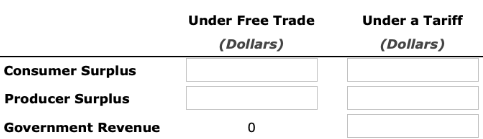
Complete the following table to summarize your results from the previous two graphs.
Based on your analysis, as a result of the tariff, Zambia's consumer surplus _______ by $_______ , producer surplus _______ by
and the government collects _______ in revenue. Therefore, the net welfare effect is a _______ of _______ .
Homework Answers
World price = $800 per ton.
If Zambia allows international trade in the market for oranges , it will import (35-15)= 20 tons of oranges.
Consumer surplus is the triangle area above the price of $800 and below the demand curve .
CS= (0.5)(1150-800)(35)= $ (0.5)(350)(35)= $ 6,125
Producer surplus is the triangle area above the supply curve and below the price of $800.
PS = (0.5)(800-650)(15)= (0.5)(150)(15)= $ 1125
These areas are shown in the below figure:

Now, suppose the government decides to impose a tariff of $50 on each imported ton of oranges . After the tariff ,the price Zambian consumers pay for a ton of oranges is $(800+50)= $850 per ton and Zambia will import (30-20)= 10 tons of oranges.
Consumer surplus with tariff is the triangle area above the price of $850 and below the demand curve .CS with tariff = (0.5)(1150-850)(30)= (0.5)(300)(30)= $ 4500
Producer surplus with tariff is the triangle area above the supply curve and below the price of $850.
PS with tariff = (0.5)(850-650)(20)= (0.5)(200)(20)= $2000
Government revenue is the rectangle area = (850-800)(30-20)= $500
These areas are shown in the below figure :

| Under free trade (Dollars) | Under Tariff (Dollars) | |
| Consumer surplus | 6125 | 4500 |
| Producer surplus | 1125 | 2000 |
| Government revenue | 0 | 500 |
As a result of the tariff ,Zambia's consumer surplus decreases by (6125-4500) = $1625 , producer surplus increases by (2000-1125)= $875 and the government collects $500 in revenue. Therefore, the net welfare effect is a decrease of (1625-875-500)= $ 250.
Add Answer to:
Suppose Zambia is open to free trade in the world market for oranges. Because of Zambia's small size, the demand for and supply of oranges in Zambia do not affect the world price.
Suppose Panama is open to free trade in the world market for maize. Because of Panama's small size, the demand for and supply of maize in Panama do not affect the world price.
 6. Welfare effects of a tariff in a small country Suppose Panama is open to free trade in the world market for maize. Because of Panama's small size, the demand for and supply of maize in Panama do not affect the world price. The following graph shows the domestic maize market in Panama. The world price of maize is Pw =$350 per ton. On the following graph, use the green triangle (triangle symbols) to shade the area representing consumer surplus (CS) when...
Suppose Bangladesh is open to free trade in the world market for maize. Because of Bangladesh's small size, the demand for and supply of maize in Bangladesh do not affect the world price.
 6. Welfare effects of a tariff in a small country Suppose Bangladesh is open to free trade in the world market for maize. Because of Bangladesh's small size, the demand for and supply of maize in Bangladesh do not affect the world price. The following graph shows the domestic maize market in Bangladesh. The world price of maize is Pw=$350 per ton. On the following graph, use the green triangle (triangle symbols) to shade the area representing consumer surplus (CS) when the...
Suppose Kenya is open to free trade In the world market for wheat. Because of Kenya's small size, the demand for and supply of wheat In Kenya do not affect the world price.
 3. Welfare effects of a tariff In a small country Suppose Kenya is open to free trade In the world market for wheat. Because of Kenya's small size, the demand for and supply of wheat In Kenya do not affect the world price. The following graph shows the domestic wheat market In Kenya. The world price of wheat is Pw - $250 per ton. On the following graph, use the green triangle (triangle symbols) to shade the area representing consumer surplus (CS)...
Aplia Homework: International Trade 3. Welfare effects of a tariff in a small country Suppose Zambia...
 Aplia Homework: International Trade 3. Welfare effects of a tariff in a small country Suppose Zambia is open to free trade in the world market for soybeans. Because of Zambia's small size, the demand for and supply of soybeans in Zambia do not affect the world price. The following graph shows the domestic soybeans market in Zambia. The world price of soybeans is Pw-$400 per ton On the following graph, use the green triangle (triangle symbols) to shade the area...
Suppose Jordan is open to free trade in the world market for oranges. Because of Jordan's...
 Suppose Jordan is open to free trade in the world market for oranges. Because of Jordan's small size, the demand for and supply of oranges in Jordan do not affect the world price. The following graph shows the domestic oranges market in Jordan. The world price of oranges is Pw $800 per ton. On the following graph, use the green triangle (triangle symbols) to shade the area representing consumer surplus (CS) when the economy is at the free-trade equilbrium. Then,...
Suppose New Zealand is open to free trade in the world market for wheat. Because of...
 Suppose New Zealand is open to free trade in the world market for wheat. Because of New Zealand's small size, the demand for apd supply of wheat in New Zealand do not affect the world price. The following graph shows the domestic wheat market in New Zealand. The world price of wheat is Rv $250 per ton. On the following graph, use the green triangle (triangle symbols) to shade the area representing consumer surplus (CS) when the economy is at...
3. Welfare effects of a tariff in a small country Suppose Bolivia is open to free...
 3. Welfare effects of a tariff in a small
country
Suppose Bolivia is open to free trade in the world market for
wheat. Because of Bolivia’s small size, the demand for and supply
of wheat in Bolivia do not affect the world price. The following
graph shows the domestic wheat market in Bolivia. The world price
of wheat is PWPW = $250 per ton.
On the following graph, use the green triangle (triangle
symbols) to shade the area representing consumer...
3. Welfare effects of a tariff in a small
country
Suppose Bolivia is open to free trade in the world market for
wheat. Because of Bolivia’s small size, the demand for and supply
of wheat in Bolivia do not affect the world price. The following
graph shows the domestic wheat market in Bolivia. The world price
of wheat is PWPW = $250 per ton.
On the following graph, use the green triangle (triangle
symbols) to shade the area representing consumer...
Use the black point (plus symbol) to indicate the equilibrium price of a tonne of oranges...
 Use the black point (plus symbol) to indicate the equilibrium price of a tonne of oranges and the equilibrium quantity of oranges in Zambia in the absence of international trade. Then, use the green point (triangle symbol) to shade the area representing consumer surplus in equilibrium. Finally, use the purple point (diamond symbol) to shade the area representing producer surplus in equilibrium. Note: Select and drag a fill area point from the palette to the graph. To fill in regions...
3. welfare effects of tariff in small country Suppose Bolivia is open to free trade in...
 3. welfare effects of tariff in small country Suppose Bolivia is open to free trade in the world market for wheat. Because of Bolivia's small size, the demand for and supply of wheat in Bolivia do not affect the world price. The following graph shows the domestic wheat market in Bolivia. The world price of wheat is P $250 per ton. On the folowing graph, use the green triangle (triangle symbols)to shade the area representing consumer surplus (CS) when the...
fill in the blank 1)increase/decrease 2)increase/decrease 3)gain/loss Suppose New Zealand is open to free trade in...
 fill in the blank
1)increase/decrease
2)increase/decrease
3)gain/loss
Suppose New Zealand is open to free trade in the world market for wheat. Because of New Zealand's small size, the demand for and supply of wheat in New Zealand do not affect the world price. The following graph shows the domestic wheat market in New Zealand. The world price of wheat is Pw = $250 per ton. On the following graph, use the green triangle (triangle symbols) to shade the area representing...
fill in the blank
1)increase/decrease
2)increase/decrease
3)gain/loss
Suppose New Zealand is open to free trade in the world market for wheat. Because of New Zealand's small size, the demand for and supply of wheat in New Zealand do not affect the world price. The following graph shows the domestic wheat market in New Zealand. The world price of wheat is Pw = $250 per ton. On the following graph, use the green triangle (triangle symbols) to shade the area representing...
 Aplia Homework: International Trade 3. Welfare effects of a tariff in a small country Suppose Zambia is open to free trade in the world market for soybeans. Because of Zambia's small size, the demand for and supply of soybeans in Zambia do not affect the world price. The following graph shows the domestic soybeans market in Zambia. The world price of soybeans is Pw-$400 per ton On the following graph, use the green triangle (triangle symbols) to shade the area...
 Suppose Jordan is open to free trade in the world market for oranges. Because of Jordan's small size, the demand for and supply of oranges in Jordan do not affect the world price. The following graph shows the domestic oranges market in Jordan. The world price of oranges is Pw $800 per ton. On the following graph, use the green triangle (triangle symbols) to shade the area representing consumer surplus (CS) when the economy is at the free-trade equilbrium. Then,...
 Suppose New Zealand is open to free trade in the world market for wheat. Because of New Zealand's small size, the demand for apd supply of wheat in New Zealand do not affect the world price. The following graph shows the domestic wheat market in New Zealand. The world price of wheat is Rv $250 per ton. On the following graph, use the green triangle (triangle symbols) to shade the area representing consumer surplus (CS) when the economy is at...
 3. Welfare effects of a tariff in a small
country
Suppose Bolivia is open to free trade in the world market for
wheat. Because of Bolivia’s small size, the demand for and supply
of wheat in Bolivia do not affect the world price. The following
graph shows the domestic wheat market in Bolivia. The world price
of wheat is PWPW = $250 per ton.
On the following graph, use the green triangle (triangle
symbols) to shade the area representing consumer...
3. Welfare effects of a tariff in a small
country
Suppose Bolivia is open to free trade in the world market for
wheat. Because of Bolivia’s small size, the demand for and supply
of wheat in Bolivia do not affect the world price. The following
graph shows the domestic wheat market in Bolivia. The world price
of wheat is PWPW = $250 per ton.
On the following graph, use the green triangle (triangle
symbols) to shade the area representing consumer...
 Use the black point (plus symbol) to indicate the equilibrium price of a tonne of oranges and the equilibrium quantity of oranges in Zambia in the absence of international trade. Then, use the green point (triangle symbol) to shade the area representing consumer surplus in equilibrium. Finally, use the purple point (diamond symbol) to shade the area representing producer surplus in equilibrium. Note: Select and drag a fill area point from the palette to the graph. To fill in regions...
 3. welfare effects of tariff in small country Suppose Bolivia is open to free trade in the world market for wheat. Because of Bolivia's small size, the demand for and supply of wheat in Bolivia do not affect the world price. The following graph shows the domestic wheat market in Bolivia. The world price of wheat is P $250 per ton. On the folowing graph, use the green triangle (triangle symbols)to shade the area representing consumer surplus (CS) when the...
 fill in the blank
1)increase/decrease
2)increase/decrease
3)gain/loss
Suppose New Zealand is open to free trade in the world market for wheat. Because of New Zealand's small size, the demand for and supply of wheat in New Zealand do not affect the world price. The following graph shows the domestic wheat market in New Zealand. The world price of wheat is Pw = $250 per ton. On the following graph, use the green triangle (triangle symbols) to shade the area representing...
fill in the blank
1)increase/decrease
2)increase/decrease
3)gain/loss
Suppose New Zealand is open to free trade in the world market for wheat. Because of New Zealand's small size, the demand for and supply of wheat in New Zealand do not affect the world price. The following graph shows the domestic wheat market in New Zealand. The world price of wheat is Pw = $250 per ton. On the following graph, use the green triangle (triangle symbols) to shade the area representing...
Most questions answered within 3 hours.
-
Where is the error in this code sequence?
String s1 = "Hello";
String s2 = "ello";...
asked 11 months ago -
Financial data for Joel de Paris, Inc., for last year
follow:
Joel de Paris, Inc.
Balance...
asked 11 months ago -
Consider this reaction:
Al2(SO4)3 (aq)+ BaCl3
(aq) Al2Cl6 (aq)- +
3BaSO4(s) . What is the...
asked 11 months ago -
Suppose that Savneet is considering increasing her
recent random sample from 20 car rentals to 40...
asked 11 months ago -
Trucks arrive at an unloading terminal at an average rate of 120
per hour.
Trucks arrive...
asked 11 months ago -
Why are methanol and ethanol completely soluble in water while
octanol is not very little soluble....
asked 11 months ago -
A facilities manager at a university reads in a research report
that the mean amount of...
asked 11 months ago -
When the CuSO4 is rehydrated by adding water to the anhydrous
compound, is this an endothermic...
asked 11 months ago -
A ray of sunlight is passing from diamond into crown glass; the
angle of incidence is...
asked 11 months ago -
A block of mass 0.249 kg is placed on top of a light, vertical
spring of...
asked 11 months ago -
how do the kidneys compensate in the presences of acidosis
a) trigger hyperventilate
b) reserve acid...
asked 11 months ago -
Question 501 pts
The rental rate of capital to the firm increases. Which of the
following...
asked 11 months ago