The overhang beam is subjected to the uniform distributed load having intensity of w = 55 kN/m. Determine shear stress developed in the beam.
The overhang beam is subjected to the uniform distributed load having intensity of w = 55 kN/m. Determine shear stress developed in the beam.
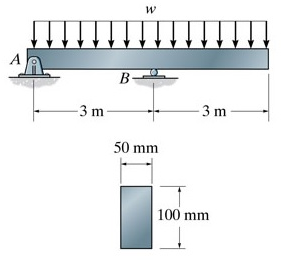
Homework Answers
A beam may be defined as a structural element that is used to bear load in transverse direction or horizontal direction.
A pin support restricts both horizontal and vertical forces but not a moment. They will allow the structure to rotate, but not to translate in any direction. Therefore, it produces two reaction forces, one in vertical and other on horizontal direction
A roller support restricts only the perpendicular force acting on it and allow both rotation and translation in horizontal direction. Therefore, it will give only single reaction in the vertical direction.
A fixed support restricts horizontal force, vertical forces and the moment too. They will not allow the structure to translate or rotate. Therefore, it produces two reaction forces and a reaction bending moment.
When all the supports are removed by replacing them with forces that prevents the translation of body in a given direction that diagram is called free body diagram. When their resultant force and couples becomes equal to zero then the body is said to be in equilibrium.
To apply these equilibrium equations, we need to know the known and unknown forces that act on the body.
The load acting on the beams may be a point load or a distributed load.
A distributed loading over a surface may be defined as the load acting over a length or area of the surface instead of a point.
From analysis point of view, to simplify their analysis these can be replaced by a equivalent concentrated point load which can be applied at a specific point. The magnitude of this equivalent load can be determined by geometry method or by integral method.
If the beam is cut at some location located at  and the portion is removed as free body, an internal shear force and bending moment must act on the cut surface for equilibrium.
Shear force and bending moment diagrams represent the shear force at each section and bending moment at each point of the beam.
The shear force and moment acting on a surface will manifest themselves as force distribution across the entire area. These force distributions have two components in normal and tangential directions called normal stress and tangential shear stress.
Write the equilibrium equations.

Here, the resultant force is  and the resultant moment about any arbitrary point is
  .
.
To determine the equivalent force of distributed loads, two methods are there:
1.Geometry method
2.Integral method
In Geometry method, the distribution curve is required for analysis. For this we have to draw the distribution curve. The area under the curve gives the magnitude of the equivalent load and the location of this point is the centroid of this distribution curve. This method is generally preferred when the curve is simple, that is, when the area and the centroid of the curve can be easily calculated.
In integral method, the distributed pressure is required as a function of length variable for example  . It is integrated over the area to get the resultant pressure.
The resultant (equivalent) load is given as:

And the point of application of this is given as:

The internal forces at any section in the beam are represented in two different ways:
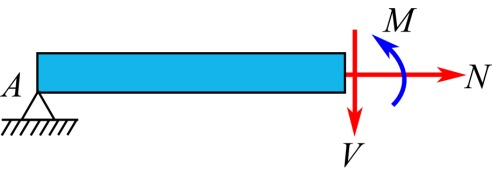
First representation: When the internal forces at any section in the beam are considered from the left end of the beam, the representation of the forces will be as follows:
Second representation: When the internal forces at any section in the beam are considered from the right end of the beam, the representation of the forces will be as follows:
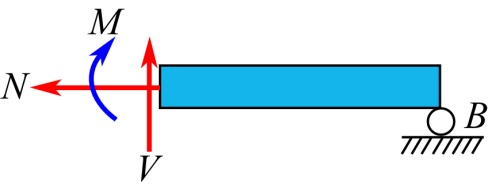
Here, V is the internal shear force, N is the internal normal force, and M is the internal bending moment.
Basic equations for the calculation of internal forces are as follows:
Moment equilibrium condition,

Force equilibrium condition along vertical direction,

Force equilibrium condition along horizontal direction,

The maximum shear stress in the beams due to vertical loads are given as:

Here, K is a factor that depends upon the section, V is the vertical load and A is the cross-sectional area.
For circular sections:

For rectangular and square sections:

General sign convention for bending moment: The bending moment is considered positive in counter-clockwise direction (also called as sagging bending) and negative in clockwise direction (also called as hogging bending).
General sign convention for vertical force: Forces in the upward direction are considered positive and in the downward direction are considered negative.
General sign convention for horizontal force: Forces towards the right direction are considered positive and towards the left direction are considered negative.
Draw Free body diagram representing forces in all directions.
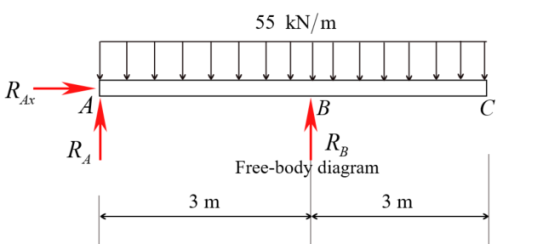
Apply the equilibrium of forces in the horizontal direction.

Here,  is the horizontal reaction force at point A.
Take moment about point A.

Here,  is the vertical reaction force at point B.
Substitute  for w.

Apply the equilibrium of forces in the vertical direction.

Here,  is the vertical reaction force at point A.
Substitute for w and  for
for  .
.

Consider a section at a distance of x from point A as shown below .
.
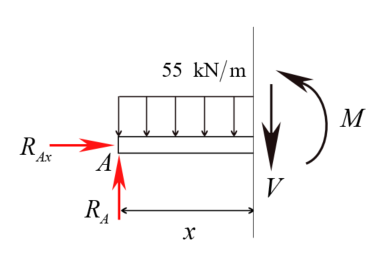
Calculate the internal forces in this section.
Apply the equilibrium of forces in the vertical direction.

Here, V is the shear force in the section.
Substitute  for
for  .
.

Calculate the shear force at  and
and  .
.
Substitute  for x.

Substitute  for x.

Consider a section at a distance of x from point A as shown below .
.
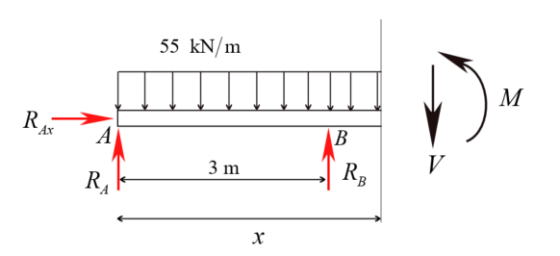
Calculate the internal forces in this section.
Apply the equilibrium of forces in the vertical direction.

Here, V is the shear force in the section.
Substitute  for
for  and
and  for
for  .
.

Calculate the shear force at  and
and  .
.


Use the values of shear force calculated at various points to plot shear force diagram as shown below.
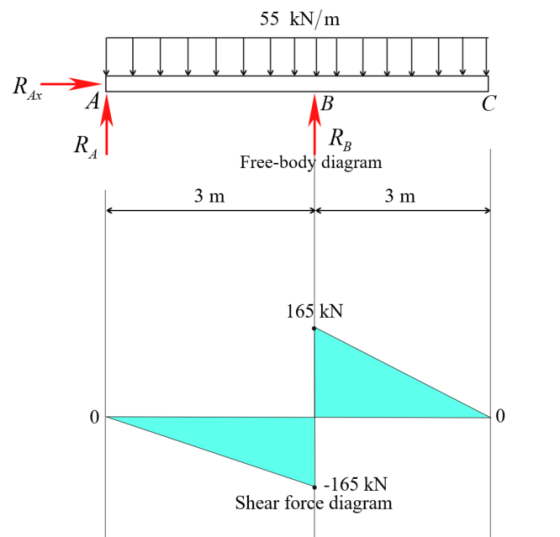
From the shear force diagram the maximum shear force in the beam is at B and equals to  .
.

Calculate the cross-sectional area of the beam.

The maximum shear stress in the beam of rectangular cross-section is:

Substitute  for A and for
  .
.

The maximum shear stress developed in the beam is  .
.
Add Answer to:
The overhang beam is subjected to the uniform distributed load having intensity of w = 55 kN/m. Determine shear stress developed in the beam.
The overhang beam is subjected to the uniform distributed load having an intensity of w = 46 kN/m (Figure 1)
 The overhang beam is subjected to the uniform distributed load having an intensity of w = 46 kN/m (Figure 1) Part A Determine the maximum shear stress developed in the beam.
The simply supported beam is subjected to a uniform distributed load, w of 30 kN/m in...
 The simply supported beam is subjected to a uniform distributed load, w of 30 kN/m in the negative y-direction and a point load, P of 15 kN in the negative z-direction. The total length, L of the beam is 6 m. Answer the questions that follow: 'n Eenvoudige opgelegde balk word belas met 'n uniform verspreide belasting van w 30 kN/m in die negatiewe y-rigting en 'n puntlas P = 15 kN in die negatiewe z-rigting. Die totale lengte, L...
The beam having a cross-section as shown is subjected to the distributed load w (1) Calculate...
 The beam having a cross-section as shown is subjected to the distributed load w (1) Calculate the moment of inertia, I (2) If the allowable maximum normal stress ơmax-20 MPa, determine the largest distributed load 5. w. (3) If w 1.5 kN/m, determine the maximum bending stress in the beam. Sketch the stress distribution acting over the cross-section. 100 mm 50mm 120 mm 3 m50 mm 3 m
Beam ABC with an overhang at one end supports a partial uniform load of intensity 12 kN/m and a concentrated moment of magnitude 4 kN·m at C (see figure).
 Beam ABC with an overhang at one end supports a partial uniform load of intensity 12 kN/m and a concentrated moment of magnitude 4 kN·m at C (see figure). Draw the shear-force and bending-moment diagrams for this beam.
Question 3. A uniform load of intensity 12 kN/m and a concentrated load of magnitude 2.4...
 Question 3. A uniform load of
intensity 12 kN/m and a concentrated load of magnitude 2.4 kN are
supported by a beam ABC with overhang at one end (see Figure 3).
Draw the shear-force and bending-moment diagrams for this beam.
Also, determine the position of maximum moment with respect to
point A.
12 kN/m 2.4 kN A С B -1.6 m -1.6 m -1.6 m
Question 3. A uniform load of
intensity 12 kN/m and a concentrated load of magnitude 2.4 kN are
supported by a beam ABC with overhang at one end (see Figure 3).
Draw the shear-force and bending-moment diagrams for this beam.
Also, determine the position of maximum moment with respect to
point A.
12 kN/m 2.4 kN A С B -1.6 m -1.6 m -1.6 m
Question 3. A uniform load of intensity 12 kN/m and a concentrated load of magnitude 2.4...
 Question 3. A uniform load of intensity 12 kN/m and a concentrated load of magnitude 2.4 kN are supported by a beam ABC with overhang at one end (see Figure 3). Draw the shear-force and bending-moment diagrams for this beam. Also, determine the position of maximum moment with respect to point A. (20 marks) 12 kN/m 2.4 kN A C B -1.6 m -1.6 m -1.6 m I Figure 3
Question 3. A uniform load of intensity 12 kN/m and a concentrated load of magnitude 2.4...
 Question 3. A uniform load of intensity 12 kN/m and a concentrated load of magnitude 2.4 kN are supported by a beam ABC with overhang at one end (see Figure 3). Draw the shear- force and bending-moment diagrams for this beam. Also, determine the position of maximum moment with respect to point A. (20 marks) 12 kN/m 2.4 kN А C B -1.6 m 1.6 m *1.6 m Figure 3
Question 3. A uniform load of intensity 12 kN/m and a concentrated load of magnitude 2.4...
 Question 3. A uniform load of intensity 12 kN/m and a concentrated load of magnitude 2.4 kN are supported by a beam ABC with overhang at one end (see Figure 3). Draw the shear- force and bending-moment diagrams for this beam. Also, determine the position of maximum moment with respect to point A. (20 marks) 12 kN/m 2.4 kN A С B ΟΙΟΙΟ -1.6 m 1.6 m - 1.6 m Figure 30
Question 3. A uniform load of intensity 12 kN/m and a concentrated load of magnitude 2.4...
 Question 3. A uniform load of intensity 12 kN/m and a concentrated load of magnitude 2.4 kN are supported by a beam ABC with overhang at one end (see Figure 3). Draw the shear- force and bending-moment diagrams for this beam. Also, determine the position of maximum moment with respect to point A. (20 marks) 12 kN/m 2.4 KN KNJ I А. C B 1.6 m -1.6 m -1.6 m Figure 3
If the shaft is subjected to a uniform distributed torque of to = 12 kN-m/m.
 Strength of Material If the shaft is subjected to a uniform distributed torque of to = 12 kN-m/m. The shaft is made of 2014-T6 aluminum alloy and is fixed at A and C. Part A Determine the maximum shear stress developed in the shaft. The shaft in is used to transmit 29 hp while turning at 590 rpm. Part A Determine the maximum shear stress in the shaft. The segments are connected together using a fillet weld having a radius of 0.18 in.
 The simply supported beam is subjected to a uniform distributed load, w of 30 kN/m in the negative y-direction and a point load, P of 15 kN in the negative z-direction. The total length, L of the beam is 6 m. Answer the questions that follow: 'n Eenvoudige opgelegde balk word belas met 'n uniform verspreide belasting van w 30 kN/m in die negatiewe y-rigting en 'n puntlas P = 15 kN in die negatiewe z-rigting. Die totale lengte, L...
 The beam having a cross-section as shown is subjected to the distributed load w (1) Calculate the moment of inertia, I (2) If the allowable maximum normal stress ơmax-20 MPa, determine the largest distributed load 5. w. (3) If w 1.5 kN/m, determine the maximum bending stress in the beam. Sketch the stress distribution acting over the cross-section. 100 mm 50mm 120 mm 3 m50 mm 3 m
 Question 3. A uniform load of
intensity 12 kN/m and a concentrated load of magnitude 2.4 kN are
supported by a beam ABC with overhang at one end (see Figure 3).
Draw the shear-force and bending-moment diagrams for this beam.
Also, determine the position of maximum moment with respect to
point A.
12 kN/m 2.4 kN A С B -1.6 m -1.6 m -1.6 m
Question 3. A uniform load of
intensity 12 kN/m and a concentrated load of magnitude 2.4 kN are
supported by a beam ABC with overhang at one end (see Figure 3).
Draw the shear-force and bending-moment diagrams for this beam.
Also, determine the position of maximum moment with respect to
point A.
12 kN/m 2.4 kN A С B -1.6 m -1.6 m -1.6 m
 Question 3. A uniform load of intensity 12 kN/m and a concentrated load of magnitude 2.4 kN are supported by a beam ABC with overhang at one end (see Figure 3). Draw the shear-force and bending-moment diagrams for this beam. Also, determine the position of maximum moment with respect to point A. (20 marks) 12 kN/m 2.4 kN A C B -1.6 m -1.6 m -1.6 m I Figure 3
 Question 3. A uniform load of intensity 12 kN/m and a concentrated load of magnitude 2.4 kN are supported by a beam ABC with overhang at one end (see Figure 3). Draw the shear- force and bending-moment diagrams for this beam. Also, determine the position of maximum moment with respect to point A. (20 marks) 12 kN/m 2.4 kN А C B -1.6 m 1.6 m *1.6 m Figure 3
 Question 3. A uniform load of intensity 12 kN/m and a concentrated load of magnitude 2.4 kN are supported by a beam ABC with overhang at one end (see Figure 3). Draw the shear- force and bending-moment diagrams for this beam. Also, determine the position of maximum moment with respect to point A. (20 marks) 12 kN/m 2.4 kN A С B ΟΙΟΙΟ -1.6 m 1.6 m - 1.6 m Figure 30
 Question 3. A uniform load of intensity 12 kN/m and a concentrated load of magnitude 2.4 kN are supported by a beam ABC with overhang at one end (see Figure 3). Draw the shear- force and bending-moment diagrams for this beam. Also, determine the position of maximum moment with respect to point A. (20 marks) 12 kN/m 2.4 KN KNJ I А. C B 1.6 m -1.6 m -1.6 m Figure 3
Most questions answered within 3 hours.
-
Where is the error in this code sequence?
String s1 = "Hello";
String s2 = "ello";...
asked 10 months ago -
Financial data for Joel de Paris, Inc., for last year
follow:
Joel de Paris, Inc.
Balance...
asked 10 months ago -
Consider this reaction:
Al2(SO4)3 (aq)+ BaCl3
(aq) Al2Cl6 (aq)- +
3BaSO4(s) . What is the...
asked 10 months ago -
Suppose that Savneet is considering increasing her
recent random sample from 20 car rentals to 40...
asked 10 months ago -
Trucks arrive at an unloading terminal at an average rate of 120
per hour.
Trucks arrive...
asked 10 months ago -
Why are methanol and ethanol completely soluble in water while
octanol is not very little soluble....
asked 10 months ago -
A facilities manager at a university reads in a research report
that the mean amount of...
asked 10 months ago -
When the CuSO4 is rehydrated by adding water to the anhydrous
compound, is this an endothermic...
asked 10 months ago -
A ray of sunlight is passing from diamond into crown glass; the
angle of incidence is...
asked 10 months ago -
A block of mass 0.249 kg is placed on top of a light, vertical
spring of...
asked 10 months ago -
how do the kidneys compensate in the presences of acidosis
a) trigger hyperventilate
b) reserve acid...
asked 10 months ago -
Question 501 pts
The rental rate of capital to the firm increases. Which of the
following...
asked 10 months ago