A force F⃗ of magnitude F making an angle θ with the x axis is applied...
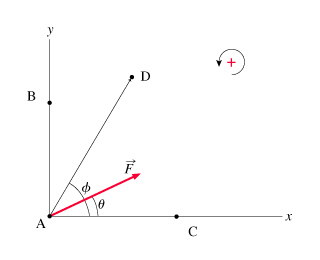
A force F⃗ of magnitude F making an angle θ with the x axis is applied to a particle located along axis of rotation A, at Cartesian coordinates (0,0) in the figure. The vector F⃗ lies in the xy plane, and the four axes of rotation A, B, C, and D all lie perpendicular to the xy plane.
A particle is located at a vector position r⃗ r→r_vec with respect to an axis of rotation (thus r⃗ r→r_vec points from the axis to the point at which the particle is located). The magnitude of the torque ττtau about this axis due to a force F⃗ F→F_vec acting on the particle is given by
τ=rFsin(α)=(momentarm)⋅F=rF⊥τ=rFsin(α)=(momentarm)⋅F=rF⊥,
where ααalpha is the angle between r⃗ r→r_vec and F⃗ F→F_vec, rrr is the magnitude of r⃗ r→r_vec, FFF is the magnitude of F⃗ F→F_vec, the component of r⃗ r→r_vec that is perpendicualr to F⃗ F→F_vec is the moment arm, and F⊥F⊥F_\perp is the component of the force that is perpendicular to r⃗ r→r_vec.
Sign convention: You will need to determine the sign by analyzing the direction of the rotation that the torque would tend to produce. Recall that negative torque about an axis corresponds to clockwise rotation.
In this problem, you must express the angle ααalpha in the above equation in terms of θθtheta, ϕϕphi, and/or ππpi when entering your answers. Keep in mind that π=180degrees and (π/2)=90degrees
A) What is the torque τA about axis A due to the force F_vec?.
B) What is the torque τB about axis B due to the force →F_vec? (B is the point at Cartesian coordinates (0,b)(0,b), located a distance b from the origin along the y axis.)
C) What is the torque τC about axis C due to →F_vec? (C is the point at Cartesian coordinates (c,0)(c,0), a distance c along the x axis.)
D) What is the torque τD about axis D due to →F_vec? (D is the point located at a distance d from the origin and making an angle ϕ with the x axis.)
Homework Answers
![BA(0,6) 90-0 Ē Ko A(0,0) @ 9=rXF ¢ (drosordein 17=11171 sing 0=60 19²0 Nm] (Ề = XP -1811Fising, = bfsin (90-0) y cobf coso (C](http://img.homeworklib.com/questions/cd3c23d0-9edf-11ea-9aae-4d8c12beccf1.png?x-oss-process=image/resize,w_560)
Add Answer to:
A force F⃗ of magnitude F making an angle θ with the x axis is
applied...
To understand two different techniques for computing the torqueon an object due to an applied...
To understand two different techniques for computing the torque on an object due to an applied force.Imagine an object with a pivot point p at the origin of the coordinate system shown (Figure 1). The force vector F⃗ lies in the xy plane, and this force of magnitude F acts on the object at a point in the xy plane. The vector r⃗ is the position vector relative to the pivot point p to the point where F⃗ is applied.The torque on the...
A torque RF is applied on a door by pushing with a perpendicular force F at...
 A torque RF is applied on a door by pushing with a perpendicular force F at a distance R from the hinge (axis of rotation), which of the following will increase the magnitude of the torque? Mark all that apply. a. Move force F closer to the axis of rotation. b. Move force F farther from the axis of rotation. c. Apply force F parallel to the moment arm. d. Apply force F at an angle of 30 to the...
A metal bar is in the xy-plane with one end of the bar at the origin. A force F⃗ =( 6.39 N )i^+( -3.16 N )j^ is applied to the bar at the point x = 2.29 m, y = 3.19 m.
A metal bar is in the xy-plane with one end of the bar at the origin. A force F =( 6.39 N )i +( -3.16 N )j is applied to the bar at the point x = 2.29 m, y = 3.19 m.A) What is the position vector r⃗ for the point where the force is applied?Enter the x and y components of the radius vector separated by a comma.*B) What is the magnitude of the torque with respect to...
What is the magnitude of the force F⃗ on the −10 nCcharge?F=? NWhat is...
 What is the magnitude of the force F⃗ on the −10 nC
charge?F=? NWhat is the direction of the force F⃗ on the −10 nC
charge? (angle from the +x-axis)θ =? ∘
What is the magnitude of the force F⃗ on the −10 nC
charge?F=? NWhat is the direction of the force F⃗ on the −10 nC
charge? (angle from the +x-axis)θ =? ∘
Two forces, F⃗ 1 and F⃗ 2, act at a point. F⃗ 1 has a magnitude...
Two forces, F⃗ 1 and F⃗ 2, act at a point. F⃗ 1 has a magnitude of 9.40 N and is directed at an angle of 58.0 ∘ above the negative x axis in the second quadrant. F⃗ 2 has a magnitude of 6.20 N and is directed at an angle of 53.1 ∘ below the negative x axis in the third quadrant. A)What is the x component of the resultant force? B)What is the y component of the resultant...
Two forces, F⃗ 1 and F⃗ 2, act at a point. The magnitude of F⃗ 1...
Two forces, F⃗ 1 and F⃗ 2, act at a point. The magnitude of F⃗ 1 is 9.50 N , and its direction is an angle 65.0 ∘ above the x-axis in the second quadrant. The magnitude of F⃗ 2 is 5.50 N , and its direction is an angle 53.1 ∘ below the x-axis in the third quadrant. A) What is the x-component of the resultant force? Express your answer in newtons. B) What is the y-component of the...
Two forces, F⃗ 1 and F⃗ 2, act at a point. F⃗ 1 has a magnitude...
Two forces, F⃗ 1 and F⃗ 2, act at a point. F⃗ 1 has a magnitude of 8.20 N and is directed at an angle of 55.0 ∘ above the negative x axis in the second quadrant. F⃗ 2 has a magnitude of 5.80 N and is directed at an angle of 53.6 ∘ below the negative x axis in the third quadrant. a) What is the x component of the resultant force? Express your answer in newtons. b) What...
Calculate the torque (magnitude and direction) about point O due to the force F⃗ in each of...
 Calculate the torque (magnitude and direction) about point O due
to the force F⃗ in each of the cases sketched in the
figure (Figure 1). In each case, the force F⃗ and the
rod both lie in the plane of the page, the rod has length 4.00 m,
and the force has magnitude 16.0 N .
We were unable to transcribe this imageConstants Part C Calculate the torque (magnitude and direction) about point O due to the force F in each of...
Calculate the torque (magnitude and direction) about point O due
to the force F⃗ in each of the cases sketched in the
figure (Figure 1). In each case, the force F⃗ and the
rod both lie in the plane of the page, the rod has length 4.00 m,
and the force has magnitude 16.0 N .
We were unable to transcribe this imageConstants Part C Calculate the torque (magnitude and direction) about point O due to the force F in each of...
Torque Related Question: Explain how the derivative is found. mas (Height (h) and angle (a) are...
 Torque Related Question: Explain how the derivative is found. mas (Height (h) and angle (a) are held constant) dan i. Write an expression for the magnitude of the torque exerted by the hanging mass about the rotation axis (pivot point), using r1, ml, a, and g. ri: the distance from the pivot to the hanging mass m1: the mass of the hanging object a: the angle between the rigid object and the floor g: the acceleration due to gravity üi....
Write the expression for the magnitude of the torque τ about a point O due to...
Write the expression for the magnitude of the torque τ about a point O due to a force F with arrow applied at distance r with arrow from O and the angle between the two vectors is θ. (Use the following as necessary: F, r, and θ.)
 A torque RF is applied on a door by pushing with a perpendicular force F at a distance R from the hinge (axis of rotation), which of the following will increase the magnitude of the torque? Mark all that apply. a. Move force F closer to the axis of rotation. b. Move force F farther from the axis of rotation. c. Apply force F parallel to the moment arm. d. Apply force F at an angle of 30 to the...
 What is the magnitude of the force F⃗ on the −10 nC
charge?F=? NWhat is the direction of the force F⃗ on the −10 nC
charge? (angle from the +x-axis)θ =? ∘
What is the magnitude of the force F⃗ on the −10 nC
charge?F=? NWhat is the direction of the force F⃗ on the −10 nC
charge? (angle from the +x-axis)θ =? ∘
 Calculate the torque (magnitude and direction) about point O due
to the force F⃗ in each of the cases sketched in the
figure (Figure 1). In each case, the force F⃗ and the
rod both lie in the plane of the page, the rod has length 4.00 m,
and the force has magnitude 16.0 N .
We were unable to transcribe this imageConstants Part C Calculate the torque (magnitude and direction) about point O due to the force F in each of...
Calculate the torque (magnitude and direction) about point O due
to the force F⃗ in each of the cases sketched in the
figure (Figure 1). In each case, the force F⃗ and the
rod both lie in the plane of the page, the rod has length 4.00 m,
and the force has magnitude 16.0 N .
We were unable to transcribe this imageConstants Part C Calculate the torque (magnitude and direction) about point O due to the force F in each of...
 Torque Related Question: Explain how the derivative is found. mas (Height (h) and angle (a) are held constant) dan i. Write an expression for the magnitude of the torque exerted by the hanging mass about the rotation axis (pivot point), using r1, ml, a, and g. ri: the distance from the pivot to the hanging mass m1: the mass of the hanging object a: the angle between the rigid object and the floor g: the acceleration due to gravity üi....
Most questions answered within 3 hours.
-
Where is the error in this code sequence?
String s1 = "Hello";
String s2 = "ello";...
asked 11 months ago -
Financial data for Joel de Paris, Inc., for last year
follow:
Joel de Paris, Inc.
Balance...
asked 11 months ago -
Consider this reaction:
Al2(SO4)3 (aq)+ BaCl3
(aq) Al2Cl6 (aq)- +
3BaSO4(s) . What is the...
asked 11 months ago -
Suppose that Savneet is considering increasing her
recent random sample from 20 car rentals to 40...
asked 11 months ago -
Trucks arrive at an unloading terminal at an average rate of 120
per hour.
Trucks arrive...
asked 11 months ago -
Why are methanol and ethanol completely soluble in water while
octanol is not very little soluble....
asked 11 months ago -
A facilities manager at a university reads in a research report
that the mean amount of...
asked 11 months ago -
When the CuSO4 is rehydrated by adding water to the anhydrous
compound, is this an endothermic...
asked 11 months ago -
A ray of sunlight is passing from diamond into crown glass; the
angle of incidence is...
asked 11 months ago -
A block of mass 0.249 kg is placed on top of a light, vertical
spring of...
asked 11 months ago -
how do the kidneys compensate in the presences of acidosis
a) trigger hyperventilate
b) reserve acid...
asked 11 months ago -
Question 501 pts
The rental rate of capital to the firm increases. Which of the
following...
asked 11 months ago