Consider a father pushing a child on a playground merry-go-round. The system has a moment of...
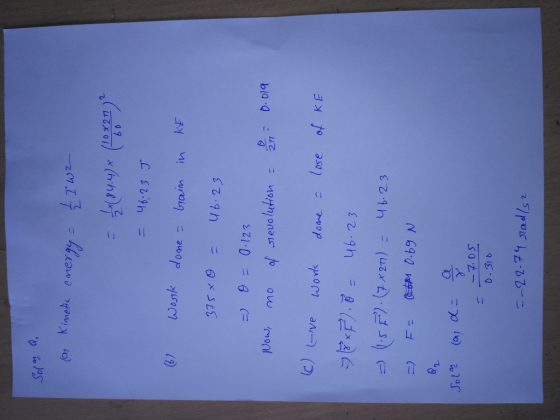
Consider a father pushing a child on a playground merry-go-round. The system has a moment of inertia of 84.4 kg · m2. The father exerts a force on the merry-go-round perpendicular to its 1.50 m radius to achieve a torque of 375 N · m.
(a) Calculate the rotational kinetic energy (in J) in the merry-go-round plus child when they have an angular velocity of 10.0 rpm.
___J
(b) Using energy considerations, find the number of revolutions the father will have to push to achieve this angular velocity starting from rest.
___revolutions
(c)
Again, using energy considerations, calculate the force (in N) the father must exert to stop the merry-go-round in seven revolutions.
___N
QUESTION 2 During a very quick stop, a car undergoes an acceleration of -7.05 m/s2.
(a) What is the angular acceleration (in rad/s2) of its 0.310 m radius tires, assuming they do not slip on the pavement? (Indicate the direction with the sign of your answer. Assume the tires initially rotated in the positive direction.)
rad/s2
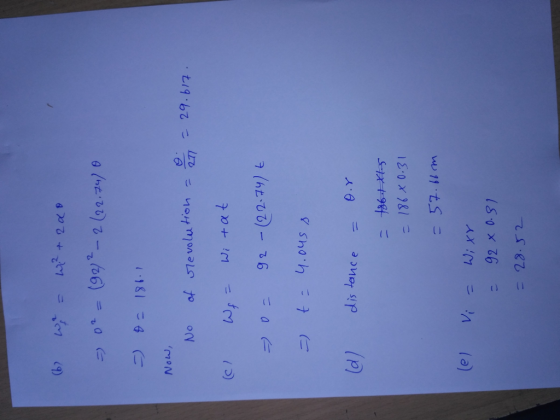
(b) How many revolutions do the tires make before coming to rest, given their initial angular velocity is 92.0 rad/s?
____revolutions
(c) How long (in s) does the car take to stop completely?
___ s
(d) What distance (in m) does the car travel in this time?
____ m
(e) What was the car's initial velocity (in m/s)? (Indicate the direction with the sign of your answer.)
___ m/s
PLEASE ANSWER ALL THE QUESTIONS DONT GIVE ANY WRONG ANSWERS THANKS FOR YOUR HELP !
Homework Answers
Add Answer to:
Consider a father pushing a child on a playground
merry-go-round. The system has a moment of...
Consider a father pushing a child on a playground merry-go-round. The system has a moment of...
Consider a father pushing a child on a playground merry-go-round. The system has a moment of inertia of 84.4 kg · m2. The father exerts a force on the merry-go-round perpendicular to its 1.50 m radius to achieve a torque of 375 N · m. (a) Calculate the rotational kinetic energy (in J) in the merry-go-round plus child when they have an angular velocity of 22.6 rpm. J (b)Using energy considerations, find the number of revolutions the father will have...
Consider a father pushing a child on a playground merry 90 round. The system has a...
 Consider a father pushing a child on a playground merry 90 round. The system has a moment of inertia of 14.4 kgm its 1.50 m radius to achieve a torque of 375 N m . . The father exerts a force on the merry-go-round perpendicular to (a) Calculate the rotational Kinetic energy (in) in the merry-go-round plus child when they have an angular velocity of 14.8 rpm. (b) Using energy considerations, find the number of revolutions the father will have...
A child sits on a merry-go-round that has a diameter of 6.00 m. The child uses...
 A child sits on a merry-go-round that has a diameter of 6.00 m. The child uses her legs to push the merry-go-round, making it go from rest to an angular speed of 15.0 rpm in a time of 37.0 s. What is the average angular acceleration aavg of the merry-go-round in units of radians per second squared (rad/s2)? avg0.042 rad/s2 What is the angular displacement Δθ of the merry-go-round, in units of radians (rad), during the time the child pushes...
A child sits on a merry‑go‑round that has a diameter of 5.00 m. The child uses...
A child sits on a merry‑go‑round that has a diameter of 5.00 m. The child uses her legs to push the merry‑go‑round, making it go from rest to an angular speed of 20.0 rpm in a time of 44.0 s. PART 1 What is the average angular acceleration ?avg of the merry‑go‑round in units of radians per second squared (rad/s2)? PART 2 What is the angular displacement Δ? of the merry‑go‑round, in units of radians (rad), during the time the...
A child sits on a merry‑go‑round that has a diameter of 4.00 m. The child uses...
A child sits on a merry‑go‑round that has a diameter of 4.00 m. The child uses her legs to push the merry‑go‑round, making it go from rest to an angular speed of 19.0 rpm in a time of 47.0 s. What is the average angular acceleration ?avg of the merry‑go‑round in units of radians per second squared (rad/s2)? ?avg= What is the angular displacement Δ? of the merry‑go‑round, in units of radians (rad), during the time the child pushes the...
A child sits on a merry‑go‑round that has a diameter of 6.00 m. 6.00 m. The...
A child sits on a merry‑go‑round that has a diameter of 6.00 m. 6.00 m. The child uses her legs to push the merry‑go‑round, making it go from rest to an angular speed of 19.0 rpm 19.0 rpm in a time of 44.0 s. 44.0 s. What is the average angular acceleration ? avg αavg of the merry‑go‑round in units of radians per second squared ( rad/s 2 )? ? avg = _rad/s2 What is the angular displacement Δ? Δθ...
A playground merry-go-round has a mass of 120 kg and a radius of 2.00 m and...
A playground merry-go-round has a mass of 120 kg and a radius of 2.00 m and it is rotating with an angular velocity of 0.500 rev/s. What is its angular velocity after a 20.0-kg child gets onto it by grabbing its outer edge? The child is initially at rest. a) 1.36 rad/s b) 1.88 rad/s c) 2.35 rad/s d) 3.21 rad/s
A merry-go-round with moment of inertia 400 kg-m^2 and radius 2.0m is rotating with angular speed...
A merry-go-round with moment of inertia 400 kg-m^2 and radius 2.0m is rotating with angular speed 0.50 rad/s in the clockwise direction about a fixed axis. A child of mass 40 kg runs tangentially to the merry-go-round with speed 3.0m/s and grabs onto the outside edge of the merry-go-round. a. What is the final angular velocity of the system (merry-go-round plus child)/ What is the final tangential speed of the child? b. What is the change in kinetic energy? c....
Three children are riding on the edge of a merry-go-round that is 162 kg, has a...
 Three children are riding on the edge of a merry-go-round that is 162 kg, has a 1.60 m radius, and is spinning at 17.3 rpm. The children have masses of 17.4, 29.0, and 32.8 kg. If the child who has a mass of 32.8 kg moves to the center of the merry-go-round, what is the new angular velocity in rpm? rpm An ultracentrifuge accelerates from rest to 100,000 rpm in 2.50 min. (a) What is its angular acceleration in rad/s2?...
A child is pushing a merry-go-round. The angle through which the merry-go-round has turned varies with...
A child is pushing a merry-go-round. The angle through which the merry-go-round has turned varies with time according to θ(t) = γt + βt3, where γ = 0.40 rad/s and β = 0.012 rad/s3 Calculate the angular velocity of the merry-go-round as a function of time Calculate the average angular velocity ωav − z for the time interval t = 0 to t = 4.0 s.
 Consider a father pushing a child on a playground merry 90 round. The system has a moment of inertia of 14.4 kgm its 1.50 m radius to achieve a torque of 375 N m . . The father exerts a force on the merry-go-round perpendicular to (a) Calculate the rotational Kinetic energy (in) in the merry-go-round plus child when they have an angular velocity of 14.8 rpm. (b) Using energy considerations, find the number of revolutions the father will have...
 A child sits on a merry-go-round that has a diameter of 6.00 m. The child uses her legs to push the merry-go-round, making it go from rest to an angular speed of 15.0 rpm in a time of 37.0 s. What is the average angular acceleration aavg of the merry-go-round in units of radians per second squared (rad/s2)? avg0.042 rad/s2 What is the angular displacement Δθ of the merry-go-round, in units of radians (rad), during the time the child pushes...
 Three children are riding on the edge of a merry-go-round that is 162 kg, has a 1.60 m radius, and is spinning at 17.3 rpm. The children have masses of 17.4, 29.0, and 32.8 kg. If the child who has a mass of 32.8 kg moves to the center of the merry-go-round, what is the new angular velocity in rpm? rpm An ultracentrifuge accelerates from rest to 100,000 rpm in 2.50 min. (a) What is its angular acceleration in rad/s2?...
Most questions answered within 3 hours.
-
Where is the error in this code sequence?
String s1 = "Hello";
String s2 = "ello";...
asked 10 months ago -
Financial data for Joel de Paris, Inc., for last year
follow:
Joel de Paris, Inc.
Balance...
asked 10 months ago -
Consider this reaction:
Al2(SO4)3 (aq)+ BaCl3
(aq) Al2Cl6 (aq)- +
3BaSO4(s) . What is the...
asked 10 months ago -
Suppose that Savneet is considering increasing her
recent random sample from 20 car rentals to 40...
asked 10 months ago -
Trucks arrive at an unloading terminal at an average rate of 120
per hour.
Trucks arrive...
asked 10 months ago -
Why are methanol and ethanol completely soluble in water while
octanol is not very little soluble....
asked 10 months ago -
A facilities manager at a university reads in a research report
that the mean amount of...
asked 10 months ago -
When the CuSO4 is rehydrated by adding water to the anhydrous
compound, is this an endothermic...
asked 10 months ago -
A ray of sunlight is passing from diamond into crown glass; the
angle of incidence is...
asked 10 months ago -
A block of mass 0.249 kg is placed on top of a light, vertical
spring of...
asked 10 months ago -
how do the kidneys compensate in the presences of acidosis
a) trigger hyperventilate
b) reserve acid...
asked 10 months ago -
Question 501 pts
The rental rate of capital to the firm increases. Which of the
following...
asked 10 months ago