
Homework Answers
Add Answer to:
Consider a father pushing a child on a playground merry 90 round. The system has a...
Consider a father pushing a child on a playground merry-go-round. The system has a moment of...
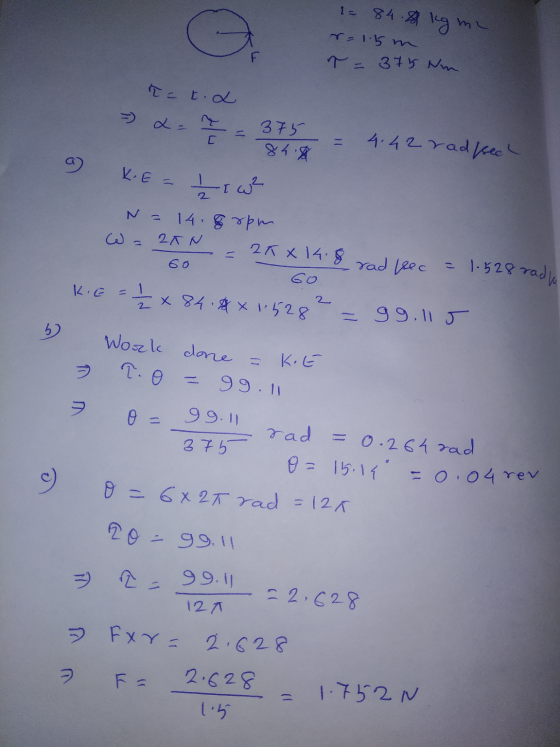
Consider a father pushing a child on a playground merry-go-round. The system has a moment of inertia of 84.4 kg · m2. The father exerts a force on the merry-go-round perpendicular to its 1.50 m radius to achieve a torque of 375 N · m. (a) Calculate the rotational kinetic energy (in J) in the merry-go-round plus child when they have an angular velocity of 22.6 rpm. J (b)Using energy considerations, find the number of revolutions the father will have...
Consider a father pushing a child on a playground merry-go-round. The system has a moment of...
Consider a father pushing a child on a playground merry-go-round. The system has a moment of inertia of 84.4 kg · m2. The father exerts a force on the merry-go-round perpendicular to its 1.50 m radius to achieve a torque of 375 N · m. (a) Calculate the rotational kinetic energy (in J) in the merry-go-round plus child when they have an angular velocity of 10.0 rpm. ___J (b) Using energy considerations, find the number of revolutions the father will...
A Father spinning a child on a merry-go round , he exerts a Force of 117...
A Father spinning a child on a merry-go round , he exerts a Force of 117 N, at a distance of 1.2 m. And does this over 1.1 revolutions. What is the rotational work done?
A playground merry-go-round has a radius of R = 4.0m and has a moment of inertia...
 A playground merry-go-round has a radius of R = 4.0m and has a moment of inertia I_cm = 7.0 times 10^3 kg middot m^2 about an axis passing through the center of mass. There is negligible friction about its vertical axis. Two children each of mass m = 25kg are standing on opposite sides a distance r_0 = 3.0m from the central axis. The merry-go-round is initially at rest. A person on the ground applies a constant tangential force of...
a merry-go-round in the park has a radius of 2.5 m and rotational inertia of 1000...
a merry-go-round in the park has a radius of 2.5 m and rotational inertia of 1000 kg*m^2. a child pushes the merry-go-round with a constant force of 50 N applied at a point tangent to the edge. a frictional torque of 12 N*m acts at the axle of the merry-go-round. what is the rotational acceleration of the merry-go-round while the child is pushing? at this rate, what will the rotational velocity of the merry-go-round be after 12 s if it...
A 25 kg boy stands 2.1 m from the center of a frictionless playground merry‐go‐round, which...
A 25 kg boy stands 2.1 m from the center of a frictionless playground merry‐go‐round, which has a moment of inertia of 200 kg m2 and is spinning with one revolution every two seconds. The child moves inward to a radius of 1.5 m. a) What is the initial angular velocity of the merry‐go‐round? b) What is the new angular velocity of the merry‐go‐round, after the child moves? c) By how much did the kinetic energy of the merry‐go‐round increase?...
1.A playground merry-go-round has a radius of 3.0 m and a rotational inertia of 600 kgˑm2....
 1.A playground merry-go-round has a radius of 3.0 m and a
rotational inertia of 600 kgˑm2. It is initially
spinning at 0.80 rad/s when a 20 kg child crawls from the center to
the rim. When the child reaches the rim the angular velocity of the
merry-go-round in rad/s is:
2.A picture P of weight W = 40 N is hung by two strings as
shown. The magnitude of the tension force
of each string is T and θ=30°. The...
1.A playground merry-go-round has a radius of 3.0 m and a
rotational inertia of 600 kgˑm2. It is initially
spinning at 0.80 rad/s when a 20 kg child crawls from the center to
the rim. When the child reaches the rim the angular velocity of the
merry-go-round in rad/s is:
2.A picture P of weight W = 40 N is hung by two strings as
shown. The magnitude of the tension force
of each string is T and θ=30°. The...
A brave child decides to grab onto an already spinning merry-go-round. The child is initially at...
 A brave child decides to grab onto an already spinning merry-go-round. The child is initially at rest and has a mass of 33.5 kg. The child grabs and clings to a bar that is 1.20 m from the center of the merry-go-round, causing the angular velocity of the merry-go-round to abruptly drop from 47.0 rpm to 17.0 rpm. What is the moment of inertia of the merry-go-round with respect to its central axis? moment of inertia: kg. m²
A child is pushing a merry-go-round. The angle through which the merry-go-round has turned varies with...
A child is pushing a merry-go-round. The angle through which the merry-go-round has turned varies with time according to θ(t) = γt + βt3, where γ = 0.40 rad/s and β = 0.012 rad/s3 Calculate the angular velocity of the merry-go-round as a function of time Calculate the average angular velocity ωav − z for the time interval t = 0 to t = 4.0 s.
A brave child decides to grab on to an already spinning merry-go-round. The child is initially...
A brave child decides to grab on to an already spinning merry-go-round. The child is initially at rest and has a mass of 26.5 kg. The child grabs and clings to a bar that is 1.45 m from the center of the merry-go-round, causing the angular velocity of the merry-go-round to abruptly drop from 55.0 rpm to 19.0 rpm. What is the moment of inertia of the merry-go-round with respect to its central axis?
 A playground merry-go-round has a radius of R = 4.0m and has a moment of inertia I_cm = 7.0 times 10^3 kg middot m^2 about an axis passing through the center of mass. There is negligible friction about its vertical axis. Two children each of mass m = 25kg are standing on opposite sides a distance r_0 = 3.0m from the central axis. The merry-go-round is initially at rest. A person on the ground applies a constant tangential force of...
 1.A playground merry-go-round has a radius of 3.0 m and a
rotational inertia of 600 kgˑm2. It is initially
spinning at 0.80 rad/s when a 20 kg child crawls from the center to
the rim. When the child reaches the rim the angular velocity of the
merry-go-round in rad/s is:
2.A picture P of weight W = 40 N is hung by two strings as
shown. The magnitude of the tension force
of each string is T and θ=30°. The...
1.A playground merry-go-round has a radius of 3.0 m and a
rotational inertia of 600 kgˑm2. It is initially
spinning at 0.80 rad/s when a 20 kg child crawls from the center to
the rim. When the child reaches the rim the angular velocity of the
merry-go-round in rad/s is:
2.A picture P of weight W = 40 N is hung by two strings as
shown. The magnitude of the tension force
of each string is T and θ=30°. The...
 A brave child decides to grab onto an already spinning merry-go-round. The child is initially at rest and has a mass of 33.5 kg. The child grabs and clings to a bar that is 1.20 m from the center of the merry-go-round, causing the angular velocity of the merry-go-round to abruptly drop from 47.0 rpm to 17.0 rpm. What is the moment of inertia of the merry-go-round with respect to its central axis? moment of inertia: kg. m²
Most questions answered within 3 hours.
-
Where is the error in this code sequence?
String s1 = "Hello";
String s2 = "ello";...
asked 10 months ago -
Financial data for Joel de Paris, Inc., for last year
follow:
Joel de Paris, Inc.
Balance...
asked 10 months ago -
Consider this reaction:
Al2(SO4)3 (aq)+ BaCl3
(aq) Al2Cl6 (aq)- +
3BaSO4(s) . What is the...
asked 10 months ago -
Suppose that Savneet is considering increasing her
recent random sample from 20 car rentals to 40...
asked 10 months ago -
Trucks arrive at an unloading terminal at an average rate of 120
per hour.
Trucks arrive...
asked 10 months ago -
Why are methanol and ethanol completely soluble in water while
octanol is not very little soluble....
asked 10 months ago -
A facilities manager at a university reads in a research report
that the mean amount of...
asked 10 months ago -
When the CuSO4 is rehydrated by adding water to the anhydrous
compound, is this an endothermic...
asked 10 months ago -
A ray of sunlight is passing from diamond into crown glass; the
angle of incidence is...
asked 10 months ago -
A block of mass 0.249 kg is placed on top of a light, vertical
spring of...
asked 10 months ago -
how do the kidneys compensate in the presences of acidosis
a) trigger hyperventilate
b) reserve acid...
asked 10 months ago -
Question 501 pts
The rental rate of capital to the firm increases. Which of the
following...
asked 10 months ago