Physics 2: Dipole Moment and Electric Potential
Having a hard time with some of these questions. Help would be
greatly appreciated. If you could put in all equations used and
show your work it would be greatly appreciated. I want to compare
the answers I got. You will be rewarded! Thanks :-)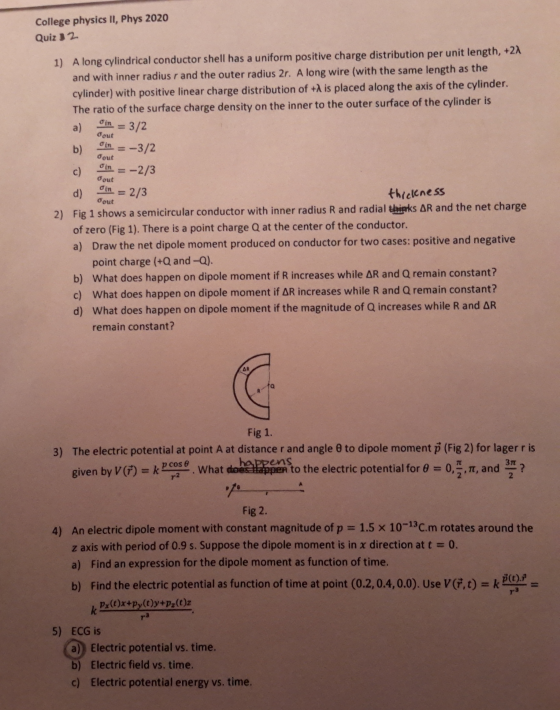
Homework Answers

Add Answer to:
Physics 2: Dipole Moment and Electric Potential
Having a hard time with some of these questions....
Some types of molecules that do not possess an intrinsic electric dipole moment can be given...
 Some types of molecules that do not possess an intrinsic electric dipole moment can be given one by an external electric field in a process called charge separation, or polarization. In this process their internal charge distribution becomes distorted by the field, with the result that the region of a molecule on the side in the direction of the field gains a positive net charge, while the region on the other side gains a negative net charge. Both charges have...
Some types of molecules that do not possess an intrinsic electric dipole moment can be given...
 Some types of molecules that do not possess an intrinsic electric dipole moment can be given one by an external electric field in a process called charge separation, or polarization. In this process their internal charge distribution becomes distorted by the field, with the result that the region of a molecule on the side in the direction of the field gains a positive net charge, while the region on the other side gains a negative net charge. Both charges have...
1-Calculate the electric potential due to a dipole whose dipole moment is 3.8×10⁻³⁰ C⋅mC⋅m at a...
1-Calculate the electric potential due to a dipole whose dipole moment is 3.8×10⁻³⁰ C⋅mC⋅m at a point rr = 3.2×10⁻⁹ mm away. Suppose that r≫ℓr≫ℓ, where ℓℓ is the distance between the charges in the dipole. If this point is 60 ∘∘ above the axis but nearer the negative charge. Express your answer to two significant figures and include the appropriate units. 2- The charge on a capacitor increases by 15 μCμC when the voltage across it increases from 93...
Find the electric dipole moment of a cylinder of radius R and height h. The volume...
Find the electric dipole moment of a cylinder of radius R and height h. The volume charge density in the cylinder is given by ρ(z) = k·cos(πz/h). The z-axis is the axis of the cylinder, and the origin is placed at the bottom of the cylinder. Give the answer in terms of k, h, and R in unit vector notation.
Please draw pictures! 33. . (II) Calculate the electric potential due to a dipole whose dipole...
 Please draw pictures!
33. . (II) Calculate the electric potential due to a dipole whose dipole moment is 4.2 × 10⁻³⁰ C . m at a point 2.4 x 10m away if this point is (a) along the axis of the dipole nearer the positive charge: (b) 45° above the axis but nearer the positive charge; (c) 45° above the axis but nearer the negative charge.
Please draw pictures!
33. . (II) Calculate the electric potential due to a dipole whose dipole moment is 4.2 × 10⁻³⁰ C . m at a point 2.4 x 10m away if this point is (a) along the axis of the dipole nearer the positive charge: (b) 45° above the axis but nearer the positive charge; (c) 45° above the axis but nearer the negative charge.
5. Consider the dipole shown below. What is the electric potential, V, at point P in...
 5. Consider the dipole shown below. What is the electric potential, V, at point P in terms of approximate potential at point P in terms of various constants, r, θ, and the dipole moment p (= 2aq)? Where does V-0? For a given r where does V have its greatest positive value? Its greatest negative value? tq a a q
Question 1: Find the potential of an electric dipole at a point P some radius away...
 Question 1: Find the potential of an electric dipole at a point P some radius away by superposing the point charge potentials of the two charges. A diagram of the setup is shown below: +q -q Question 2: I'd like to use the answer to Question 1 to find the capacitance between two spheres of opposite charge distance d apart, with some fixed radii R, but I won't necessarily get the right answer, write why not. Estimate the required relationship...
Question 1: Find the potential of an electric dipole at a point P some radius away...
 Question 1: Find the potential of an electric dipole at a point P some radius away by superposing the point charge potentials of the two charges. A diagram of the setup is shown below: +q -q Question 2: I'd like to use the answer to Question 1 to find the capacitance between two spheres of opposite charge distance d apart, with some fixed radii R, but I won't necessarily get the right answer, write why not. Estimate the required relationship...
Some types of molecules that do not possess an intrinsic electric dipole moment can be given...
 Some types of molecules that do not possess an intrinsic electric dipole moment can be given one by an external electric field in a process called charge separation, or polarization. In this process, their internal charge distribution becomes distorted by the field, which results in the region of a molecule on the side in the direction of the field gaining a positive net charge and the region on the other side gaining a negative net charge. Both charges have equal...
2 Considet the field due to an electric dipole of moment p. By intro- ducimg a certain surface ch...
 electromagnetics
2 Considet the field due to an electric dipole of moment p. By intro- ducimg a certain surface chaske distibution on the sphesical suface radius R arcund the electhic dipole, is it possible to produce zeo electric field outside the sphere? Find the ทecessary su charge disthibution also. าว่า
2 Considet the field due to an electric dipole of moment p. By intro- ducimg a certain surface chaske distibution on the sphesical suface radius R arcund the electhic dipole,...
electromagnetics
2 Considet the field due to an electric dipole of moment p. By intro- ducimg a certain surface chaske distibution on the sphesical suface radius R arcund the electhic dipole, is it possible to produce zeo electric field outside the sphere? Find the ทecessary su charge disthibution also. าว่า
2 Considet the field due to an electric dipole of moment p. By intro- ducimg a certain surface chaske distibution on the sphesical suface radius R arcund the electhic dipole,...
 Some types of molecules that do not possess an intrinsic electric dipole moment can be given one by an external electric field in a process called charge separation, or polarization. In this process their internal charge distribution becomes distorted by the field, with the result that the region of a molecule on the side in the direction of the field gains a positive net charge, while the region on the other side gains a negative net charge. Both charges have...
 Some types of molecules that do not possess an intrinsic electric dipole moment can be given one by an external electric field in a process called charge separation, or polarization. In this process their internal charge distribution becomes distorted by the field, with the result that the region of a molecule on the side in the direction of the field gains a positive net charge, while the region on the other side gains a negative net charge. Both charges have...
 Please draw pictures!
33. . (II) Calculate the electric potential due to a dipole whose dipole moment is 4.2 × 10⁻³⁰ C . m at a point 2.4 x 10m away if this point is (a) along the axis of the dipole nearer the positive charge: (b) 45° above the axis but nearer the positive charge; (c) 45° above the axis but nearer the negative charge.
Please draw pictures!
33. . (II) Calculate the electric potential due to a dipole whose dipole moment is 4.2 × 10⁻³⁰ C . m at a point 2.4 x 10m away if this point is (a) along the axis of the dipole nearer the positive charge: (b) 45° above the axis but nearer the positive charge; (c) 45° above the axis but nearer the negative charge.
 5. Consider the dipole shown below. What is the electric potential, V, at point P in terms of approximate potential at point P in terms of various constants, r, θ, and the dipole moment p (= 2aq)? Where does V-0? For a given r where does V have its greatest positive value? Its greatest negative value? tq a a q
 Question 1: Find the potential of an electric dipole at a point P some radius away by superposing the point charge potentials of the two charges. A diagram of the setup is shown below: +q -q Question 2: I'd like to use the answer to Question 1 to find the capacitance between two spheres of opposite charge distance d apart, with some fixed radii R, but I won't necessarily get the right answer, write why not. Estimate the required relationship...
 Question 1: Find the potential of an electric dipole at a point P some radius away by superposing the point charge potentials of the two charges. A diagram of the setup is shown below: +q -q Question 2: I'd like to use the answer to Question 1 to find the capacitance between two spheres of opposite charge distance d apart, with some fixed radii R, but I won't necessarily get the right answer, write why not. Estimate the required relationship...
 Some types of molecules that do not possess an intrinsic electric dipole moment can be given one by an external electric field in a process called charge separation, or polarization. In this process, their internal charge distribution becomes distorted by the field, which results in the region of a molecule on the side in the direction of the field gaining a positive net charge and the region on the other side gaining a negative net charge. Both charges have equal...
 electromagnetics
2 Considet the field due to an electric dipole of moment p. By intro- ducimg a certain surface chaske distibution on the sphesical suface radius R arcund the electhic dipole, is it possible to produce zeo electric field outside the sphere? Find the ทecessary su charge disthibution also. าว่า
2 Considet the field due to an electric dipole of moment p. By intro- ducimg a certain surface chaske distibution on the sphesical suface radius R arcund the electhic dipole,...
electromagnetics
2 Considet the field due to an electric dipole of moment p. By intro- ducimg a certain surface chaske distibution on the sphesical suface radius R arcund the electhic dipole, is it possible to produce zeo electric field outside the sphere? Find the ทecessary su charge disthibution also. าว่า
2 Considet the field due to an electric dipole of moment p. By intro- ducimg a certain surface chaske distibution on the sphesical suface radius R arcund the electhic dipole,...
Most questions answered within 3 hours.
-
Where is the error in this code sequence?
String s1 = "Hello";
String s2 = "ello";...
asked 10 months ago -
Financial data for Joel de Paris, Inc., for last year
follow:
Joel de Paris, Inc.
Balance...
asked 10 months ago -
Consider this reaction:
Al2(SO4)3 (aq)+ BaCl3
(aq) Al2Cl6 (aq)- +
3BaSO4(s) . What is the...
asked 10 months ago -
Suppose that Savneet is considering increasing her
recent random sample from 20 car rentals to 40...
asked 10 months ago -
Trucks arrive at an unloading terminal at an average rate of 120
per hour.
Trucks arrive...
asked 10 months ago -
Why are methanol and ethanol completely soluble in water while
octanol is not very little soluble....
asked 10 months ago -
A facilities manager at a university reads in a research report
that the mean amount of...
asked 10 months ago -
When the CuSO4 is rehydrated by adding water to the anhydrous
compound, is this an endothermic...
asked 10 months ago -
A ray of sunlight is passing from diamond into crown glass; the
angle of incidence is...
asked 10 months ago -
A block of mass 0.249 kg is placed on top of a light, vertical
spring of...
asked 10 months ago -
how do the kidneys compensate in the presences of acidosis
a) trigger hyperventilate
b) reserve acid...
asked 10 months ago -
Question 501 pts
The rental rate of capital to the firm increases. Which of the
following...
asked 10 months ago