
Homework Answers
Add Answer to:
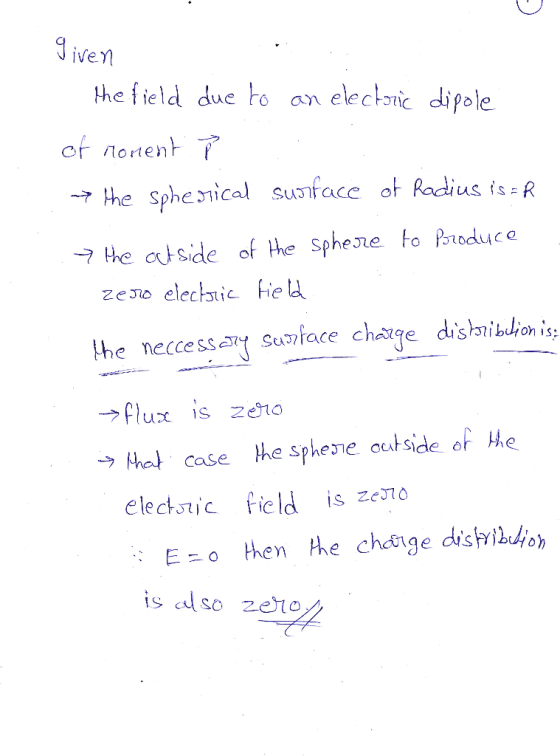
2 Considet the field due to an electric dipole of moment p. By intro- ducimg a certain surface ch...
2. Spherical Dipole - The surface charge density on a sphere of radius R is constant, +0, on the entire northern hemisphere, and-oo on the entire southern hemisphere. There are no other charges prese...
 2. Spherical Dipole - The surface charge density on a sphere of radius R is constant, +0, on the entire northern hemisphere, and-oo on the entire southern hemisphere. There are no other charges present inside or outside the sphere. (a) (4 pts) Compute the dipole moment of that sphere (with the +z-axis up through the pole of the positive, +Oo, hemisphere). Use the definition of a dipole moment, p-Jr, (7)dr', which in this case becomes p:-:J20(7)dA. Write your final answer...
2. (30 POINTS) A spherical shell of radius R holds a potential on its surface of:...
 2. (30 POINTS) A spherical shell of radius R holds a potential on its surface of: V(R, 0) = V.(1 + 2cose - cos20) (a.) Find the potential inside and outside the sphere. (b.) Find the surface charge density on the sphere. (c.) Find the dipole moment and the dipole term of the electric field, Epip.
Physics 2: Dipole Moment and Electric Potential Having a hard time with some of these questions....
 Physics 2: Dipole Moment and Electric Potential
Having a hard time with some of these questions. Help would be
greatly appreciated. If you could put in all equations used and
show your work it would be greatly appreciated. I want to compare
the answers I got. You will be rewarded! Thanks :-)
A long cylindrical conductor shell has a uniform positive charge distribution per unit length, +2 lambda and with inner radius r and the outer radius 2r.A long wire...
Physics 2: Dipole Moment and Electric Potential
Having a hard time with some of these questions. Help would be
greatly appreciated. If you could put in all equations used and
show your work it would be greatly appreciated. I want to compare
the answers I got. You will be rewarded! Thanks :-)
A long cylindrical conductor shell has a uniform positive charge distribution per unit length, +2 lambda and with inner radius r and the outer radius 2r.A long wire...
Problem 1: Dipole moment. We have a sphere of radius R with a uniform surface charge...
 Problem 1: Dipole moment. We have a sphere of radius R with a uniform surface charge density +ao over the northern hemisphere, and -oo over the southern hemisphere (oo is a positive constant). There are no other charges present inside or outside the sphere. Compute the dipole moment p of this charge distribution assuming the z-axis is the symmetry axis of the distribution. Does p depend on your choice of origin? Why or why not? Are any components of p...
An electric dipole with dipole moment p is placed in the center of a spherical hollow...
An electric dipole with dipole moment p is placed in the center of a spherical hollow of an infinite conductive material a) Find the surface charge density induced on the surface of the spherical cavity. b) Show that the force on the dipole is zero.
"question 2 from pset 2" 4. Place an electric dipole in the electric field you found...
 "question 2 from pset 2"
4. Place an electric dipole in the electric field you found in problem 9 on PSET 2, such that the dipole moment points along the positive x-axis. In a figure, show the direction of the electric field, the dipole moment and the torque exerted by this field on the dipole. Determine the torque on the dipole due to the external electric field, and the work that the electric field does to rotate the dipole into...
"question 2 from pset 2"
4. Place an electric dipole in the electric field you found in problem 9 on PSET 2, such that the dipole moment points along the positive x-axis. In a figure, show the direction of the electric field, the dipole moment and the torque exerted by this field on the dipole. Determine the torque on the dipole due to the external electric field, and the work that the electric field does to rotate the dipole into...
2. Potentials and a Conducting Surface The electric potential outside of a solid spherical conductor of...
 2. Potentials and a Conducting Surface The electric potential outside of a solid spherical conductor of radius R is found to be V(r, 9) = -E, cose (--) where E, is a constant and r and 0 are the spherical radial and polar angle coordinates, respectively. This electric potential is due to the charges on the conductor and charges outside of the conductor 1. Find an expression for the electric field inside the spherical conductor. 2. Find an expression for...
4. Magnetic Dipole Moment on a PEC Sphere: In HW 4-Problem 5, you found the electric dipole momen...
 4. Magnetic Dipole Moment on a PEC Sphere: In HW 4-Problem 5, you found the electric dipole moment for a metal sphere of radius a in a uniform electric field. In this problem you will find the magnetic dipole moment for the same metal sphere but now in a uniform magnetic field, Hext-Hext2. Note:Assume that the sphere is centered at the origin of a spherical coordinate system. Express Hext in spherical coordinates. To find the magnetic field that is induced...
Question 11: Can you calculate the electric field of a dipole using Gauss' Law? If yes,...
 Question 11: Can you calculate the electric field of a dipole using Gauss' Law? If yes, sketch the Gaussian surface you would use. If no, explain why not, including a sketch. 3 Using Gauss' Law to calculate the electric field of a spherical object Question 12: a) What is the volume charge density p= for a uniformly charged solid sphere of radius R and with total charge Q? Sketch a graph of p as a function of radius, r; mark...
2. Electric dipole (20%) A very common charge arrangement in electromagnetics is the dipole. A charge...
 2. Electric dipole (20%) A very common charge arrangement in electromagnetics is the dipole. A charge dipole is illustrated in the figure below. In this problem, we will find the potential and field due to a dipole. tq X (a) Find the electrostatic potential at an arbitrary position in spherical coordinates, that is find the potential at the position (r, 0,0). (b) For large values of r, we can write: Z(17 cos 0 + -1/2 ~(1 7. cos 6)-1/2 ~...
 2. Spherical Dipole - The surface charge density on a sphere of radius R is constant, +0, on the entire northern hemisphere, and-oo on the entire southern hemisphere. There are no other charges present inside or outside the sphere. (a) (4 pts) Compute the dipole moment of that sphere (with the +z-axis up through the pole of the positive, +Oo, hemisphere). Use the definition of a dipole moment, p-Jr, (7)dr', which in this case becomes p:-:J20(7)dA. Write your final answer...
 2. (30 POINTS) A spherical shell of radius R holds a potential on its surface of: V(R, 0) = V.(1 + 2cose - cos20) (a.) Find the potential inside and outside the sphere. (b.) Find the surface charge density on the sphere. (c.) Find the dipole moment and the dipole term of the electric field, Epip.
 Physics 2: Dipole Moment and Electric Potential
Having a hard time with some of these questions. Help would be
greatly appreciated. If you could put in all equations used and
show your work it would be greatly appreciated. I want to compare
the answers I got. You will be rewarded! Thanks :-)
A long cylindrical conductor shell has a uniform positive charge distribution per unit length, +2 lambda and with inner radius r and the outer radius 2r.A long wire...
Physics 2: Dipole Moment and Electric Potential
Having a hard time with some of these questions. Help would be
greatly appreciated. If you could put in all equations used and
show your work it would be greatly appreciated. I want to compare
the answers I got. You will be rewarded! Thanks :-)
A long cylindrical conductor shell has a uniform positive charge distribution per unit length, +2 lambda and with inner radius r and the outer radius 2r.A long wire...
 Problem 1: Dipole moment. We have a sphere of radius R with a uniform surface charge density +ao over the northern hemisphere, and -oo over the southern hemisphere (oo is a positive constant). There are no other charges present inside or outside the sphere. Compute the dipole moment p of this charge distribution assuming the z-axis is the symmetry axis of the distribution. Does p depend on your choice of origin? Why or why not? Are any components of p...
 "question 2 from pset 2"
4. Place an electric dipole in the electric field you found in problem 9 on PSET 2, such that the dipole moment points along the positive x-axis. In a figure, show the direction of the electric field, the dipole moment and the torque exerted by this field on the dipole. Determine the torque on the dipole due to the external electric field, and the work that the electric field does to rotate the dipole into...
"question 2 from pset 2"
4. Place an electric dipole in the electric field you found in problem 9 on PSET 2, such that the dipole moment points along the positive x-axis. In a figure, show the direction of the electric field, the dipole moment and the torque exerted by this field on the dipole. Determine the torque on the dipole due to the external electric field, and the work that the electric field does to rotate the dipole into...
 2. Potentials and a Conducting Surface The electric potential outside of a solid spherical conductor of radius R is found to be V(r, 9) = -E, cose (--) where E, is a constant and r and 0 are the spherical radial and polar angle coordinates, respectively. This electric potential is due to the charges on the conductor and charges outside of the conductor 1. Find an expression for the electric field inside the spherical conductor. 2. Find an expression for...
 4. Magnetic Dipole Moment on a PEC Sphere: In HW 4-Problem 5, you found the electric dipole moment for a metal sphere of radius a in a uniform electric field. In this problem you will find the magnetic dipole moment for the same metal sphere but now in a uniform magnetic field, Hext-Hext2. Note:Assume that the sphere is centered at the origin of a spherical coordinate system. Express Hext in spherical coordinates. To find the magnetic field that is induced...
 Question 11: Can you calculate the electric field of a dipole using Gauss' Law? If yes, sketch the Gaussian surface you would use. If no, explain why not, including a sketch. 3 Using Gauss' Law to calculate the electric field of a spherical object Question 12: a) What is the volume charge density p= for a uniformly charged solid sphere of radius R and with total charge Q? Sketch a graph of p as a function of radius, r; mark...
 2. Electric dipole (20%) A very common charge arrangement in electromagnetics is the dipole. A charge dipole is illustrated in the figure below. In this problem, we will find the potential and field due to a dipole. tq X (a) Find the electrostatic potential at an arbitrary position in spherical coordinates, that is find the potential at the position (r, 0,0). (b) For large values of r, we can write: Z(17 cos 0 + -1/2 ~(1 7. cos 6)-1/2 ~...
Most questions answered within 3 hours.
-
Where is the error in this code sequence?
String s1 = "Hello";
String s2 = "ello";...
asked 11 months ago -
Financial data for Joel de Paris, Inc., for last year
follow:
Joel de Paris, Inc.
Balance...
asked 11 months ago -
Consider this reaction:
Al2(SO4)3 (aq)+ BaCl3
(aq) Al2Cl6 (aq)- +
3BaSO4(s) . What is the...
asked 11 months ago -
Suppose that Savneet is considering increasing her
recent random sample from 20 car rentals to 40...
asked 11 months ago -
Trucks arrive at an unloading terminal at an average rate of 120
per hour.
Trucks arrive...
asked 11 months ago -
Why are methanol and ethanol completely soluble in water while
octanol is not very little soluble....
asked 11 months ago -
A facilities manager at a university reads in a research report
that the mean amount of...
asked 11 months ago -
When the CuSO4 is rehydrated by adding water to the anhydrous
compound, is this an endothermic...
asked 11 months ago -
A ray of sunlight is passing from diamond into crown glass; the
angle of incidence is...
asked 11 months ago -
A block of mass 0.249 kg is placed on top of a light, vertical
spring of...
asked 11 months ago -
how do the kidneys compensate in the presences of acidosis
a) trigger hyperventilate
b) reserve acid...
asked 11 months ago -
Question 501 pts
The rental rate of capital to the firm increases. Which of the
following...
asked 11 months ago